
Getting LASIK in Korea: 5 Steps From Message to Flight Home
Getting LASIK in Korea, step by step: what to send first, when to stop lenses, how exam and surgery days run, and what you take home. By a Gangnam surgeon.

Dr. Kim Sun-young, Director
Cornea · Glaucoma · Cataract
Contents
I'm Dr. Kim Sun-young, medical director of Healing Eye Clinic in Sinnonhyeon, Gangnam, Seoul. I was a clinical professor of cornea and cataract surgery at a university hospital, and I now see international patients every week, with English interpreters on site.
Once people decide to come, the next message is usually practical: "Dr. Kim, what actually happens, day by day? What do I do first?"
If you're searching getting lasik in korea, you're probably past the "should I?" stage and into the "how?" stage. That's a good place to be, and I understand it can still feel like a lot to organise from abroad.
So here's my honest promise: the surgery is the shortest part of the trip. The steps around it are what make it go smoothly. I'll walk you through them in order, the way I explain them to patients before they travel.
Getting LASIK in Korea: the five steps, in order
Each step has one job. If you get that job done, the next step is easy.
1. Send your numbers before you buy a ticket
Message us your current prescription, your age, how long the prescription has been stable, and your travel window.
That's not a formality. It lets us tell you about obvious obstacles before you've spent anything — a prescription that changed last year, for example, or a history of dry eye we'd want to treat first.
2. Stop contact lenses and book a flexible trip
Soft lenses need to come out at least a week before the exam; rigid lenses longer. Lenses press on the cornea, and measurements taken too early can mislead the whole plan.
Book a changeable fare and at least three nights, ideally four. We're closed on Sundays, so plan your surgery so the next-day check doesn't fall on one.
3. Exam day
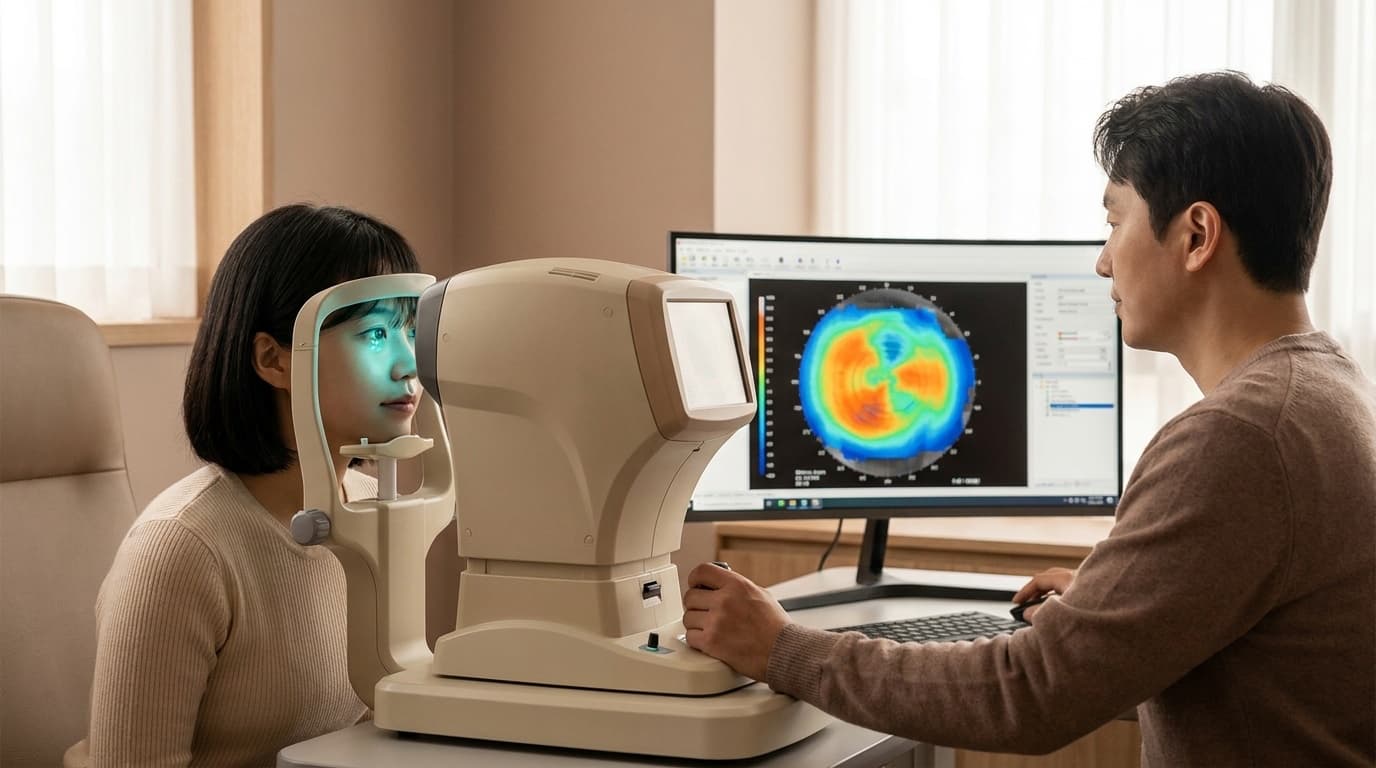
You'll have a full exam: corneal thickness and topography, pupil size, tear film and eye pressure. Then you sit down with me and the interpreter, and we go through the results.
This is where the procedure is decided. Sometimes it's LASIK. Sometimes it's LASEK, or ICL, and sometimes it's "not yet". I'd rather you hear that on day one than on day two.
4. Surgery day
Numbing drops, no injection. Both eyes usually take about ten minutes, and most people describe pressure rather than pain.
For a few hours afterwards your eyes may feel dry, gritty or watery. We check you before you leave. Your only job that evening is to rest and not rub your eyes.
5. Next-day check, records, and home
The next morning I check the healing myself. Most people see clearly enough for daily life from that day.
Before you fly, you get a written record: procedure, prescription, ablation depth, corneal thickness and drops. Your one-week, one-month and three-month checks can then happen with an ophthalmologist at home.
Message first, lenses out, flexible ticket, then exam → surgery → next-day check. Three nights is the minimum; four gives the exam room to change the plan without costing you a flight.
Why the exam decides everything is explained in my overview of LASIK in Korea.
One doctor from the first scan to the last check
The steps above only work if one surgeon owns your case — the same doctor who reads your exam operates and sees you the next day.
A few things you can verify. International patients pay the same price as Korean patients. We have 4.8 stars from 154 Google reviews. I'm a full member of the European Society of Cataract and Refractive Surgeons (ESCRS). I list these so you have something concrete to check.
So what does my week in Seoul look like?
Here's the usual LASIK schedule. LASEK and ICL change it, as noted.
| Day | What happens | Your job |
|---|---|---|
| Arrival | Settle in, rest your eyes | No lenses |
| Day 1 | Full exam, consultation with interpreter | Ask everything |
| Day 2 | Clear LASIK or the procedure your exam supports | Rest, don't rub |
| Day 3 | Next-day check with the same surgeon | Pick up your record |
| Day 4 | Buffer day, pre-flight check if needed | Fly when cleared |
LASEK needs about a week, because the protective lens must come out before you fly. ICL can add a day or two if the lens is ordered to your measurements.
What you can comfortably do on each of those days is in LASIK in Korea recovery time. The full budget, line by line, is in how much does LASIK cost in Korea, and our list is on the price page.
When the plan changes on exam day
I'd be misleading you if I said every trip ends in surgery. I ask people to wait when I find:
- A cornea too thin for the correction, or early keratoconus signs
- Untreated dry eye
- A prescription still changing in the last year
After LASIK, expect some dryness, possible night glare or halos, and in higher prescriptions some regression. Results vary from person to person.
Getting here, and practical details
- Address: Gangnam-daero 470, 10th–11th floors — one minute from Sinnonhyeon Station, about 70 minutes from Incheon Airport.
- Hours: Mon–Thu 10:00–18:30, Fri until 21:00, Sat until 14:00; closed Sundays and public holidays.
- Partner hotel: O'Cloud Hotel in Seocho, if you'd like a suggestion.
- Directions in Korean are on the head office's location page.
Don't book the flight first — send the message first
The order matters. Message, then exam, then decision — never the other way round.
Wherever you go, choose a clinic that answers your pre-trip questions in writing and tells you plainly if your eyes aren't ready. Send us your prescription, age and travel window on WhatsApp, and if LASIK isn't right for you, I'll say so.
I look forward to meeting you in Seoul.
— Dr. Kim Sun-young, Medical Director, Healing Eye Clinic (Sinnonhyeon, Gangnam, Seoul)
Frequently asked questions
What is the first step to getting LASIK in Korea?
Send the clinic your current prescription, your age, how long the prescription has been stable, and your travel window — before you buy a flight. That lets the clinic flag obvious problems early and suggest dates that fit its schedule.
How many nights do I need for LASIK in Korea?
At least three nights: exam, surgery and the next-day check. I recommend four as a buffer, because the exam can change the plan. If the exam points to LASEK, plan about a week instead.
When should I stop wearing contact lenses?
At least one week before the exam for soft lenses, and longer for rigid lenses. Lenses change the shape of the cornea, and measurements taken too soon can be wrong.
How long does the LASIK surgery itself take?
Both eyes usually take about ten minutes in the operating room. Numbing drops are used, so most people feel pressure rather than pain. We check your eyes again the same day before you go back to your hotel.
Can I do my follow-up checks at home?
Yes. The next-day check happens here, and the one-week, one-month and three-month checks can be done by an ophthalmologist at home. We give you a written record of the procedure, prescription, ablation depth, corneal thickness and drops.
Do I need to speak Korean?
No. An English interpreter is on site from the exam explanation to the consent form. When risks are explained and the consent is signed, the interpreter is in the room.
Message us on official LINE / WhatsApp for a special offer
Your exact candidacy and cost are confirmed in a free 1:1 consultation.