Halos After Laser Eye Surgery: Most Fade, Some Don't
Most halos after laser eye surgery ease over the first months; large pupils and high prescriptions raise the odds. Send your exam numbers on WhatsApp.

MS, Catholic Univ. College of Medicine · Ophthalmology specialist, Catholic Medical Center · Clinical Professor (Cornea & Cataract), Uijeongbu St. Mary's Hospital · 108th Korean Ophthalmological Society Research Award · KDCA epidemiology citation
Medically reviewed byDr. Kim Sun-young, Director· Medical Director
Edited by: Dr. Kim Sun-young
Contents
Will halos after laser eye surgery still circle every headlight once you're back home and driving at night, with the surgeon who treated you a long flight away? For most people the rings are strongest in the first weeks and fade over roughly three to six months as the cornea settles. The halos that stay usually trace back to things that can be measured before surgery: your pupil size in dim light, the size of the treated zone and how strong your prescription is.
Hello, I'm Dr. Kim Sun-young, Medical Director at Healing Eye Clinic in Gangnam. Large pupils are tied directly to night glare, so with Personal Custom LASIK we account for them at the design stage, using a map of your eye's own aberrations. One surgeon handles your exam, surgery and follow-up, and we go through your results together in English with an interpreter, at no extra charge to you.
If you have a recent glasses prescription or eye exam printout, send a photo of it on WhatsApp with a line about how much of your driving happens after dark. Then ask whether halos are a reason to consider a different method for your eyes.
Why do lights grow rings after the laser?
Laser vision correction reshapes the front of the cornea inside a central treatment zone a few millimetres wide. In daylight your pupil is small and looks through the middle of that zone. At night the pupil widens, and if it opens past the edge of the treated area, some light passes through the transition between corrected and untreated cornea. That light focuses in a slightly different place, and you see it as a ring or glow around each light.
Three other things add to halos in the early weeks. After LASIK the cornea is mildly swollen for a while. The tear film turns patchy because surface nerves were cut and reflex tearing drops, and an uneven tear film scatters light. If a small amount of prescription is left over, lights also blur into halos, much as they would with slightly wrong glasses.
Higher corrections remove more tissue and tend to add more spherical aberration, a fine optical error that shows up mostly in dim light. Someone starting at minus eight usually has more to weigh here than someone at minus two.
Ask whether this applies to your eyes, which dates are open, and about the English interpreter.
Ask us on WhatsAppHow long do halos last after LASIK?
For most people, halos peak in the first nights and shrink over the following weeks, with most of the change done by three to six months. On our Personal Custom LASIK recovery timeline, the first check-up is the day after surgery, flying is allowed from that day, and by month one vision and the cornea enter a stable phase. Rings around the cabin lights on your flight home are expected at that stage.
| When | What's typical | What helps |
|---|---|---|
| First nights | Rings and starbursts are at their strongest while the cornea is swollen and the surface is dry | Lubricating drops as prescribed, no night driving |
| Weeks 1 to 4 | Halos shrink as the surface smooths, and flare up when eyes are dry or tired | Drops before evening screens or drives, full blinks |
| Months 1 to 6 | Most people notice them less each month as the cornea settles | Judge halos after drops, note changes for follow-up |
| Beyond 6 months | A smaller group still sees them, usually tied to pupil size, leftover prescription or aberrations | A full re-exam to find which cause it is |
Two habits make this period easier to read. Judge your halos only after putting in a drop and blinking fully a few times: if the ring shrinks or sharpens within a minute, a dry surface is part of the cause, and that part responds to treating the dryness. And before surgery, note how streetlights look to you now with glasses or contacts at night. Many people already see some halo, especially with astigmatism or tired contact lenses, and without that baseline it's hard to tell afterward what's new.
Starbursts, dry eye and night glare: what's common, and who should wait
The US FDA's patient guidance on LASIK lists glare, halos and double vision among the known risks, noting they can seriously affect night vision in some people. Halos after laser eye surgery are common in the first weeks. A smaller group keeps noticeable halos long term, mostly people whose pupils open wide in the dark or who had a large correction. Dry eye travels with them: dryness makes every halo look worse, and it usually eases over months too. How strongly you'll notice any of this, and for how long, differs from one person to the next.
I'd ask you to wait, or to look at another method, if any of these apply:
- Your prescription has changed within the last year or so.
- Dry eye already gives you symptoms and hasn't been treated.
- Topography shows a thin, steepening or irregular cornea, which can be an early sign of keratoconus.
- You're pregnant or breastfeeding, when prescriptions can shift.
- Your pupils are large in dim light, your work depends on night driving, and your cornea can't carry a wide treatment zone.
Once you're home, halos that slowly fade are part of normal healing. Pain that's getting worse, vision that's dropping, a red eye with discharge or new sensitivity to light are a different matter: see an ophthalmologist near you that same day, and message us too.
Can the exam predict who keeps their halos?
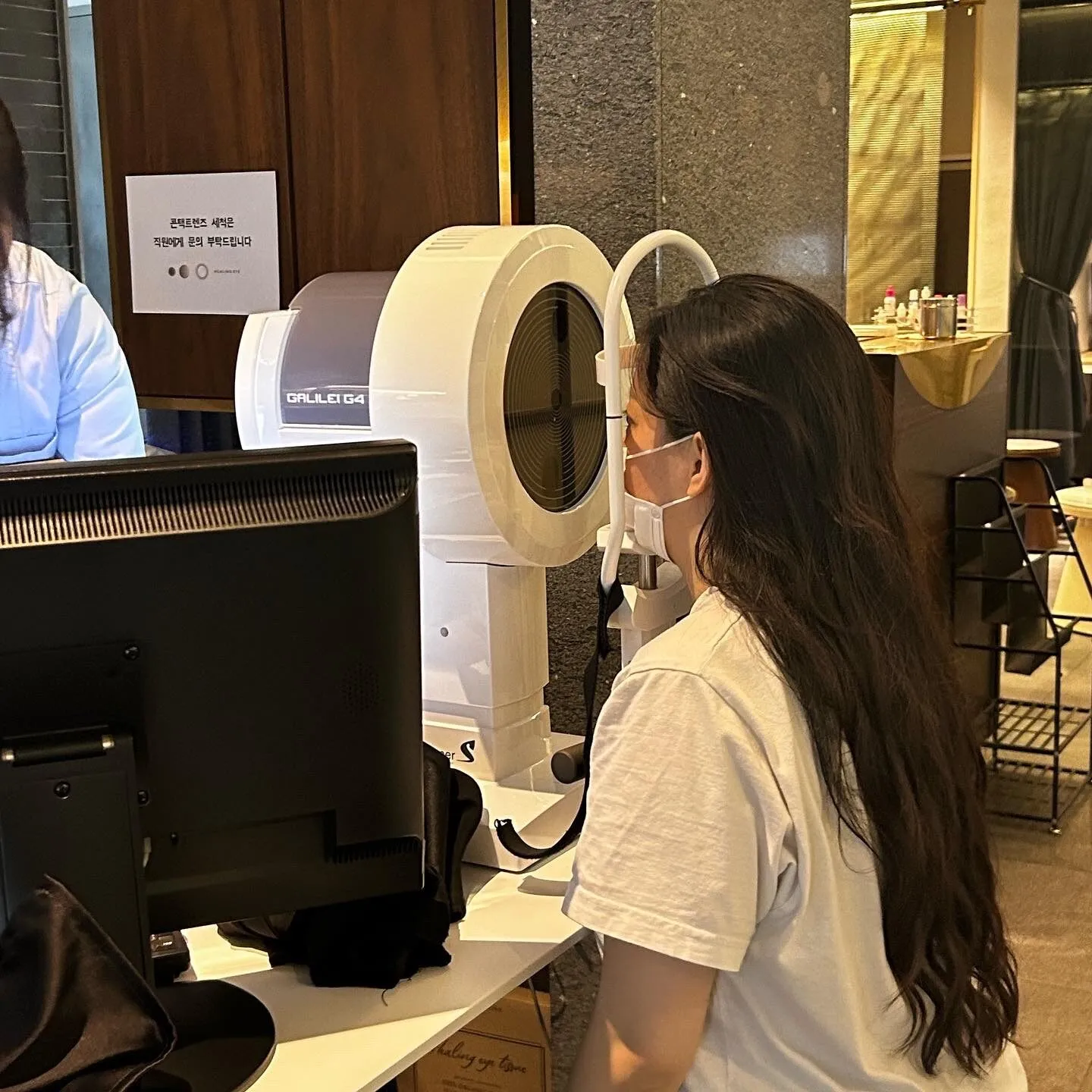
Partly, and that's where most of the decision is made. Before custom LASIK we assess corneal thickness and shape, pupil size, the tear film, how much cornea would remain, and any warning signs of keratoconus. A wavefront analyzer and corneal topography measure how light bends through your eye at hundreds of points, and that aberration map becomes the blueprint the laser follows.
The numbers that matter most for halos are your dim-light pupil set against the treatment zone your cornea can afford, the size of the correction, and the higher-order aberrations you already have. A thick cornea with a modest prescription leaves room for a wide zone. A thin cornea with a strong prescription forces a trade-off between zone size and the tissue left behind, and I won't spend tissue the cornea needs for its strength.
The three main routes for laser eye surgery in Korea, and when to skip them, are laid out side by side in another post. A custom design and extra measurements can also change the quote, and the guide to which price row matches your eyes shows what moves it. Our main Korean site keeps its own LASIK page in Korean, describing the same procedure.
If halos are still bothering you once you're home
Halos that linger past the first months usually have a cause that can be found. A full re-exam sorts out whether it's dryness, leftover prescription, or the treated zone against your pupil, and each has a different fix.
Dryness gets treated directly, with lubricating drops, lid care and, when the oil glands are involved, the kind of programs a dry-eye clinic runs. A small leftover prescription can be corrected for night driving with a thin pair of glasses, or with a touch-up once the eye has been stable for months and enough cornea remains. When the pupil is the problem, some doctors use drops that make it smaller in the evening. Each of these has limits, and none fully erases a large mismatch between pupil and zone.
The surgeon who measured and treated your eyes stays your doctor afterward, and we keep following your progress by video call or messenger after you return home. We also run a dedicated revision center for people whose vision declined or became uncomfortable after surgery. Keep your exam printouts and surgery record with you, so an ophthalmologist near home can see exactly what was done.
The post on aftercare at home after laser eye surgery in Korea covers the first weeks back in more detail. If you're traveling on your own, read what you can manage on a solo trip before booking, since you won't want to be the one driving after dark in the first days. Our treatments and how a consultation works are listed on Healing Eye Clinic's English homepage.
What should you ask any clinic about night vision?
Whether you end up with us or with another surgeon, get clear answers to these before you book a flight:
- What is my pupil size in dim light, and how does it compare with the planned treatment zone?
- Were an aberration map and corneal topography taken, and will the treatment design use them?
- How much cornea will remain after my correction?
- Is the doctor who measures my eyes the same one who operates and follows up?
- How is follow-up handled once I'm back home, and who looks at it?
- If halos are still there after six months, what options exist for my eyes?
Where I stand on halos
If you drive at night, halos are the side effect I'd want you to understand before anything else, because they're the one you'd notice every evening. Most fade. The ones that don't are largely predictable from numbers we can measure first, and if those numbers argue against a laser, I'd rather tell you in the exam room than have you find out on a dark road. Take a season to collect your answers if you need it; your eyes will wait.
We're at 470 Gangnam-daero, 10–11F, a one-minute walk from Sinnonhyeon Station. What settles this for your eyes is your dim-light pupil measured against the zone your cornea can carry.
— Dr. Kim Sun-young, Medical Director
Frequently asked questions
Do halos in the first week mean the surgery went wrong?
No. Halos in the first nights come from swelling, a dry surface and the healing cornea, and they're expected. Signs of a problem are different: worsening pain, dropping vision, a red eye with discharge or increasing light sensitivity. Those need an ophthalmologist the same day.
Can I drive at night while I'm still in Korea after LASIK?
Plan not to. Night vision is at its weakest in the first days, and halos are strongest then. Many people wait a couple of weeks and until lights look crisp enough to judge distances; also check your home country's vision standard for driving.
Are halos different with LASEK or SMILE?
All three methods reshape the cornea, so all three can cause halos. With LASEK the surface takes longer to heal, so early haze and halos can last longer in the first weeks. Over the long term, pupil size, zone size and the strength of the correction matter more than the method's name.
Should I stop wearing contacts before the exam?
Yes. Contact lenses change the corneal shape for a while, which skews the topography and the measurements used to predict halos. The number of days depends on the lens type, so confirm it at consultation before you book your flight.
Does a custom design always reduce halos?
Not always. It helps most when your eye already has noticeable higher-order aberrations. If those are small, standard LASIK or LASEK may do the job, and a custom design adds little for you.
Questions about your own case or available dates? English interpreter on site.
Ask us on WhatsAppMessage us on official LINE / WhatsApp for a special offer
Your exact candidacy and cost are confirmed in a free 1:1 consultation.