What Is the Newest Lens for Cataract Surgery? Who It Suits
What is the newest lens for cataract surgery? EDOF, trifocal and light-adjustable lenses, and who each suits, from a Seoul cataract surgeon.

MS, Catholic Univ. College of Medicine · Ophthalmology specialist, Catholic Medical Center · Clinical Professor (Cornea & Cataract), Uijeongbu St. Mary's Hospital · 108th Korean Ophthalmological Society Research Award · KDCA epidemiology citation
Medically reviewed byDr. Kim Sun-young, Director· Medical Director
Edited by: Dr. Kim Sun-young
Contents
What is the newest lens for cataract surgery, and is it worth paying extra and flying to Seoul for? There isn't one single newest lens. The recent designs fall into a few families: trifocal and continuous-range lenses, extended-depth-of-focus (EDOF) lenses, enhanced monofocals, and a light-adjustable lens that is tuned with UV light weeks after surgery. Whether any of them suits you better than a standard lens comes down to your cornea, your macula and how much you drive after dark.
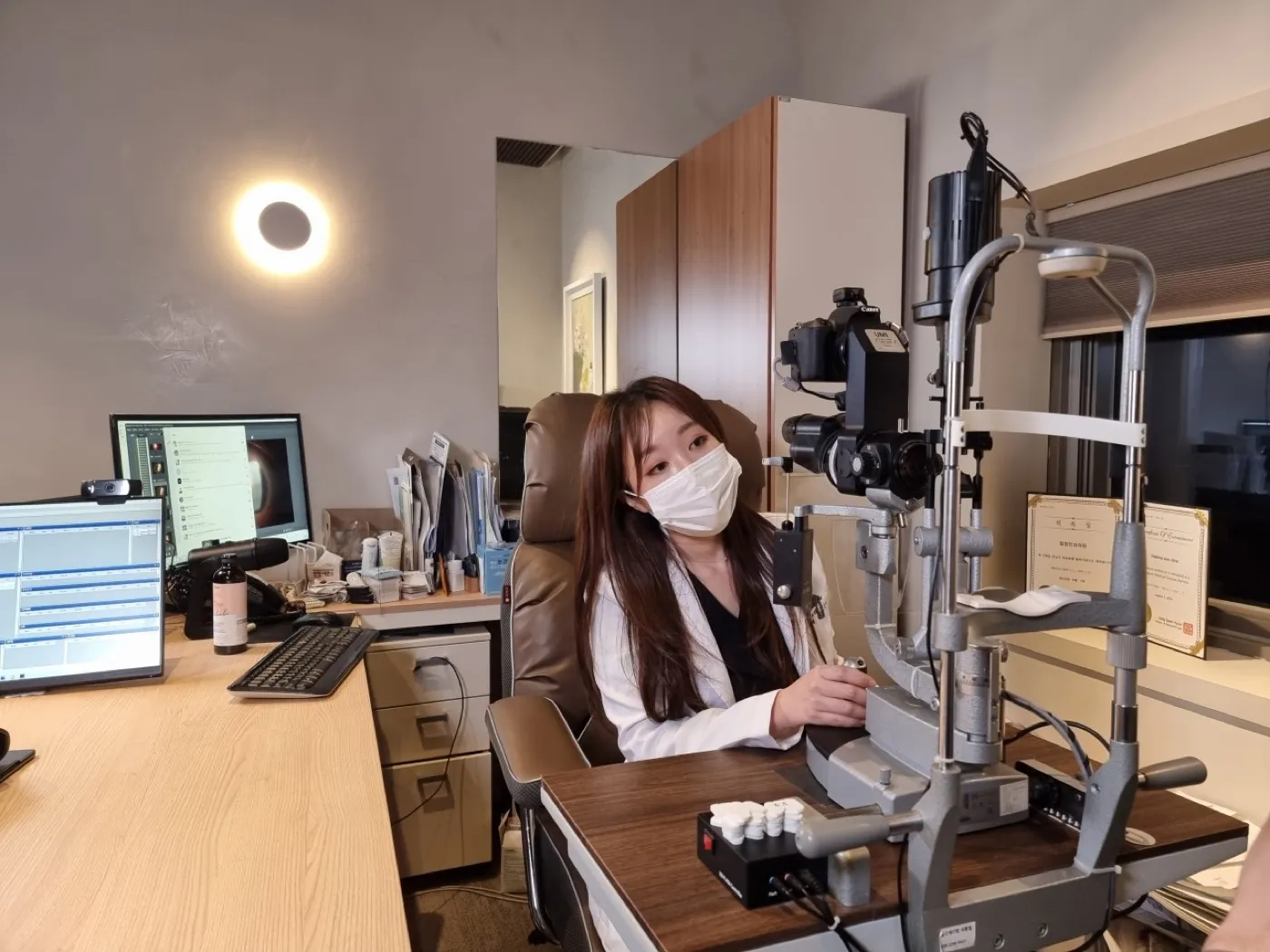
Hello, I'm Dr. Kim Sun-young, Medical Director of Healing Eye Clinic in Gangnam, and before this I was a clinical professor in cornea and cataract at Uijeongbu St. Mary's Hospital. Here the same surgeon does your exam, your surgery and your aftercare, an English interpreter joins your consultation at no extra charge, and international patients pay exactly what Korean patients pay.
If you don't have a cataract yet and just want to be rid of glasses, the lens you've been reading about may belong to a different operation, the implantable lens (ICL), which goes inside the eye without reshaping the cornea and leaves your natural lens in place.
If you have a cataract report from your eye doctor at home, send a photo of it on WhatsApp along with two distances you use every day: how far your phone or book sits from your eyes, and how far away your computer screen is. Ask which lens families are realistic for eyes like yours. The WhatsApp consultation is free.
What is the newest lens for cataract surgery right now?
Recent lenses do one of two things: they give you more than one focus distance, or they let the power be fine-tuned after the lens is already in your eye. Every cataract operation removes your clouded natural lens and puts a clear artificial one in its place. What changed over the last decade is what that artificial lens does with light.
Trifocal and continuous-range lenses split incoming light so that far, intermediate (a laptop) and near (a menu) can all be in focus without glasses for many people. On our lens list these include FineVision, LISA tri and Synergy, the last designed to give a continuous range rather than three separate points.
Risks and side effects to know
EDOF lenses stretch one focus across a longer range, so distance and arm's length are sharp while small print often still needs readers. They tend to produce fewer halos than trifocals.
Enhanced monofocals, such as Eyhance on our list, look and behave much like a standard monofocal but add a little intermediate range. Night vision stays close to that of a standard lens.
The light-adjustable lens is usually what people have in mind when they ask about the newest option. The US Food and Drug Administration approved it in 2017. After surgery you wear UV-protective glasses, and 17 to 21 days later you go back for three or four short light treatments over one to two weeks that set the final power.
Most of these families also come in toric versions, which correct regular astigmatism of the cornea in the same operation.
Ask whether this applies to your eyes, which dates are open, and about the English interpreter.
Ask us on WhatsAppSplitting light: what a multifocal trades at night
Think of pouring one jug of water into three glasses. Every glass gets some, and none gets the whole jug. A trifocal does the same with light: some goes to distance, some to intermediate, some to near, so each distance gets a little less contrast than a monofocal would give it. In daylight you rarely notice. On a wet road at night, with your pupils wide open, that split shows up as rings around headlights and a slightly washed-out look to dark scenes.
For many people the rings fade over several months as the brain learns to ignore them. That's the part travelers don't plan for: a week in Seoul is far too early to judge a multifocal, so the real verdict on your new lens comes at home, around the three-month mark. If that wait would make you anxious, it's a reason to lean toward an EDOF or enhanced monofocal lens.
A standard monofocal makes the opposite trade. All the light goes to one distance, usually far, so contrast at night is the cleanest of the group, and you wear readers for close work.
Which lens suits which eyes?
| Lens family | Tends to suit | Think twice if |
|---|---|---|
| Standard monofocal | Night drivers, people who don't mind readers, eyes with macular or glaucoma changes | You strongly want to read without glasses |
| Enhanced monofocal | People who want some arm's-length range with near-standard night vision | You read small print for hours a day |
| EDOF | Screen work and driving, with readers for fine print | You want to be free of glasses up close |
| Trifocal or continuous range | Heavy readers with a healthy macula and a regular cornea who rarely drive at night | You drive a lot after dark, or have dry eye or an irregular cornea |
| Light-adjustable | People living near the clinic who can attend several visits weeks later | You are traveling abroad for the surgery |
One tip saves a lot of back-and-forth: before your consultation, take a tape measure and note the distances you actually live at. Your phone, your book, your laptop screen, the dashboard. Arm's length is roughly 60 to 70 cm, which is the range EDOF and enhanced monofocal lenses are built around; a phone held at 35 cm is near vision, where trifocals do more of the work. Those numbers tell you more about which lens fits your life than any product brochure will.
Is the newest lens worth it when you're also paying for the trip?
Say you're 58, you drive a delivery route before dawn outside Vancouver, you check invoices on a tablet held at arm's length, and you've never minded drugstore readers. A trifocal would buy you freedom from readers you don't care about, at the price of halos on exactly the drive you do most. I'd steer that conversation toward an enhanced monofocal or EDOF lens set for distance, and keep the readers in the glovebox.
Change one detail, a retired reader who rarely drives after dark, with a healthy macula and a regular cornea, and a trifocal becomes a reasonable choice.
Lens type is the biggest single thing that moves the bill. The others are one eye or both, whether you need a toric version for astigmatism, the pre-op exam, and how many days you stay in Seoul. I've written separately about what changes the cost of cataract surgery in Korea. For the figure on your own case, ask on WhatsApp what the lens types you're weighing would cost for your eyes.

Halos, dry eye and a damaged macula: when a multifocal is the wrong lens
After any cataract surgery, a gritty feeling, light sensitivity and some blur are common for the first few days, and vision keeps settling over the following weeks. With trifocal and, to a lesser degree, EDOF lenses, halos and glare around lights and a little less contrast in dim light are expected rather than rare, and how quickly you adapt varies from person to person.
Months or years later, the capsule behind the lens can turn cloudy (posterior capsule opacification), which blurs vision again and is usually cleared with a short laser treatment. Infection, swelling at the center of the retina and retinal detachment are uncommon but serious.
These are reasons to slow down before choosing a multifocal or EDOF lens:
- macular degeneration, an epiretinal membrane or diabetic changes in the retina
- glaucoma that has already damaged the optic nerve
- an irregular cornea or signs of keratoconus on the corneal map
- significant dry eye, which should be settled first because an unstable tear film skews the lens measurements
- previous LASIK or LASEK, which makes lens power harder to calculate, so bring the old records
- a job or life built around night driving
If something changes after you fly home, act on it the same day. Worsening pain, a sudden drop in vision, increasing redness, or new flashes, a shower of floaters or a curtain across your sight all mean seeing an ophthalmologist at once. Carry your surgery record with the lens model and power in your hand luggage, so a doctor at home knows exactly what's in your eye. And if your cataract is still mild, deciding when to have the surgery may matter more right now than which lens you pick.
How long is the trip, and who sees your eyes once you're home?
The operation itself takes about 15 to 20 minutes per eye. The exact number of days is set at your consultation, once the exam shows what your eyes need.
We're open Monday to Thursday 10:00 to 18:30, Friday until 21:00 and Saturday 10:00 to 14:00, with lunch from 13:00 to 14:00, and closed on Sundays and public holidays. The Friday evening hours help if you can only reach the clinic after a working day. The clinic is a minute's walk from Sinnonhyeon Station, and our partner hotel, O'Cloud Hotel, is in Seocho-gu.
You can browse treatments and lens options on Healing Eye Clinic's English site, and if you read Korean, our main Korean site has a page on premium artificial lenses.
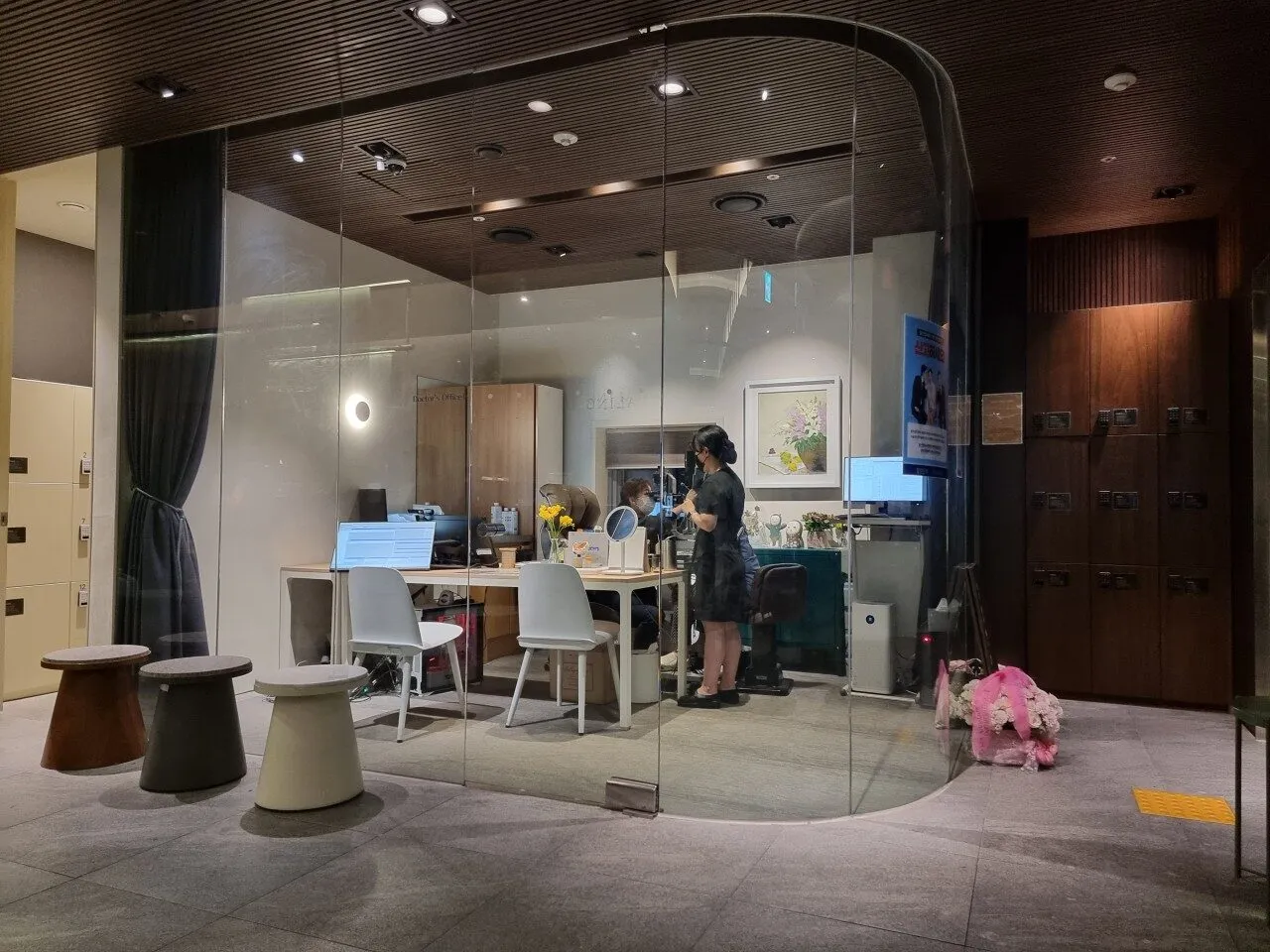
While you're in Seoul, the surgeon who examined you is the one who operates and checks you afterward. Before you fly, book an appointment with an ophthalmologist at home for the weeks after your return, and ask us how follow-up from abroad would work for your dates.
Presbyopia and Cataract Surgery Together: Fixing Two Problems in One Operation go further into what usually comes next.
Questions to ask any clinic before you choose a lens
- Will the doctor who measures your eyes be the one who operates and sees you afterward?
- Was your macula scanned before a multifocal was offered?
- Which lens families does the clinic actually stock, and why this one for the distances you use?
- If you've had laser surgery before, how will they calculate the lens power?
- What record of the lens will you take home, and who do you contact if something feels wrong after you fly?
- Do international patients pay the same as local ones?
Wherever you end up having the operation, those answers will tell you more than the year a lens was launched.
Where I stand: a newer lens is worth it only when your eyes are healthy enough to use what it adds and your daily life needs it. For a lot of people, a lens chosen for their own distances does more for them than the latest design. A cataract that's still mild gives you time, so there's no reason to settle this from a brochure or in a single week.
On WhatsApp, send a photo of your latest eye report, any records from earlier LASIK or LASEK, and the weeks you could travel, then ask: given how I use my eyes, is a multifocal sensible at all? The WhatsApp consultation is free. What decides it is the shape of your cornea and the health of your macula, both measured at your exam at 470 Gangnam-daero, 10–11F, Gangnam-gu, Seoul.
— Dr. Kim Sun-young, Medical Director
Frequently asked questions
Is a newer multifocal lens always better than a standard monofocal?
No. A standard monofocal puts all the light into one distance, so it gives the cleanest contrast at night. If you don't mind readers or you drive a lot after dark, it is often the more sensible lens. Newer designs add range, and the price you pay for that range is some contrast and some halos.
What if I can't get used to a multifocal lens?
Most halos fade over several months as the brain adapts, so give it time before judging. If they don't, the lens can be exchanged, but this gets harder as the months pass because the capsule around the lens seals. That's why it's worth thinking it through before surgery instead of planning on a swap.
Do both eyes need the same lens?
Not always. Some surgeons set the two eyes slightly differently, for example one aimed a little closer, to widen your range with simpler lenses. Whether that works for you comes down to your exam and how you tolerate the difference between the eyes, so ask about it at the consultation.
I had LASIK years ago. Can I still get a premium cataract lens?
Often, yes, but LASIK changes the cornea's shape, so standard formulas can miss the lens power. Your old records (the prescription before LASIK and the surgery report) make the calculation more accurate. Multifocal lenses are also less forgiving on a cornea that has been reshaped.
Does a toric lens correct all astigmatism?
It corrects regular astigmatism of the cornea. Irregular astigmatism, from keratoconus or scarring for example, is not corrected the same way. A toric lens can also rotate slightly in the first days, and occasionally it has to be repositioned, which is one more reason to keep the day-after check.
Questions about your own case or available dates? English interpreter on site.
Ask us on WhatsAppMessage us on official LINE / WhatsApp for a special offer
Your exact candidacy and cost are confirmed in a free 1:1 consultation.