Severe Dry Eye and Vision Correction: What Your Options Actually Are
If severe dry eye has you fearing you'll never be glasses-free, here's how I assess it and what's realistically possible — and when it isn't.

Dr. Kim Sun-young, Director
Cornea · Glaucoma · Cataract
Contents
A patient wrote to us last month, exhausted: "Every clinic either says I'm fine for LASIK or won't reply at all. My eyes burn by lunchtime. I just want someone to tell me the truth about severe dry eye and vision correction."
That message stayed with me, because it's the honest middle ground most patients live in — too dry for a cheerful "you're fine," not so dry that surgery is impossible. So let me walk through how I actually think about severe dry eye, what's realistic, and where the limits genuinely are.
First, let's define "severe" properly
"Severe" is a word patients and doctors use loosely, and that causes real confusion. In the exam room, I'm not interested in how dry your eyes feel on your worst day. I'm interested in what I can measure.
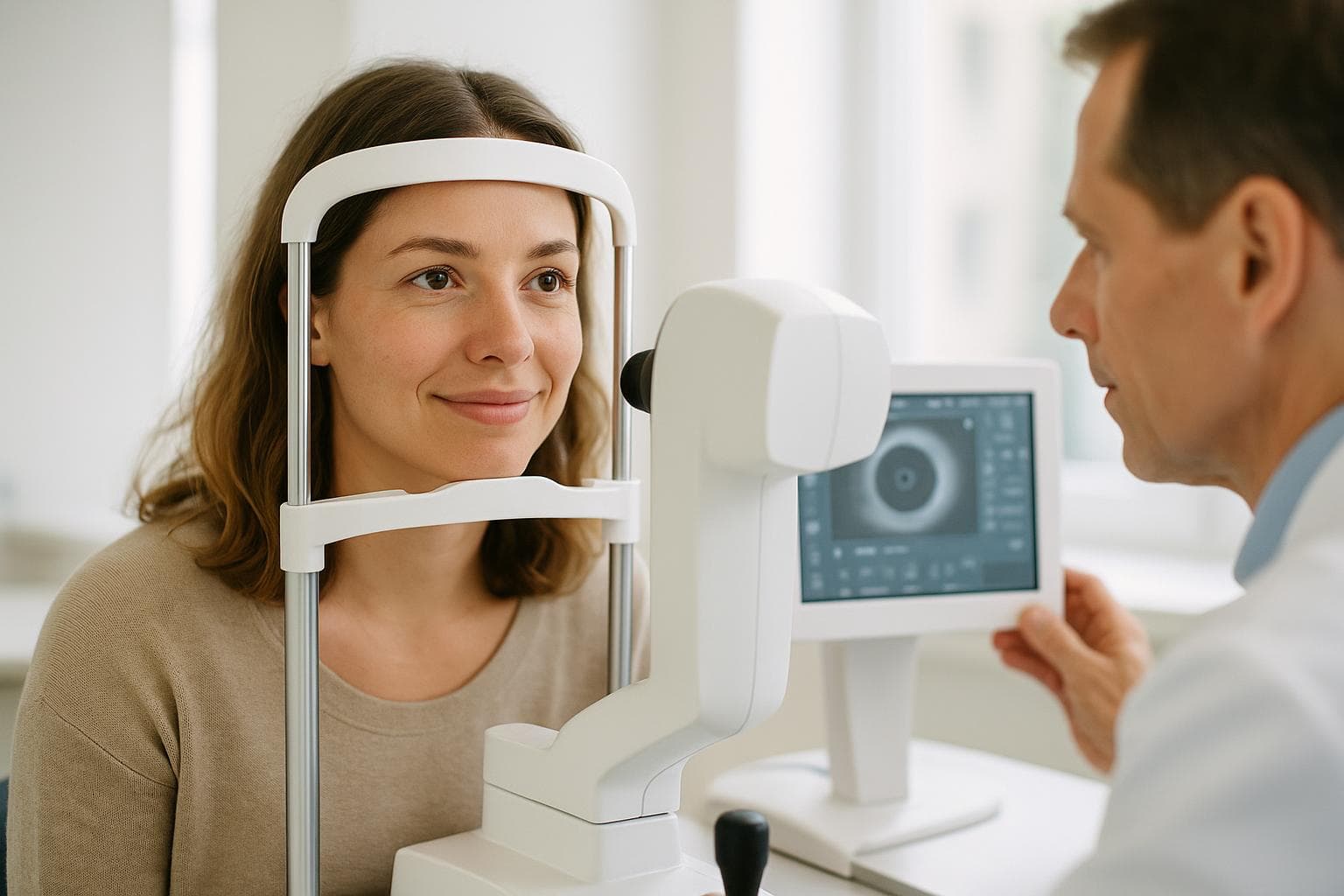
I look at tear break-up time — how many seconds your tear film stays smooth before it breaks apart. I measure tear volume. I stain the surface to see where cells are damaged. And I examine your meibomian glands, the tiny oil glands along your eyelid margins that keep tears from evaporating too fast. When those glands are blocked or dropping out, that's often the real engine behind severe dry eye, and no amount of artificial tears fixes it on its own.
Severe dry eye is a diagnosis made by measurement, not by how bad a day feels. Symptoms and clinical signs frequently disagree — which is exactly why a proper exam matters before anyone discusses surgery.
Why severe dry eye and laser surgery pull against each other
Here's the mechanism, plainly. Your cornea is one of the most densely nerved surfaces in the body, and those nerves are part of the feedback loop that tells your eye to make tears. Laser vision correction — particularly flap-based LASIK — temporarily interrupts some of those nerves. On a healthy ocular surface, that dip recovers over weeks to months and most people are fine.
On a surface that's already severely dry, that same temporary dip lands on top of an existing problem. Weeks of expected mild dryness can become months of genuine misery. That's the honest concern, and it's why I treat the surface first rather than operating and hoping.
What we treat — and in what order
When severe dry eye walks in, surgery is the last conversation, not the first. We start with the surface.
Depending on what your exam shows, that care might include medicated anti-inflammatory drops, structured meibomian gland treatment, IPL for the glands, careful lid hygiene, and in some cases autologous serum drops made from your own blood for surfaces that won't settle otherwise. Then — and this is the part many clinics skip — we re-measure. Treating dry eye without re-testing the tear film is just guessing.
Once the surface is stable, what's realistically possible
This is where it gets more hopeful. If your ocular surface genuinely stabilises with treatment, options can open up — but the procedure choice matters enormously for dry-eye-prone eyes.
Flap-free approaches like SMILE (a small-incision technique) and LASEK tend to disturb fewer surface nerves than traditional flap-based LASIK, so post-operative dryness is often milder. For some patients, a lens-based option like ICL sidesteps the corneal-nerve issue differently, because it doesn't reshape the corneal surface the same way. None of these is automatically "the answer" — each depends on your prescription, astigmatism, corneal thickness and how your surface tests after treatment. But severe dry eye doesn't always mean the door is shut. Often it means we walk through a different door, later.

The honest limitation
Here's the part I won't soften: for some patients with truly severe, advanced dry eye, the right answer is that vision correction surgery isn't appropriate — not now, and sometimes not at all. If your surface can't be made stable, operating on it doesn't serve you. In those cases I'll tell you directly, and we focus on managing the dry eye well so your eyes are comfortable, glasses or not. A good outcome isn't always a surgery. Sometimes it's an eye that finally stops hurting.
How a sensible plan usually unfolds
For most severe dry-eye patients, the path looks like this: a full surface assessment, a focused treatment phase, then re-measurement after several weeks. If the numbers improve, we discuss which procedure — if any — fits. If they don't, we stay honest about it. Throughout, the same surgeon sees you from exam to aftercare, so nobody's reading your file cold.
Let's get you a real answer
If severe dry eye has been quietly deciding your life — which jobs you can do at a screen, whether you can wear contacts, whether you dare hope for surgery — you deserve more than a yes-or-no from a search bar.
Message us free on our official WhatsApp or LINE. Tell me how your eyes feel through the day, your prescription, and everything you've already tried. I'll give you an honest first read: whether we treat the surface first, whether a gentler procedure might suit you down the line, or whether surgery isn't the right tool for you. Whatever the answer, it'll be the truth.
— Dr. Kim Sun-young, Medical Director, Healing Eye Clinic
Frequently asked questions
Can I have vision correction surgery if I have severe dry eye?
Sometimes, but rarely as the first step. With genuinely severe dry eye, I treat the ocular surface first and re-measure your tear film over weeks. If it stabilises, certain procedures may become possible. If it doesn't, I'll say so honestly rather than operate on a surface that can't heal well.
Why does dry eye matter so much for laser surgery?
Laser procedures temporarily reduce corneal nerve signalling, which lowers tear production for a while. On a healthy surface that recovers. On an already-struggling surface, that dip can turn weeks of mild dryness into months of real discomfort, so I won't rush it.
Is my dry eye severe, or does it just feel that way?
They're not the same thing. Symptoms and signs often disagree. We measure tear break-up time, tear volume, surface staining and meibomian gland health. Some people who feel terrible test mild, and some who barely complain test severe. The exam decides, not the bad days.
What treatments come before any surgery talk?
It depends on the cause, but often medicated drops, meibomian gland (oil gland) care, IPL, lid hygiene, and sometimes autologous serum drops. The goal is a stable, healthier surface first. Many patients feel noticeably better in daily life before surgery is even on the table.
Can you tell me online whether I'm a candidate?
Not honestly, no. Severe dry eye needs measurement. Message us free on WhatsApp or LINE with your symptoms, prescription and what you've tried, and I'll give you a realistic first read on whether treatment-then-surgery, a gentler procedure, or no surgery is the right path.
Message us on official LINE / WhatsApp for a special offer
Your exact candidacy and cost are confirmed in a free 1:1 consultation.