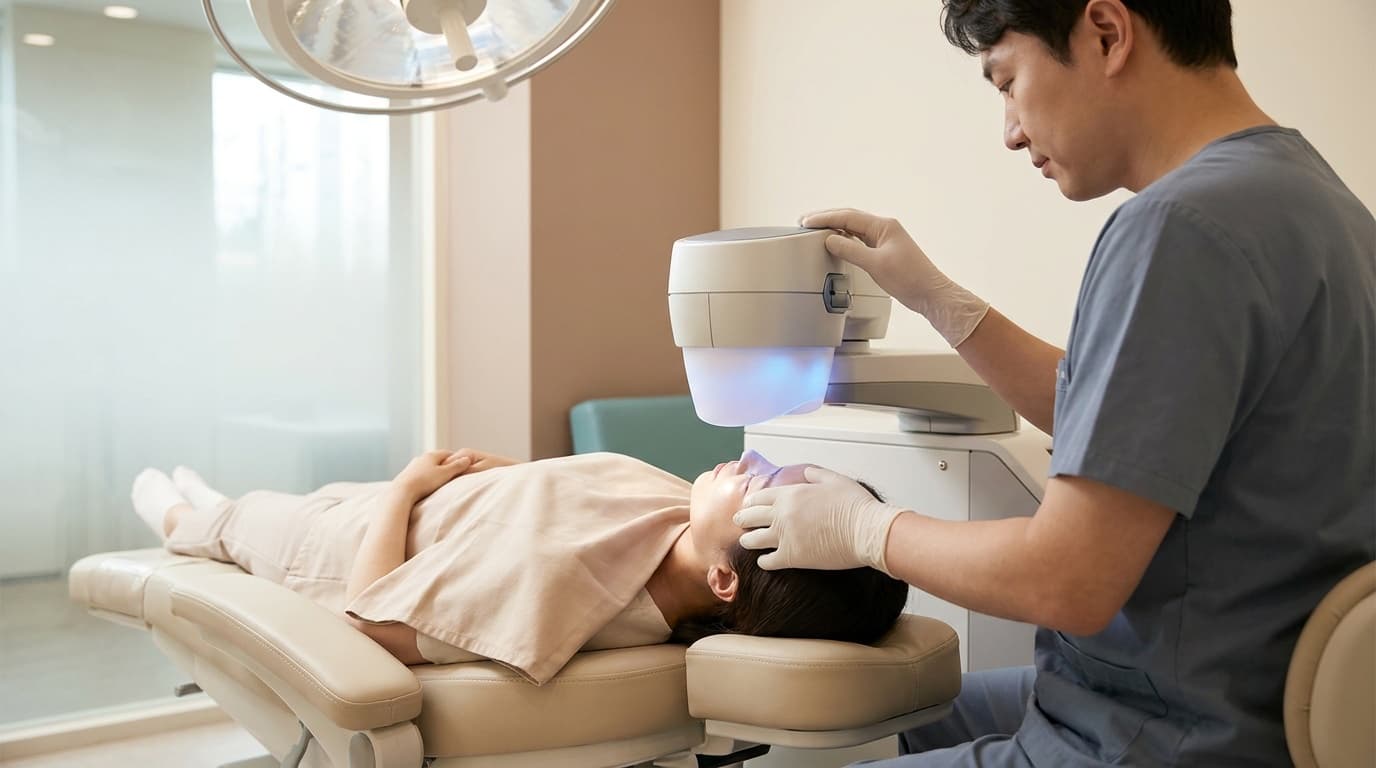
~10 min (both eyes)
Back to daily life in 1-2 days
Imagine opening your eyes in the morning and, instead of fumbling for your glasses, finding the numbers on your bedside clock already in focus. Fourth-generation Clear LASIK combines a precisely engineered thin corneal flap with a laser profile mapped to the unique data of each eye, pursuing both fast recovery and sharp visual quality at once. It suits people who have leaned on glasses and contacts for years with myopia or astigmatism, and who want the shortest possible recovery. For anyone weighing the cost of LASIK in Korea, my goal is to design that change for you in the most stable way I can.
Fourth-generation Clear LASIK creates a precise corneal flap for fast recovery and excellent visual quality. Each cornea is analyzed and the procedure custom-designed, with a 1:1 dedicated surgeon from exam to aftercare.
- Fast recovery
- Sharp visual quality
- Custom design
Is it right for me?
A good fit if
- A good fit if you have stable myopia or myopic astigmatism, with little change in your prescription over the past year or so.
- If your corneal thickness is sufficient and your corneal topography is even, you can expect Clear LASIK's fast recovery within the LASIK family.
- Well suited to busy professionals and students who can't take long off to recover, or to those visiting Korea briefly who need to return to daily life quickly after surgery.
- A strong choice if LASEK's longer recovery or discomfort feels daunting and you prioritize crisp visual quality.
- Recommended if you want your exam, surgery, and aftercare handled calmly in your own language by the same team — and don't want to pay more simply because you're a foreign patient.
Consider carefully if
- If your cornea is thin or your topography shows irregularity or signs suggesting keratoconus, it's safer to consider alternatives like LASEK or an implantable lens (ICL) rather than flap-based LASIK.
- If you have significant dry eye, are pregnant or breastfeeding, or your prescription hasn't stabilized yet, the timing may need adjusting or another approach may suit you better — I'll tell you honestly after the exam.
- If you do activities with frequent strong impact to the eyes, such as combat sports, a flapless method may suit you better than flap-based LASIK — so we look at your occupation and lifestyle too.
1What 4th-generation Clear LASIK is, and how it differs from standard LASIK
LASIK creates a thin flap in the cornea, lifts it, and uses an excimer laser to precisely reshape the corneal tissue beneath to correct your prescription, then repositions the flap. The heart of Clear LASIK is designing that flap thinner and more uniform, and mapping the data gathered during your exam precisely into the laser correction profile. The more uniform the flap, the more stable both visual quality and recovery speed tend to be. Even under the single name 'LASIK,' results differ in character depending on how the flap is made and how the correction is designed — and I tune that design to your individual eye.
2Precise testing is what determines the result
A good result begins not on surgery day but in the exam room. I assess broadly — corneal thickness and topography, pupil size, tear film, intraocular pressure, and even the corneal endothelial cells. I check in advance whether topography shows subtle irregularity or signs of keratoconus, whether enough safe residual cornea remains after the flap, and, for those whose pupils open widely in the dark, the likelihood of nighttime glare — then adjust the prescription and optical zone design accordingly. Only when this step is thorough can I tell you honestly whether surgery truly suits you or another method would be better. We review your results together in your own language, with an interpreter.
3Compared with LASEK and ICL, who is Clear LASIK right for?
There is no single right answer in vision correction. Clear LASIK's strengths are fast recovery and little discomfort, which suit those with adequate cornea who value a quick return to daily life. Conversely, flapless LASEK may be better if your cornea is thin or your job involves frequent impact, and an implantable lens (ICL) may be the better choice for high myopia or those who want to preserve corneal tissue. I don't recommend a particular surgery for its own sake — I choose, with you and based on your exam data, the method that best fits your eyes and life. If Clear LASIK isn't right for you, I'll say so clearly and explain the alternatives.
4Support for patients coming from overseas
Healing Eye is an MOHW-registered institution for international patients, with on-site Japanese, Traditional Chinese, and English interpreters, so you can fully understand your results and surgical plan in your own language before deciding. Clear LASIK recovers quickly enough for a short trip, but I recommend allowing a few days for the detailed exam and post-op check. We're about 70 minutes from Incheon Airport and just one minute from Sinnonhyeon Station, making travel easy, and we'll map out a comfortable route together from airport arrival through exam, surgery, and your return home. International patients pay exactly the same as Korean patients, so you receive the same quality of care with no added cost.
How the surgery goes
- 1
1. Detailed exam and consultation
We comprehensively measure corneal thickness, topography, pupil, tear film and more to judge suitability, then explain the results and surgical plan in your own language with an interpreter.
- 2
2. Numbing eye drops
Numbing drops make the eye comfortable. No injection is needed — just drops — and during surgery you feel only a mild sense of pressure.
- 3
3. Creating the precise corneal flap
A precise laser creates a thin, uniform corneal flap, which is gently lifted. The flap's uniformity is what shapes both visual quality and recovery speed.
- 4
4. Customized laser correction
Following an excimer laser profile designed from your pre-op data, the corneal tissue is reshaped precisely for you alone. The actual laser time is brief.
- 5
5. Repositioning the flap and same-day check
The flap is repositioned and adheres naturally — no stitches needed. Both eyes are usually done in about ten minutes, and we check your status the same day.
Recovery timeline
For a few hours after surgery you may feel dryness or slight tearing and foreign-body sensation, but these settle soon. Rest well that day, and most importantly, don't rub your eyes.
Most people see clearly from the next day and return to daily life within one to two days. At the next-day follow-up, the same surgeon personally checks your recovery.
Use your prescribed drops on schedule, and avoid eye-rubbing, saunas, swimming, and eye makeup for the advised period. Temporary dryness is common and managed with artificial tears.
Regular check-ups confirm your results stay stable, and our lifetime surgery guarantee lets us design a care plan suited to patients from afar, so you feel secure even after returning home.
Why Healing Eye
One dedicated 1:1 surgeon owns your whole journey — exam, surgery, follow-ups — so the same doctor knows your eyes' changes precisely each time. A lifetime surgery guarantee keeps you reassured after surgery too.
On-site Japanese, Traditional Chinese, and English interpreters mean you can fully understand your results and surgical plan in your own language before deciding. We guide you from the moment you arrive at the airport.
International patients pay exactly the same as Korean patients — 100%. There's no tourist markup, so you receive the same quality of care, just as it is.
Your surgeon, Dr. Kim Sun-young, specializes in cornea, glaucoma, and cataract — an MS from Catholic University College of Medicine, a former Clinical Professor at Uijeongbu St. Mary's, and a member of ESCRS. A 4.8-star Google rating with 154+ reviews, and a location one minute from Sinnonhyeon Station, put that experience easily within reach.
Clear LASIK (4th Gen) — see if it fits you in 1 minute
Your exact candidacy and cost are confirmed in a free 1:1 consultation. No pressure, in your own language.
Frequently Asked Questions
Does the surgery hurt?
Because numbing drops are used, there's little to no pain during surgery — only a mild sense of pressure, and the dryness afterward settles within a few hours. If pain is a big concern, feel free to message us on LINE or WhatsApp; in a free consultation we'll walk you through the procedure in detail beforehand.
How long is the recovery, and when can I resume daily life?
Clear LASIK recovers quickly even among LASIK procedures — most people see clearly from the next day and return to daily life within one to two days. Still, the first one to two weeks call for care: keeping to your drops and avoiding eye-rubbing, saunas, and swimming. Recovery varies by individual, so we'll build a plan around your own schedule in a free consultation.
How do I know if I'm a good candidate for Clear LASIK?
Only detailed testing — corneal thickness and topography, pupil size, tear film, and prescription stability — can tell for sure. If your cornea is thin or shows signs of keratoconus, or if you have severe dry eye or high myopia, LASEK or ICL may be better, and I'll say so honestly. Even before the exam, if you share your prescription and eye concerns in a free consultation, we can point you toward a likely direction.
How many days do I need to stay in Korea?
Recovery is fast enough for a short visit, but I recommend allowing a few days for the detailed exam, surgery, and the next-day follow-up check. Exam and surgery can often happen on the same visit, though your eye condition may call for some adjustment. With an interpreter, we'll design a comfortable schedule around your flights and return date — so check a workable plan first via a free LINE or WhatsApp consultation before you travel.
Is it safe? Could my vision regress or could side effects occur?
When suitability is judged through accurate testing and correction is done at a stable prescription, results tend to last, and our lifetime surgery guarantee keeps your care going after surgery. Temporary symptoms like early dryness or nighttime glare can occur and usually improve with time, but since eyes can change, regular check-ups matter. I'll honestly explain the possibility of side effects and the limits after your exam — so ask me anything in a free consultation.
How much does it cost, and do foreigners pay more?
Cost depends on your exam results and the surgical design we apply, so the exact figure is given in a free consultation after your detailed exam. One thing is clear, though: international patients pay exactly the same as Korean patients — 100% — with no tourist markup whatsoever. Even before the exam, share your prescription and we can give you a rough idea, so feel free to ask on LINE or WhatsApp.
Ask today about a clearer tomorrow
Consultation is free. It only takes a minute to start.