Can You Go Blind From LASIK? Rarely, and Week One Matters
Can you go blind from LASIK? Lasting vision loss is very rare. A Seoul cornea specialist walks through week one and how many days to plan in Korea.

MS, Catholic Univ. College of Medicine · Ophthalmology specialist, Catholic Medical Center · Clinical Professor (Cornea & Cataract), Uijeongbu St. Mary's Hospital · 108th Korean Ophthalmological Society Research Award · KDCA epidemiology citation
Medically reviewed byDr. Kim Sun-young, Director· Medical Director
Edited by: Dr. Kim Sun-young
Contents
Can you go blind from LASIK, and if something did go wrong, would it show up while you're still in Seoul or only after you've flown home? Lasting blindness from LASIK is very rare. The problems that can threaten sight, mainly infection and inflammation, tend to appear in the first week and respond to treatment when they're caught early, so the days right after surgery are the ones to plan around.
Hello, I'm Dr. Kim Sun-young, Medical Director at Healing Eye Clinic in Gangnam. Whichever method you end up with, from standard LASIK to Clear LASIK, one doctor stays with you from the exam through surgery to aftercare, and you get a medical interpreter for your language at no extra charge.
Before you book any flight, send a photo of your latest eye-exam printout or glasses prescription on WhatsApp and ask how many days to plan around your flights. The first consultation on WhatsApp is free.
Can you go blind from LASIK months later, or only in the first week?
There are two windows, and they work differently.
The early window is the first week or two. Three things matter here. An infection of the cornea is rare, but it's the one that can scar the center of the cornea if it's left alone; it shows itself with pain that keeps getting worse, increasing redness, discharge and vision that drops instead of clearing. Inflammation under the flap usually appears in the first two or three days as haze, and anti-inflammatory drops treat it when it's spotted at a check-up. A flap that shifts, almost always from rubbing or a knock in the first days, can be put back in place.
The late window is months to years. The serious long-term problem is ectasia: the cornea weakens and slowly bulges, and vision blurs in a way glasses stop fixing. It's closely tied to corneas that were thin or irregular before surgery, including early keratoconus that nobody had noticed. That's why it's mostly prevented in the exam room, long before the laser.
Dry eye, halos at night and a prescription that drifts back a little are far more common than any of these. They affect how well you see, not whether you can see. Korean clinics perform a lot of this surgery, and why LASIK is so common in Korea has its own post; the screening is what keeps that volume safe for each person.
Ask whether this applies to your eyes, which dates are open, and about the English interpreter.
Ask us on WhatsAppWeek one, day by day
The signal to watch is direction. Normal recovery feels better each day. Trouble feels worse.
| When | What's usual | Get it checked the same day if |
|---|---|---|
| Surgery day | Vision starts clearing; gritty feeling and light sensitivity | Pain keeps building after a few hours of rest |
| Day 1 | First check-up; indoor activity is fine; flying is allowed after it | Vision is worse than the night before |
| Days 2–3 | Vision mostly stable; light outings are fine | New redness, discharge or rising pain |
| Week 1 | Most of daily life is back; eye makeup waits 2–3 weeks | Any sudden drop in vision in one eye |
| Month 1 | Vision and cornea settle into a stable phase | Blur that slowly worsens instead of improving |
The first two or three days are when inflammation under the flap usually shows up, and it's easiest to treat when the doctor who operated can look at it. That's the reason I'd keep at least one of those days in Seoul if your ticket allows. For what you can actually do each day, from showers to screens to sightseeing, there's a separate LASIK recovery day-by-day guide.
Infection, a shifted flap, a weakened cornea: how rare, and who should wait
The reactions almost everyone has are temporary: a scratchy, watery first evening, dryness for weeks to a few months, and halos or glare around lights at night that usually fade as the eye heals. How fast this settles differs from person to person, and that's the one place where your own healing sets the pace.
The U.S. Food and Drug Administration's guidance on who should not have LASIK lines up with what eye surgeons screen for. As general medicine, it makes sense to wait or choose another method if:
- your prescription has changed within roughly the last year
- your cornea is thin, or the corneal map shows irregularity or signs of keratoconus
- you have severe dry eye, which is usually treated first
- you're pregnant or breastfeeding
- you have a condition or take a medicine that slows healing, such as some autoimmune diseases
- you play contact sports where blows to the face are likely
When LASIK is ruled out, there are still options. A thin cornea may suit surface treatment or SMILE, done through a small opening in the cornea, depending on the numbers. ICL places a lens inside the eye without reshaping the cornea at all; its own rare risks include raised eye pressure and earlier cataract, so it gets its own screening.
If a warning sign shows up after you're home, don't wait to see whether it passes: get an eye doctor to look the same day, then contact us. The section on the first month below covers how that works.
How many days should you plan in Seoul?
Plan for a few days: the exam, the surgery, and the check-up the day after surgery. Flying is allowed once that check-up is done. The exact count is set in the consultation, around your flights and what the exam shows.
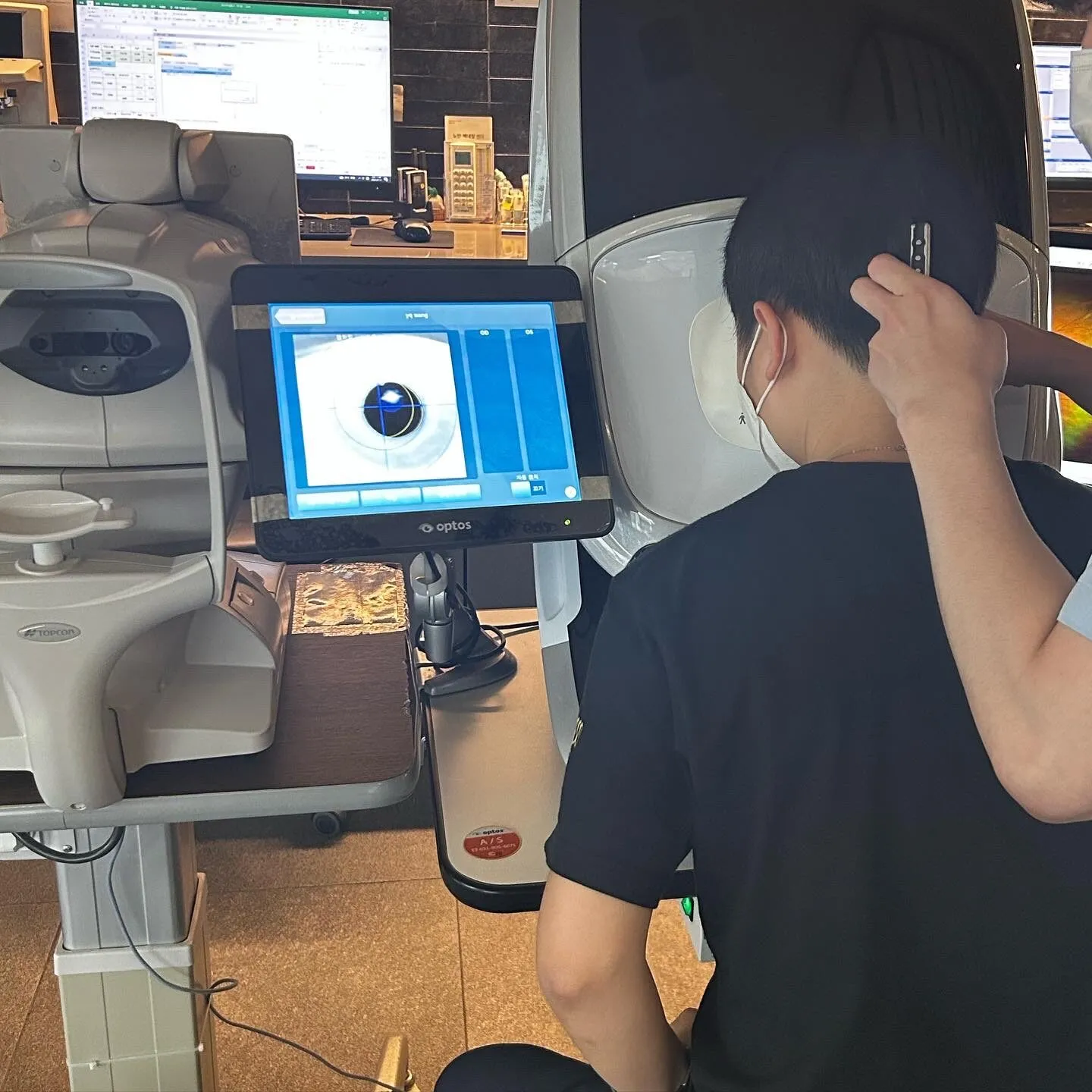
Here's how those days usually run. You land at Incheon, and the clinic is about 70 minutes away, a one-minute walk from Sinnonhyeon Station. Our partner hotel, O'Cloud Hotel, is in Seocho-gu. You'll need to stop wearing contact lenses for a while before the exam, because lenses change the shape of the cornea the measurements depend on; how many days depends on your lens type and is confirmed in the consultation.
On exam day, drops may blur your near vision for a few hours, so keep the afternoon free of anything that needs reading or driving. On surgery day, go back to the hotel and rest with your eyes closed; sleep does a lot that evening. The next morning is the check-up, and that's the visit your flight should come after, never before.
One scheduling detail matters more than people expect. The clinic is open Mon–Thu 10:00–18:30, Fri 10:00–21:00 and Sat 10:00–14:00, and closed on Sundays and holidays. A Saturday operation would push the next-day check past a closed Sunday, so put surgery on a weekday. The late Friday hours help if you're landing late in the week.
The Healing Eye Clinic international patient page shows the languages covered and how to reach us before you travel. If you read Korean, our home clinic's Clear LASIK page in Korean has the original description.
What should you ask any LASIK clinic before you book?
Put these to every clinic on your list, ours included. Under each one is how it works here.
- Does the exam measure corneal thickness, corneal shape, pupil size and the tear film? Here, all four are checked, along with the cornea that would remain after correction and any sign of keratoconus.
- Is the doctor who examines you the one who operates and sees you the next day? Here, one dedicated doctor stays with you from the exam through surgery and aftercare.
- When is the first check-up, and may you fly before it? Here, it's the day after surgery, and flying is allowed after that check.
- What happens if the exam says no? Here, I won't push ahead with LASIK; I'll explain the alternatives, such as SMILE or ICL, and I won't recommend more treatment than you need.
- Will you understand your results in your own language? Here, we go through your results together with a medical interpreter for your language, at no extra charge.
- How do you stay in touch after you fly home? Here, we keep following your progress by video call or messenger.
There's more on how to judge a LASIK clinic in Korea from abroad in a separate post.
Back home: the first month
Once you're home, the job is to protect the eye while it seals. Use every drop on the schedule you were given, including the ones that feel unnecessary by day four. Swimming pools and hot tubs are commonly avoided for the first couple of weeks, and eye makeup waits two to three weeks.
Cabin air on the flight is dry, so use artificial tears often. Screens are fine, but you'll blink less while you stare, so keep the tears within reach at work too.
After you fly home, I keep following your progress by video call or messenger. If pain gets worse, vision drops, or redness and discharge increase, see a local eye doctor that same day and then message us so we can see what they found.
One thing most people never hear: keep your pre-surgery measurements and tell every future eye doctor you've had LASIK. Eye-pressure readings come out lower on a thinner cornea, which matters for glaucoma checks, and the lens calculation for cataract surgery decades later is more accurate with your original numbers. Ask for a copy of your exam and surgery records before you leave.
My view on this question is simple. The real threats to sight from LASIK sit in two places: an eye that shouldn't have been operated on, and a first-week problem that nobody looked at in time. The exam handles the first, and the day-one check plus the way you can reach us from home handles the second. I recommend a method from your exam data and your life, and when LASIK isn't right for your eyes, I say so.
We're at 470 Gangnam-daero, 10–11F, Gangnam-gu, Seoul. Send a photo of your latest eye-exam printout or glasses prescription on WhatsApp, and ask how many days you should plan around your flights; the consultation there is free.
Dr. Kim Sun-young, Medical Director
Frequently asked questions
Can you go blind from LASIK eye surgery years later?
Very rarely. The late risk is ectasia, a slow bulging of a weakened cornea that can appear months or years after surgery, mostly in corneas that were thin or irregular beforehand. The signs are vision that keeps getting blurrier and astigmatism that keeps increasing at each new eye test. If that happens, see an ophthalmologist; treatments such as corneal cross-linking aim to stop it from progressing.
How soon would I notice an infection after LASIK?
Most infections after LASIK show up within the first few days to about two weeks. The pattern is pain that worsens instead of easing, a red eye that gets redder, discharge, or a drop in vision. Keep using the antibiotic drops exactly as prescribed, and get seen the same day if any of these appear.
I rubbed my eye on the flight home. Should I worry?
Cover each eye in turn and compare. If the vision is the same as before the flight and there's no new sharp pain, keep using your drops and stop rubbing. If one eye is newly blurred or painful, have an eye doctor check it that day, because a shifted flap is easier to put back early.
Is LASEK gentler on my eyesight than LASIK?
LASEK works on the surface of the cornea, so there's no flap to shift, and it leaves more corneal thickness. The same screening for thin or irregular corneas applies to both.
Does LASIK make glaucoma or cataract harder to manage later?
It doesn't cause either, but it changes the measurements. Eye pressure reads lower on a thinner cornea, and cataract lens calculations are more accurate with your pre-LASIK numbers. Keep your records and tell every future eye doctor about the surgery.
Questions about your own case or available dates? English interpreter on site.
Ask us on WhatsAppMessage us on official LINE / WhatsApp for a special offer
Your exact candidacy and cost are confirmed in a free 1:1 consultation.