Early Cataract Detection After 40 Often Starts Before Blur
Early cataract detection usually happens at a dilated eye exam, often before any blur. What the exam looks at, and what to send before a Seoul visit.

Dr. Kim Sun-young, Director
Cornea · Glaucoma · Cataract
Medically reviewed byDr. Kim Sun-young, Director· Medical Director
Edited by: Dr. Kim Sun-young
Contents
I'm Dr. Kim Sun-young, Medical Director of Healing Eye Clinic in Seoul. Forty is the number to remember.The National Eye Institute explains that around age 40 the proteins in the eye's lens start to break down and clump together, and that mild cataracts may cause no symptoms at first. So early cataract detection rarely begins with a complaint. It begins when an eye doctor dilates the pupils and looks at the lens itself, usually at a visit booked for something else.
If you're reading this for yourself in your 50s, or for a parent who keeps saying their glasses "just need updating", this page collects the patterns I see around how cataracts are found early, and what a first finding does and doesn't mean.
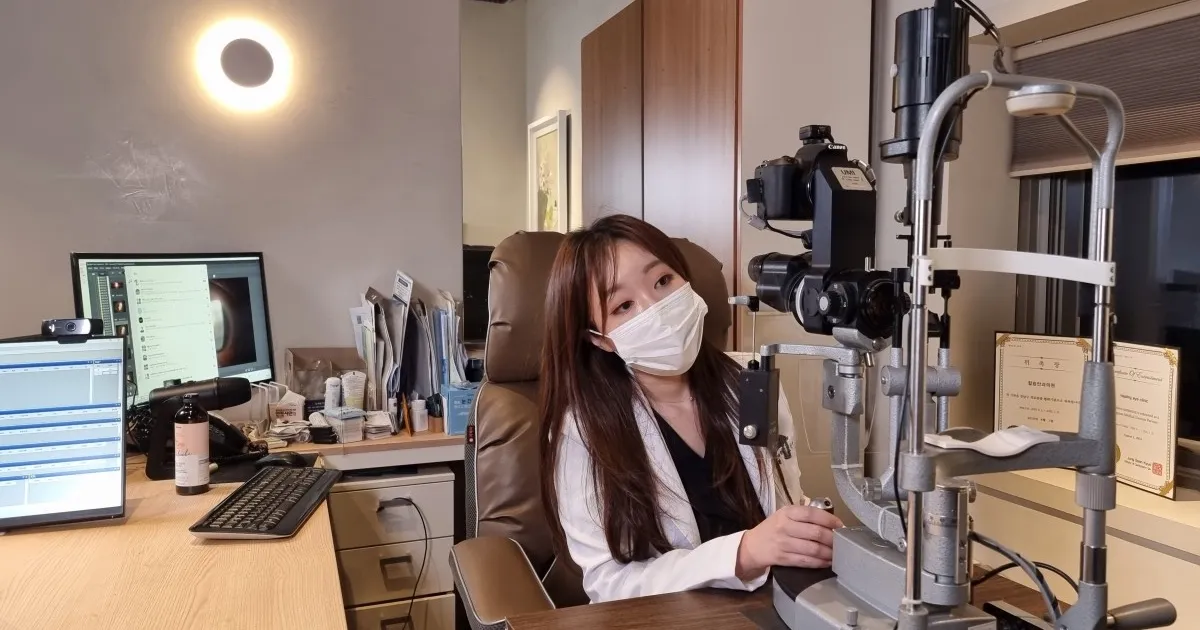
How does an eye doctor detect an early cataract?
A dilated eye exam with a slit lamp is how most early cataracts are found. Drops widen the pupil, and a microscope with a narrow beam of light shows the lens in cross-section, where early clouding appears as haze, spokes at the edges, or a cloudy patch at the back.
The American Academy of Ophthalmology lists three parts of this exam: a slit-lamp look at the front of the eye including the lens, a dilated retinal exam, and a refraction and visual acuity test for each eye separately. That last part matters more than people expect. A chart score of 20/20 can sit alongside a lens that has already started to change, because the letters on the chart are high-contrast and the room is well lit.
What I'm actually reading at the slit lamp is location and density. A faint haze in the centre of the lens behaves differently from wedge-shaped spokes at the edge, which may not touch daytime vision at all until the pupil widens at night. A small cloudy plaque right at the back of the lens, sitting on the visual axis, can cause glare out of proportion to its size. Same word on the report, three different conversations.
Why do early cataracts so often show up at a visit for something else?
Because nobody books an appointment for a symptom they don't have yet. Early lens changes tend to be found during a glasses update, a diabetes eye check, a dry-eye visit, or a consultation about vision correction.
That last one surprises people. Someone in their late 40s comes in asking about laser correction or reading glasses, and the exam shows the lens has begun to cloud. The finding changes the question. Laser correction reshapes the cornea and leaves the natural lens where it is, so if the lens is already changing, the conversation may move toward options that address the lens. The clinic's presbyopia and cataract treatment page covers the lens-based approaches; which one fits depends on the exam, not on the age printed on a passport.
The other common setting is family. Adult children notice a parent squinting at a phone, leaving lights on in the afternoon, or hesitating at night crossings, and bring them in. Those observations are useful. Write them down before the visit, with roughly when you first noticed each one.
A glasses prescription that keeps drifting is worth mentioning
A prescription that changes more than expected over a year or two, especially toward more nearsightedness, can be an early sign of a lens change and is worth telling the eye doctor about directly.
Some people over 60 even notice they can read without their reading glasses again, and treat it as good news. A denser centre of the lens can bend light more strongly and shift focus. It's a known pattern, though a cataract isn't the only possible cause, and it is exactly the kind of detail that gets lost if the optician simply makes new lenses each time.
If your parent has a drawer of old glasses, the dates on those prescriptions tell a story. Bring the most recent two or three.
Does "early cataract" on a report mean you need surgery?
No. An early finding usually means monitoring. The National Eye Institute notes that brighter lighting and an updated glasses prescription can help in the early stages, and that surgery is generally suggested when cataracts start getting in the way of everyday activities.
The AAO makes the same point from the other side: lens clouding can begin years before it causes vision problems, and surgery isn't needed while symptoms aren't bothering you much. Early detection buys time to plan, not a deadline.
What moves someone from "watch" to "consider surgery" is function: night driving that has become stressful, reading that needs a lamp at noon, glare that makes a sunny walk uncomfortable. The details of that decision are in my post on how the timing of cataract surgery is actually decided.
Who should be checked before 40, or more often?
People with diabetes, smokers, heavy drinkers, people with a family history of cataracts, and anyone using steroid medicines are at higher risk, according to the National Eye Institute, and benefit from not waiting for symptoms.
For adults without eye problems or risk factors, the AAO suggests a baseline eye disease screening every 5 to 10 years before 40, and a screening by 40 because early signs of disease and changes in vision often begin around that age. Your own eye doctor will set the interval after that.
Two groups deserve a specific mention. People who had LASIK or LASEK years ago should keep any records of their pre-surgery measurements; those numbers can help later if lens surgery is ever planned. And anyone on long-term steroid inhalers, tablets or eye drops should say so at the start of the exam, not as an afterthought.
What an early exam can't tell you, and the risks on both sides
A single exam shows how the lens looks today. It can't tell you how fast it will change, and the honest answer to "when will I need surgery?" is usually "we'll know more after the next visit". Comparing two exams over time says far more than one.
Cloudy vision also isn't always the lens. The dilated exam includes the retina and optic nerve, and the AAO notes the doctor checks for glaucoma at the same time. That's one reason I don't like early detection being reduced to a vision chart: macular or optic-nerve problems can blur vision too, and they're managed differently.
The exam itself has small practical downsides. Dilating drops blur near vision and make light uncomfortable for several hours, so don't plan to drive afterwards, and bring sunglasses.
If surgery does become the right call later, it carries real risks, including infection, inflammation, swelling at the back of the eye, and later clouding of the capsule behind the new lens, which can need a follow-up laser treatment. Results vary between people. That is a reason to choose the timing deliberately, neither rushing an early finding into the operating room nor ignoring symptoms for years. The clinic's Korean site has a plain explanation of what a cataract is if a family member reads Korean.
Getting a parent's eyes checked during a trip to Seoul
Many families combine a visit to Korea with an eye exam for a parent. Healing Eye Clinic is at 470 Gangnam-daero, 10–11F, one minute on foot from Sinnonhyeon Station, and consultations can be held with Japanese, Traditional Chinese and English interpreters.

The clinic works on a 1:1 dedicated-surgeon system, so the doctor who examines the eyes is the one who follows them over time. For cataract and presbyopia, that may be me (I'm a Clinical Professor in Cornea & Cataract at Uijeongbu St. Mary's Hospital and a member of KOS, KEEDS, KCLSS & ESCRS) or Dr. Choi Geun-hye, whose specialty is cataract, presbyopia and oculoplasty. The cataract surgery treatment page explains the procedure itself.
Hours are Monday to Thursday 10:00–18:30, Friday 10:00–21:00 and Saturday 10:00–14:00, closed Sundays and holidays. A Friday evening slot can suit a family that lands in the morning. Because dilation blurs vision for hours, plan the rest of that day as a quiet one.
What to bring: current glasses, the last two or three prescriptions, a written list of medications (steroids especially), any records of past eye surgery, and the notes you made about what you've noticed at home. If surgery is later discussed and the family wants to plan travel around it, this companion's guide for parents and the overview of cataract surgery in Korea cover the trip itself.
If your parent already has an eye exam report from home that mentions the lens, send a photo of it on WhatsApp along with their age and the medications they take. I'll review what's written there, and you'll have a clearer idea of what to ask at the exam in Seoul.
Frequently asked questions
Can a cataract be seen without dilating the eyes?
An eye doctor can sometimes see lens clouding without dilation, but a dilated exam gives a much fuller view of the lens and lets the doctor check the retina and optic nerve at the same time. Early changes at the edge of the lens may be missed with a small pupil.
Can an optician or a glasses check pick up an early cataract?
A vision test can show that something has changed, such as a prescription drifting faster than expected, but it doesn't show why. Confirming a cataract needs an eye doctor's slit-lamp exam, ideally with dilation.
Can an early cataract be reversed with eye drops or supplements?
No eye drop or supplement has been shown to clear a cataract once it has formed. In the early stages, brighter lighting and an updated glasses prescription can help, and surgery is considered when the cataract starts interfering with daily activities.
At what age do cataracts usually start?
The National Eye Institute explains that lens proteins start to break down and clump around age 40. Most people don't notice anything for years, and the risk keeps rising with age.
How often should someone with an early cataract be re-checked?
The interval depends on how dense the cataract is, where it sits, and other conditions such as diabetes. The examining eye doctor sets it; comparing two exams over time is what shows how quickly the lens is changing.
Message us on official LINE / WhatsApp for a special offer
Your exact candidacy and cost are confirmed in a free 1:1 consultation.