
Cataract Surgery in Korea: A Seoul Surgeon's Honest Guide
Thinking about cataract surgery in Korea? A Seoul cataract surgeon explains the exam, lens choice, cost, recovery and trip length — and who should wait.

Dr. Kim Sun-young, Director
Cornea · Glaucoma · Cataract
Contents
Hello, I'm Dr. Kim Sun-young, Medical Director of Healing Eye Clinic in Sinnonhyeon, Gangnam, Seoul. I served as a clinical professor of cornea and cataract at a university hospital, and today I see patients who fly in from abroad every week, with English-speaking staff in the clinic.
A message we often get starts like this: "Dr. Kim, my eye doctor says I need cataract surgery. Is it safe to have it done in Korea, so far from home?"
If you are searching for cataract surgery in Korea, you are probably asking the same thing. I understand. This is your sight, and a lens that stays in your eye for life.
So let me be honest from the start: the hardest part of cataract surgery is not the operation itself — it is choosing the right lens for your eye. I'll walk you through it the way I explain it in my consulting room.
What cataract surgery in Korea actually involves
The operation is the same standard procedure used worldwide. What differs between clinics is how carefully the eye is measured, and who takes responsibility afterwards.
1. The exam decides the lens, not the brochure
Before surgery we measure eye length, corneal curvature, astigmatism, corneal endothelial cells, the macula and the optic nerve.
These numbers set the power and type of your new lens. Choosing a lens before the exam is like buying shoes before measuring your feet.
My rule: I don't name a lens until I've seen your numbers.
2. The surgery is short; the planning is long
Through a 2–3mm incision, the clouded lens is broken up with ultrasound and removed. A folded lens goes in and opens where the old one sat.
It is done under numbing drops, the incision usually seals without stitches, and you go home the same day. Vision often looks noticeably brighter that day.
3. Monofocal or premium — this is the real decision
A monofocal lens gives one sharp distance and clean night vision. A multifocal lens covers far, middle and near, which can reduce your need for glasses.
A multifocal lens is not automatically the better lens. If you drive a lot at night, or your macula isn't perfectly healthy, I may advise a monofocal.
4. Follow-up has to be planned before you fly
We check the eye the day after surgery. After that, your 1-week, 1-month and 3-month checks can be done by an eye doctor at home.
We give you a written record of the lens model, its power and your measurements, so the next doctor isn't guessing.
For cataract surgery abroad, ask three things before anything else: what will you measure, who chooses my lens, and who looks after me once I'm home.
If you are unsure whether it's time yet, I explain the timing question in when to have cataract surgery.
Why the surgeon who examines you should be the one who operates
At Healing Eye Clinic, the same surgeon does your exam, chooses your lens with you, operates and checks you afterwards.
The person who measured your eye knows why that lens was chosen. That knowledge shouldn't be handed over halfway.
These are not boasts but facts you can check. Foreign patients pay the same price as Korean patients. We hold a Google rating of 4.8 from 154 reviews. I am a member of the European Society of Cataract and Refractive Surgeons (ESCRS), and the clinic runs a lifetime surgery responsibility program.
So which lens is right for me?
This table is how I start the conversation. The final answer comes from your exam.
| If this sounds like you | Lens I'd usually look at first |
|---|---|
| You drive at night often, or want the cleanest contrast | Monofocal |
| You want to rely on glasses less, and your eye is otherwise healthy | Multifocal (after checking pupils and macula) |
| You have significant corneal astigmatism | Toric version of either |
You can read how each lens works on our cataract surgery page and our presbyopia and cataract page. My longer comparison is in monofocal vs multifocal IOL for cataract.
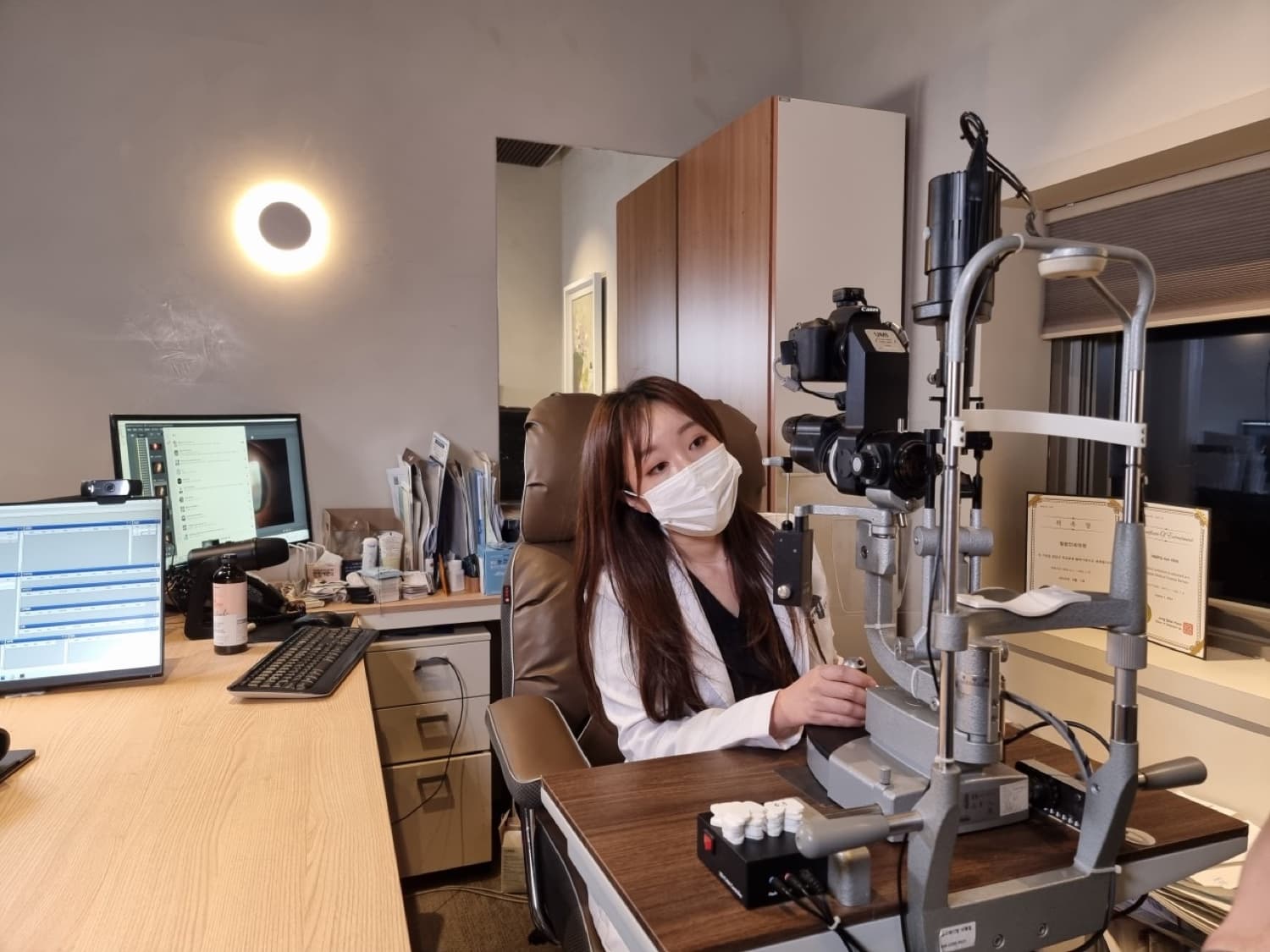
Here are our published prices for reference. A full breakdown is in cataract surgery cost in Korea and on our price page.
| Item | Price |
|---|---|
| Full exam | ₩150,000 |
| Monofocal lens | ₩1,250,000 per eye |
| Eyhance | ₩2,500,000 per eye |
| LISA tri | ₩3,000,000 per eye |
Side effects, and when I'd tell you to wait
- Grittiness and watering: common for the first days and usually settles.
- Glare and halos: more noticeable with multifocal lenses, and many patients adapt over time. Individual results vary.
- After-cataract: the membrane behind the lens can haze later; a short laser procedure clears it.
- Infection: rare, but no surgeon can promise zero risk. That's why the drops and checks matter.
What the first weeks usually feel like is covered in cataract surgery recovery time.
If your cataract is mild and not bothering daily life, I will usually tell you to wait. Cataract surgery is rarely an emergency. If you have macular disease or glaucoma, the result may be less sharp than you hope, and I'll say so before you book anything.
The Korean version of our cataract explanation is on our main site page about cataracts.
Planning your trip
- Exam, surgery, next-day check: this is the minimum. Doing both eyes changes the length, so we plan it after your exam.
- Flexible flights: choose tickets you can change by a day or two.
- Medications: bring a list, especially blood thinners, diabetes medicines and prostate medicines.
- Your home doctor: book your local 1-week check before you leave.
- Getting here: we are one minute from Sinnonhyeon Station, about 70 minutes from Incheon Airport.
Don't book the procedure yet — book the exam
My advice is simple. Don't choose a clinic by price, and don't choose a lens by its name.
Send us your age, your current diagnosis and any recent eye reports on WhatsApp. If your exam shows that surgery isn't the right step yet, or that another lens suits you better, I will tell you plainly.
I look forward to seeing your eyes in Seoul.
— Dr. Kim Sun-young, Medical Director, Healing Eye Clinic (Sinnonhyeon, Gangnam, Seoul)
Frequently asked questions
Is it worth having cataract surgery in Korea as a foreigner?
It can be, if the clinic does a full workup before choosing your lens and gives you a written record for follow-up at home. At Healing Eye Clinic foreign patients pay the same price as Korean patients, and one surgeon handles the exam, the surgery and the follow-up.
How much is cataract surgery in Korea?
At our clinic a monofocal lens is ₩1,250,000 per eye, and premium lenses are priced per lens on our price page. The full exam is ₩150,000. Your total depends on the lens your exam supports, so we confirm it after the exam.
How many days do I need to stay in Korea for cataract surgery?
Plan for at least the exam, the surgery and the next-day check. Whether one or both eyes are done on this trip changes the length, so we set the exact schedule after looking at your exam results.
Does cataract surgery hurt?
It is done under numbing eye drops, without an injection. Most patients describe bright light and pressure rather than pain. Grittiness or watering afterwards is common and usually settles on its own.
Can I choose a multifocal lens to stop wearing glasses?
Sometimes. Multifocal lenses can reduce dependence on glasses, but they can make night glare and halos more noticeable, and some eyes are better served by a monofocal lens. I decide this with you after measuring your pupils, astigmatism and macula.
Can my eye doctor at home do the follow-up checks?
Yes. We give you a written record of the lens, its power and your eye measurements so your local ophthalmologist can follow you. You can also reach us on WhatsApp after you return.
Message us on official LINE / WhatsApp for a special offer
Your exact candidacy and cost are confirmed in a free 1:1 consultation.