
Cataract Surgery in Korea: How Long to Stay, Day by Day
Cataract surgery in Korea — how long to stay? A Seoul cataract surgeon maps the days: exam, lens choice, one eye or both, next-day check and flying home.

Dr. Kim Sun-young, Director
Cornea · Glaucoma · Cataract
Contents
I'm Dr. Kim Sun-young, medical director of Healing Eye Clinic in Sinnonhyeon, Gangnam, Seoul. I was a clinical professor of cornea and cataract surgery at a university hospital, and I now see international patients every week, with an English interpreter in the room from the exam to the consent form.
The question I get most from abroad about cataracts isn't about lenses. It's this: "Dr. Kim, how many days do I need to book?"
If you searched cataract surgery in Korea how long to stay, you're probably holding a flight search in another tab. I understand. Leave and hotel nights have to be decided before anything else.
So let me be honest first: for cataract surgery, the number of eyes decides the length of your stay more than the surgery itself does. Here is the schedule the way I lay it out for patients, day by day.
Cataract surgery in Korea: how long to stay, and why it isn't one number
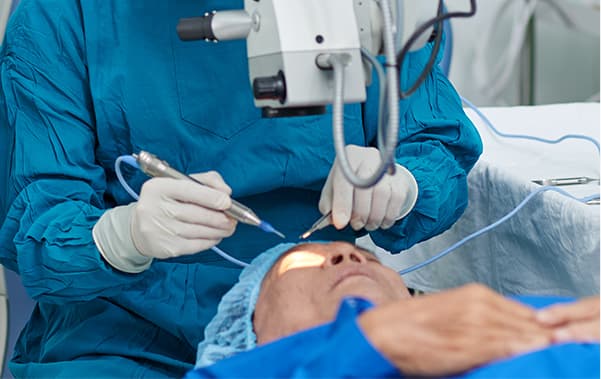
The operation on one eye is short. You go home the same day, and vision is often noticeably brighter that evening.
What takes time is everything around it. Four things set the length of your trip.
1. The exam day sets the lens — and the plan
The first day is the full exam. We measure eye length, corneal curvature, astigmatism, the corneal endothelium, the macula and the optic nerve.
Those numbers decide the lens power and whether a premium lens makes sense for you. They also decide whether surgery should happen now at all.
I don't operate on the exam day. A lens stays in your eye for life, so the choice deserves one night of sleep. Think of it like choosing glasses frames you'll never take off.
2. One eye or both changes everything
For one eye, the shape is simple: exam, surgery, next-day check, plus a buffer.
For both eyes, I do one eye first, confirm it is healing well, and then do the second. The second eye then needs its own next-day check. That gap between the eyes is what stretches the trip.
How long the gap is depends on how the first eye looks. I set it at the exam and confirm it at the first check.
3. The next-day check is the gate to the airport
The day after surgery, we look at the incision, the lens position and the eye pressure. This is when I tell you whether you're ready to fly.
That's why your flight must sit after the last next-day check, never before it.
4. Weekends and holidays move the calendar
We open Monday to Thursday 10:00–18:30, Friday until 21:00 and Saturday 10:00–14:00. Sundays and Korean public holidays are closed.
A Saturday surgery means the next-day check falls on a Sunday. So I plan surgeries for weekdays and use the weekend as rest days.
One eye: exam, surgery, next-day check and a buffer. Both eyes: add the gap between the eyes and a second next-day check. The exam sets both the lens and the calendar.
The bigger picture of how the surgery itself works is in my cataract surgery in Korea guide.
Why the surgeon who examines you should be the one who operates
The person who chooses your lens power has to be the person who read your measurements. A small error in those numbers shows up as glasses you didn't expect to need.
So at our clinic, the doctor who examines you is the doctor who operates, checks you the next day and clears you to fly. You are not handed between people.
Things you can verify, rather than take on trust: international patients pay exactly what Korean patients pay. We hold 4.8 stars from 154 reviews on Google. I'm a full member of the European Society of Cataract and Refractive Surgeons (ESCRS).
I list them so you have something to check, not to impress you.
So what does my week in Seoul actually look like?
Here is a typical shape. Your exam can change it, so treat this as a draft, not a booking.
| Day | One eye | Both eyes |
|---|---|---|
| Arrival | Rest, no appointments | Rest, no appointments |
| Day 1 | Full exam, lens consultation | Full exam, lens consultation |
| Day 2 | Surgery, home the same day | First eye surgery |
| Day 3 | Next-day check | Next-day check, first eye |
| Gap | Buffer day, then fly | Gap set at the exam, then second eye |
| After | — | Second next-day check, buffer, then fly |
The lens itself shapes the budget more than the stay. These are our published per-eye prices from the price page:
| Lens | Per eye |
|---|---|
| Monofocal IOL | ₩1,250,000 |
| Eyhance | ₩2,500,000 |
| LISA tri | ₩3,000,000 |
| FineVision / Intensity | ₩4,000,000 |
| Synergy | ₩7,000,000 |
The full exam is ₩150,000. Why one lens costs more than another is in cataract surgery cost in Korea, and the procedure page for cataract surgery covers the lens types.
Side effects, and when I'd tell you to wait
Cataract surgery is a long-established operation, but no surgery is free of risk.
- Grittiness, watering and mild haze in the first days are common and usually settle on their own.
- Infection and inflammation are uncommon, which is why the drops schedule matters after you fly.
- After-cataract: months or years later, the membrane behind the lens can haze over. A short laser treatment clears it.
- Night glare with multifocal lenses: some people notice it, and the brain needs time to adapt.
Some people I ask to wait. If the clouding is mild and isn't affecting daily life, there is no rush. If diabetes is uncontrolled, or the macula or optic nerve has other problems, we plan differently. Results and recovery vary from person to person.
Planning the trip: flights, hotel and medicines
- Book flexible tickets. A one- or two-day change is the most common adjustment.
- Arrive the day before the exam. A jet-lagged eye with a dry surface gives poorer measurements.
- Bring a medication list, especially blood thinners, diabetes medicines and prostate medicines.
- Stay close. We're one minute from Sinnonhyeon Station and about 70 minutes from Incheon Airport. Our partner hotel is O'Cloud Hotel in Seocho.
- Book your home check before you leave. The one-week, one-month and three-month checks can be done by your local ophthalmologist with the written record we give you.
The Korean head office keeps its pre- and post-operative precautions page — the same rules we hand to you in English.
If the patient is your mother or father, cataract surgery in Korea for parents covers what a companion should do on each day. For laser and ICL trips, the nights are different; that's in how long to stay in Korea for eye surgery.
Don't book the flight yet — book the exam
If you take one thing from this page: don't fix the return date first and squeeze your eyes into it.
It doesn't have to be our clinic. But choose a surgeon who will tell you how many days you really need, and who will say "not yet" if that's the honest answer.
Send us your age, whether one or both eyes are affected, any recent eye report and your travel window on WhatsApp. We'll sketch the days with you before you buy a ticket. If surgery isn't the right step yet, I'll tell you so.
I hope to see you in Seoul.
— Dr. Kim Sun-young, Medical Director, Healing Eye Clinic (Sinnonhyeon, Gangnam, Seoul)
Frequently asked questions
How long should I stay in Korea for cataract surgery on one eye?
Plan for the exam, the surgery and the next-day check as a minimum, then add a buffer day. The next-day check is the appointment that tells me the eye is settling well enough for you to fly, so your flight should never sit before it.
Can both eyes be done on the same trip?
Often, yes, but usually not on the same day. I operate on one eye, confirm it is healing well, and then schedule the second. That spacing is what makes a both-eye trip noticeably longer, and I set it after the exam, not before.
Can I have the exam and the surgery on the same day?
I don't plan cataract trips that way. The lens power comes from the biometry measured at the exam, and the lens choice deserves a night's thought. Exam on one day, surgery on a later day, is the safer shape.
When can I fly home after cataract surgery?
After the check that confirms the eye is settling — never on a fixed date booked in advance. For most people that is the next-day check after the last eye. Book tickets you can move by a day or two.
Does the clinic open on weekends?
We open on Saturday mornings from 10:00 to 14:00 and close on Sundays and Korean public holidays. Build your schedule so the exam and the surgery fall on weekdays where possible.
What does the exam cost, and how much is the surgery?
The full pre-op exam is ₩150,000. A monofocal lens is ₩1,250,000 per eye, and premium lenses are priced per eye by lens type. International patients pay exactly what Korean patients pay.
Message us on official LINE / WhatsApp for a special offer
Your exact candidacy and cost are confirmed in a free 1:1 consultation.