
Monofocal vs Multifocal IOL for Cataract: The Comparison Table I Draw for Every Patient
Monofocal vs multifocal IOL cataract choice, compared honestly by a Seoul surgeon: who each lens suits, who should avoid it, and the trade-offs.

Dr. Kim Sun-young, Director
Cornea · Glaucoma · Cataract
Contents
A patient from Vancouver sat down in my consulting room last spring, put a folded printout on the desk and said: "My surgeon at home offered me a standard lens covered by insurance, or a premium lens for extra. I don't understand what I'm actually buying." It's the most honest question in cataract surgery, and almost nobody asks it that plainly.
Monofocal vs multifocal IOL for cataract surgery is not a choice between a basic option and a better one — it is a choice about which compromise you are willing to live with, because every intraocular lens made today asks for something in return. Your natural lens is coming out either way; the only question is which artificial lens fills the space it leaves behind. Get that framing right and the rest of the decision becomes surprisingly straightforward.
What the lens choice actually decides — and what it doesn't
The surgery itself is the same operation. We remove the clouded natural lens and place an IOL in the capsule where it sat, in roughly 15–20 minutes per eye. The cataract is dealt with regardless of which lens you choose — that part is not up for negotiation, and it is why I tell patients that the surgical step and the lens step are two separate decisions that happen to occur in the same sitting. If you're still working out whether it's time to operate at all, that's a different question, and I walk through how I weigh it in my guide on when to have cataract surgery.
What the lens decides is the shape of your vision afterward: how many distances are usable without glasses, how crisp contrast is in dim light, and what headlights look like on a wet road at 9 p.m.
You are not choosing between a cheap lens and a good lens — you are choosing which trade-off you'd rather live with for the next few decades.
The comparison table I draw on paper in consultation
I physically draw this out for patients, because seeing four rows side by side does more than twenty minutes of talking. These are the realistic categories, not brand marketing.
| Option | Suits you if | What it asks of you | Don't choose it if |
|---|---|---|---|
| Monofocal (set for distance) | You drive at night often, want the cleanest contrast, or have any retinal/optic nerve concern | Readers for essentially all near work, and often for a laptop too | Freedom from glasses is your main reason for having premium surgery at all |
| Monofocal with blended vision (one eye distance, one slightly near) | You've tolerated monovision contact lenses before and want less reader dependence without multifocal optics | Slight loss of depth perception; some people never adapt | You've tried monovision contacts and disliked it, or your work depends on fine stereo depth |
| EDOF / extended-depth-of-focus (e.g. Eyhance) | You live at arm's length — screens, dashboards, cooking — and want low glare | Small print in dim light often still needs readers | You expect complete independence from reading glasses |
| Trifocal / multifocal (e.g. LISA tri, FineVision, Synergy) | You want distance, intermediate and near covered and accept an adaptation period | Halos and starbursts at night, reduced contrast for some; weeks to months of neuroadaptation | You drive for a living, do night photography, or have irregular corneas or macular disease |
How to read the trade-off column
A multifocal lens does not create light — it divides the light entering your eye between focal zones. That is a physical fact, not a brand weakness. Divided light means slightly less contrast at each focus and visible rings around point sources at night. A monofocal sends everything to one point, which is why it is often the crisper lens in exactly the conditions people complain about most.
Who should not choose a multifocal IOL
I say this plainly because too few articles do. In my practice I steer patients away from multifocal optics when there is:
- Macular disease or significant optic nerve damage. These eyes already have reduced contrast; splitting light makes that worse.
- Irregular astigmatism — from keratoconus, scarring, or older laser vision correction with an unpredictable corneal profile.
- An unstable tear film. Dry eye distorts both the pre-op measurements and the post-op image. If the tear film is bad, I treat it first and re-measure. I do not calculate lens power on unreliable data.
- Very large pupils in dim light, in some cases, which amplifies halo perception.
- A personality that cannot tolerate imperfection. This is not a joke. Neuroadaptation to a multifocal takes weeks to months, and patients who monitor every symptom daily have a harder time than those who get on with life.
If you fall into one of those groups, a multifocal is not "denied" to you — it is simply the wrong tool, and I'll tell you so at the exam rather than after the surgery.
Who should not simply default to a monofocal either
The opposite mistake is just as common, especially among patients who assume the covered option is the safe one. If your day is spent at a screen, a workbench, a music stand or a kitchen counter, a distance-only monofocal can leave you reaching for glasses more often than you expect — including for things you currently do without them. Some patients are genuinely dismayed to find that after "successful" surgery they cannot read their own phone.
And if you are in your late forties or fifties and presbyopia is already the thing bothering you, addressing both problems in a single operation is worth discussing seriously — I've set out how that works in our article on treating presbyopia and cataract together, and the full clinical detail lives on our presbyopia and cataract treatment page. Our Korean head office also keeps a comparison of the premium IOLs we implant if you want to see the model-by-model breakdown.
Night vision, halos and the honest adaptation curve
Here is what I tell patients to expect rather than hope for. In the first weeks after a multifocal implant, most people notice rings or spokes around headlights and streetlights. For many, this fades substantially over two to six months as the brain learns to suppress the out-of-focus image. For a minority, it does not fade enough to be comfortable, and we manage that — a YAG capsulotomy if the capsule has clouded, targeted glasses for night driving, or in rare cases a discussion about lens exchange, which is a second intraocular operation with its own risks and is never a casual undo button.
There is no lens on the market that is free of side effects, and any clinic telling you otherwise is selling, not advising. The realistic promise is a well-matched lens, honest expectations, and someone accountable to you afterward.
Ask your surgeon what the downside of their recommended lens is — if they can't name one specifically, keep asking.
What the choice does to your bill
Lens choice is the single biggest driver of cataract surgery cost, far more than the surgical technique. Our prices are per eye and are the same for international and Korean patients.
IOL pricing at Healing Eye (per eye)
Notice how wide that spread is, and that toric versions for astigmatism sometimes cost nothing extra. If you want the reasoning behind where each lens sits on that scale, I break it down in our guide to multifocal lens implant prices in Korea.
How we actually decide, in the exam room
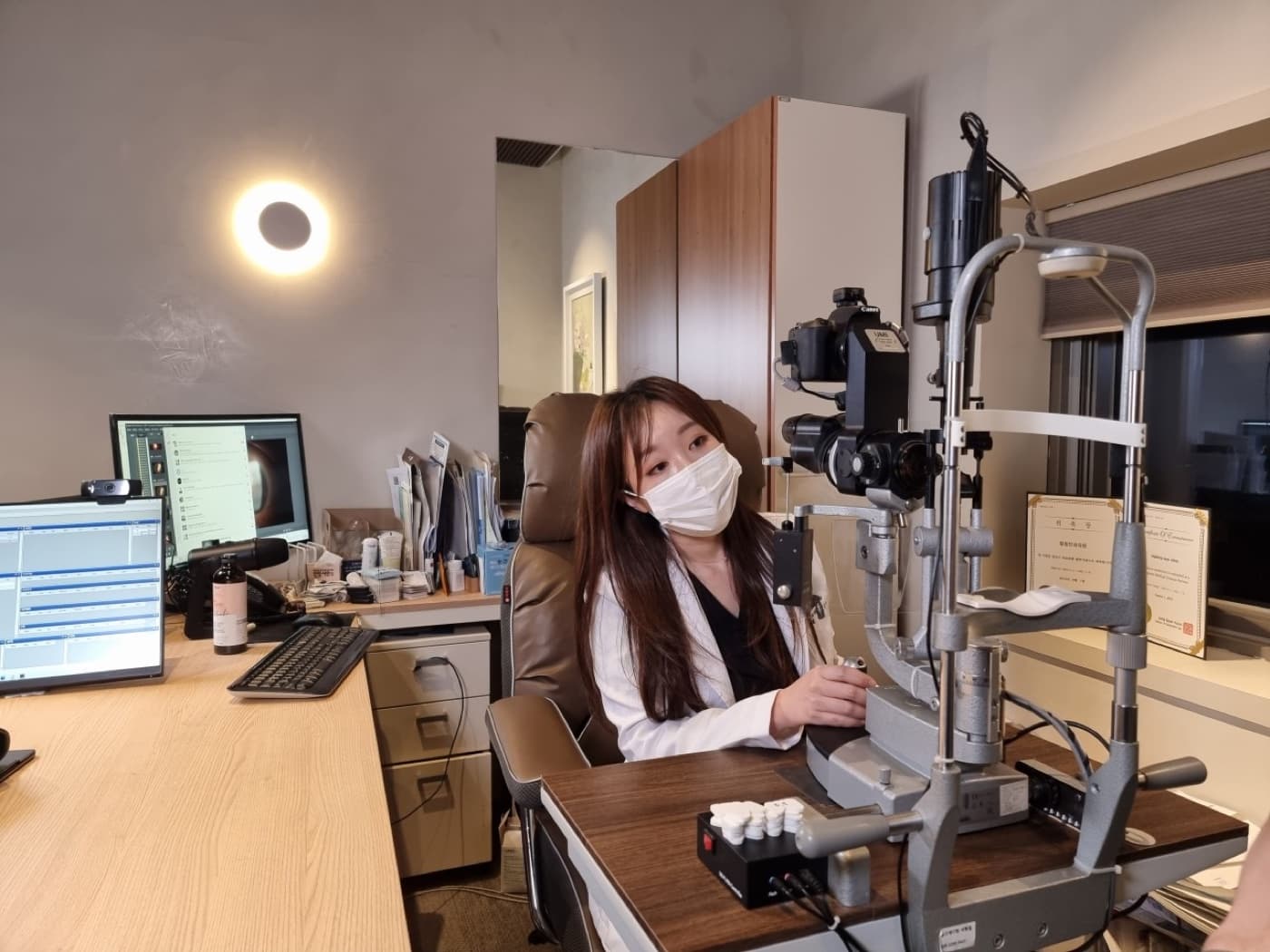
Biometry measures eye length and corneal curvature to calculate lens power. Topography reads astigmatism and whether it's regular. We check tear film, pupil size in dim light, and the health of the macula and optic nerve — because a premium lens in an eye with a compromised retina is money spent on a ceiling you cannot reach.
Then I ask questions the machines can't answer. What is the distance you look at most? How much do you drive after dark? Have you ever worn monovision contacts? The data narrows the field; your life picks the winner.
If you're flying in for this
We're about 70 minutes from Incheon Airport and one minute from Sinnonhyeon Station, and we build the exam, consultation, surgery and next-day check into one visit, with Japanese, Traditional Chinese and English interpreters on site. Vision fluctuates while the eye settles, so don't schedule a critical meeting the day after — our day-by-day cataract recovery timeline gives you a realistic picture for planning flights.
If you take one thing from this: the right lens is the one that matches the life you actually lead, not the one highest on a price list. Bring me your Tuesday, and I'll bring you the measurements — and if the honest answer is that a multifocal isn't for your eyes, I'll say so before we book anything.
— Dr. Kim Sun-young, Medical Director, Healing Eye Clinic
Frequently asked questions
Is a multifocal IOL always better than a monofocal one?
No, and I would be suspicious of any surgeon who says it is. A multifocal or trifocal lens reduces how often you reach for glasses, but it splits incoming light between focal zones, which can lower contrast and produce halos or starbursts around lights at night. A monofocal lens sends all the light to one focal point, which is why night driving and dim-light contrast are usually cleaner with it. Which lens is "better" depends entirely on the distances your day is built around and how much you drive after dark.
Can I switch lenses later if I don't like the result?
An IOL exchange is technically possible, but it is a second intraocular operation with its own risks, and the longer the lens has been in place the more the capsule has healed around it, which makes removal harder. I treat lens exchange as a rescue, not a plan B. That is why I spend so much time before surgery on the exam data and on your night-driving habits — the decision is far easier to make well than to undo. Most patients who are unhappy early adapt over weeks to months instead, with a YAG capsulotomy or a glasses tweak for specific tasks.
How many days should I stay in Seoul for cataract surgery?
We usually build the precision exam and consultation, surgery, and the next-day check into a single visit. Whether we do both eyes close together or space them a few days apart depends on your eyes, and I decide that after the measurements. Recovery is within days for most patients, though vision can fluctuate while the eye settles. Plan your flight home with some margin rather than booking the tightest possible schedule, and we stay in contact by LINE or WhatsApp after you leave.
Will I still need reading glasses with an EDOF lens?
Very possibly, for small print, and I say that openly. EDOF lenses stretch focus into a longer zone rather than creating separate near and far focal points, so intermediate distances — a laptop, a dashboard, a price tag — often come easily while fine print in poor light may still need readers. Patients who accept a pair of drugstore readers for menus but want clean, low-glare vision the rest of the time tend to be very content with EDOF. Patients who want to be free of readers entirely are usually better matched to a trifocal, if their eye anatomy allows it.
Does astigmatism change which IOL I can have?
It changes the version of the lens, not usually the category. Uncorrected corneal astigmatism blurs the image the IOL produces, and a multifocal lens is less forgiving of that blur than a monofocal, so a toric version is often the right answer. Corneal topography tells us how much astigmatism there is and, just as importantly, whether it is regular. Irregular astigmatism — from scarring, keratoconus or previous laser surgery — is one of the situations where I steer patients away from multifocal optics.
Do international patients pay a different price for premium lenses?
No. Our policy is the same price for all — international patients pay exactly what Korean patients pay, and the published per-eye figures on our price list are the figures on your quote. What genuinely moves the number is which lens goes in, whether you need a toric version, and whether both eyes are treated. If a quote you receive anywhere is vague about which specific IOL model it covers, ask for the model name before you compare prices.
Message us on official LINE / WhatsApp for a special offer
Your exact candidacy and cost are confirmed in a free 1:1 consultation.