ICL or LASIK? How I Decide, Eye by Eye, as Your Surgeon
I'm Dr. Kim. ICL or LASIK isn't a universal winner — it's about your cornea, your prescription and your dry eye. Here's how I actually decide for each patient.

Dr. Kim Sun-young, Director
Cornea · Glaucoma · Cataract
Contents
"Dr. Kim, just tell me straight — ICL or LASIK? Which one's better?"
I get asked to crown a winner constantly, and I understand why: you want a clean answer so you can stop researching. But if I'm honest with you — and honesty is the whole point of this article — there is no universal winner between ICL and LASIK. There's only what's right for your eyes.
So instead of declaring one the champion, let me show you how I actually decide in the exam room, patient by patient. By the end you'll understand which way your own eyes are likely to point — and why the final call still belongs to the exam.
First, what's really different between them
This isn't "two versions of the same surgery." They work in fundamentally different places.
- LASIK reshapes your cornea. A flap is lifted and a laser sculpts the tissue underneath to correct your prescription. It's permanent, fast to recover from, and superb within its range.
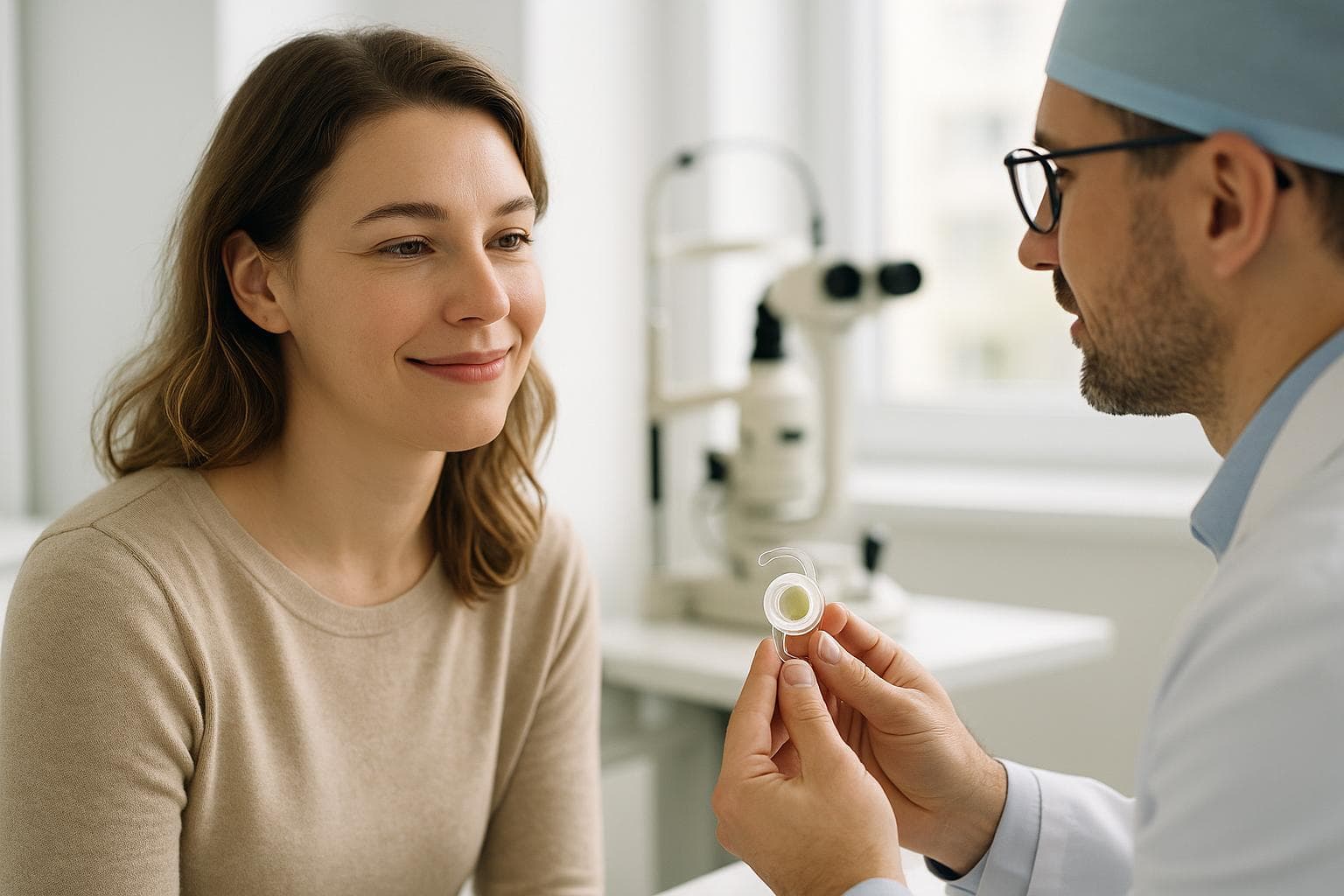
- ICL doesn't touch the corneal shape at all. We implant a thin lens inside the eye, in front of your natural lens. The cornea is preserved, and the lens can be removed or exchanged later — so it's reversible.
That single distinction — reshape the cornea versus add a lens inside the eye — is what makes one or the other right for different people.
LASIK changes your cornea; ICL leaves your cornea alone and adds a lens. Which is "better" depends entirely on which approach your eyes can safely support.
So let me split it by the person in my chair
If your cornea is thin
This is often the deciding factor. LASIK (and SMILE) work by removing corneal tissue, and if your cornea is already thin, you may not have enough to give up safely. In that case I lean toward ICL, because it preserves the cornea completely. We still confirm there's adequate space inside the eye for the lens — but a thin cornea is one of the clearest nudges toward ICL.
If you're highly myopic
The higher your prescription, the more corneal tissue a laser would need to remove. Past a certain point, that's simply more than I'm comfortable taking. For very high myopia, ICL is frequently the safer, more stable answer — it can correct prescriptions that would push a laser too far. Within its range, though, LASIK handles moderate myopia wonderfully. Your exact numbers decide where that line sits.
If you have dry eye
Flap-based LASIK can worsen dryness for a period, because creating the flap affects corneal nerves involved in tear signaling. If you already struggle with dry, tired eyes, that matters. ICL doesn't disturb those nerves the same way, so it can be gentler — and SMILE, another flapless laser option, is also worth weighing. But here's my caveat: if your dry eye is significant, I often want to treat the surface first and then decide, rather than rush either surgery.
If reversibility reassures you
Some patients simply feel calmer knowing the correction isn't permanent. Because the ICL can be removed or exchanged if your eyes change over the years, it offers that flexibility in a way LASIK can't. It's a genuine point in ICL's favor — just not, on its own, a reason to choose it.

Why I won't decide this online — and neither should you
Here's the honest limitation at the center of everything above: I can't responsibly tell you ICL or LASIK from a prescription number in a message. I need to measure your corneal thickness, map your topography, assess your tear film and pupil size, and — for ICL — check the space and pressure inside your eye. Only then does the answer become clear, and often it's clearer than you'd expect once the data is in front of us.
If any clinic promises you, before any exam, that you're "definitely an ICL candidate" or "definitely a LASIK candidate," please treat that with caution. That promise can't be kept from the internet.
The same price for everyone, and the same surgeon throughout
Two things I want you to know before you decide where to do this. First, at Healing Eye Clinic international patients pay 100% the same fee as Korean local patients — no foreigner mark-up, whichever procedure you end up choosing. Second, one dedicated surgeon stays with you from the first exam through surgery and aftercare; you won't be handed off to a new face at each visit. We sit at 4.8 stars on Google with 154+ reviews, and my background is cornea, glaucoma, and cataract — Catholic Medical Center training, a former Clinical Professorship in Cornea and Cataract at Uijeongbu St. Mary's, and ESCRS membership.
If you're travelling in: allow at least 3 days, 2 nights for the next-day check-up, know that we're a one-minute walk from Sinnonhyeon Station (about 70 minutes from Incheon Airport), and stop wearing contacts for some days before the exam — ask us the exact number so you don't fly over for nothing.
Let the exam decide — start with a free message
If this article gives you one thing, let it be this: stop trying to crown ICL or LASIK as the winner, and let your eyes tell us which one is yours. That's not a dodge — it's the most honest, and ultimately the safest, way to choose.
Message us first, for free, in English on our official WhatsApp or LINE — no appointment needed. Send your prescription, your age, any dry-eye or eye-surgery history, and the dates you're weighing up. We'll give you an honest sense of which way your eyes are likely to point, explain why, and once you're here, the exam settles it for certain. And if your eyes aren't ready for either procedure right now, we'll tell you that too — plainly, with no sales pressure.
I'll look forward to reading your eyes properly here in Seoul, and giving you a clear answer.
— Dr. Kim Sun-young, Medical Director, Healing Eye Clinic
Frequently asked questions
Is ICL or LASIK better overall?
Neither is universally better — that's the honest truth, and anyone who declares one the winner without seeing your eyes is overselling. LASIK reshapes the cornea; ICL implants a lens inside the eye. The right choice depends on your corneal thickness, your prescription, your dry-eye status, and your eye's internal anatomy. The exam decides, not a blog or a price.
If my cornea is thin, should I get ICL or LASIK?
A thin cornea usually points toward ICL, because LASIK and SMILE remove corneal tissue and a thin cornea may not have enough to spare safely. ICL preserves the cornea entirely. But we still need to confirm there's adequate space inside your eye for the lens, so it's a measured decision either way.
Which is better for high myopia, ICL or LASIK?
For very high prescriptions, ICL is often the safer and more stable choice, because correcting that much myopia with a laser can require more corneal tissue than is wise to remove. LASIK works beautifully within its range; beyond it, a lens is usually the better answer. Your exact numbers determine where that line falls for you.
I have dry eyes — does that change ICL vs LASIK?
It can. Flap-based LASIK can worsen dryness for a while; ICL doesn't touch the corneal nerves the same way, so it's sometimes gentler on already-dry eyes. SMILE is another flapless option worth weighing. We examine your tear film first, because dry eye is something we'd often want to settle before, not after, surgery.
Is ICL reversible and is LASIK permanent?
Yes — ICL is reversible because the lens can be removed or exchanged if your eyes change, while LASIK permanently reshapes the cornea. For some patients that reversibility is reassuring. It's one factor among several, not a reason to choose ICL on its own.
Message us on official LINE / WhatsApp for a special offer
Your exact candidacy and cost are confirmed in a free 1:1 consultation.