The ICL Surgery Procedure, Step by Step — From the Surgeon's Chair
I'm Dr. Kim. Patients fear the ICL surgery procedure because they can't picture it. So here is your day, minute by minute, exactly as it happens in my room.

Dr. Kim Sun-young, Director
Cornea · Glaucoma · Cataract
Contents
The fear I hear most about ICL isn't pain. It's the not-knowing. "Dr. Kim, I just can't picture what's actually happening to my eye." A teacher from Taiwan told me she'd watched three videos and somehow felt worse. So instead of medical abstractions, let me give you the thing that actually settles nerves: your day, in order, the way it unfolds in my room. This is the ICL surgery procedure with nothing skipped and nothing dramatized.
Before the day: the lens is already chosen
Here's something most people don't realize — the most important part of the ICL surgery procedure happens before you ever lie down. From your screening measurements (anterior chamber depth, white-to-white diameter, your exact prescription), I select the specific lens model, size, and power for your eye, and it's ordered in advance. So by the time you arrive, your lens already exists, made to your numbers. There's no guessing on the day.
ICL isn't carved on the day like laser surgery — your custom lens is chosen from your measurements beforehand and simply placed inside the eye.
In the days before, you'll stop wearing contact lenses for a window I'll specify (soft and hard lenses differ), because contacts subtly reshape the cornea and skew measurements. Eat normally, sleep well, and arrange for someone to travel back to your hotel with you afterward, since your vision will be hazy for the rest of that day.
Arrival and preparation
When you arrive, we begin with drops — several rounds of them. Some dilate the pupil, some are antibiotic, and some begin numbing the eye. This part is unglamorous and a little slow, and that's fine; it's the gentle on-ramp. Your blood pressure gets checked, the eye is cleaned, and you change into a gown. By the time we walk to the surgical room, the numbing drops have done their work and the eye feels heavy and distant, not painful.
Under the microscope: the implantation
You lie back, and a soft lid holder keeps you from needing to worry about blinking — one less thing for your mind to manage. The microscope light is bright, and for most patients the whole world dissolves into a warm, formless glow. You won't see instruments approaching.
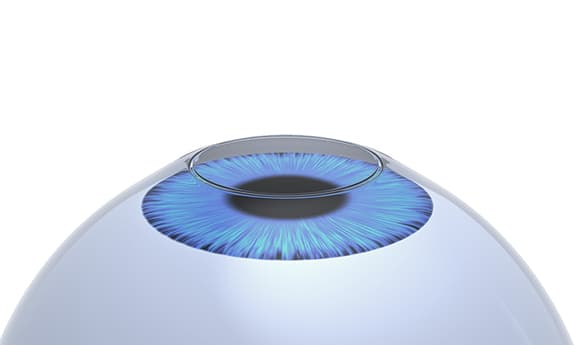
I make a tiny opening at the edge of the cornea — just a few millimeters, and self-sealing, so it usually needs no stitches. The folded ICL is loaded into a thin injector, and I gently slide it through that opening. Inside the eye, the lens unfolds on its own, slowly, like a flower opening. Then I tuck its four little corners into place behind the iris so it rests in front of your natural lens, perfectly centered. I check the position, rinse out the gel that protected the eye during insertion, and confirm the pressure is right.

That's the whole thing — roughly ten to fifteen minutes per eye. What you'll feel is pressure, a sensation of water, and shifting light, not the sharp pain people brace for. Then we do the second eye the same way in the same sitting.
The recovery room and the first hours
You sit up, and we move you to rest. Vision at this point is real but cloudy — like looking through a steamed-up window — because of the dilation and the drops. Some patients tear up or feel a mild grittiness; that's normal. We check your eye pressure again before you leave, because a brief pressure rise can happen early and I want to catch it, not assume it away.
You go back to your hotel to rest with your eyes closed for the afternoon. No screens, no reading, no sightseeing. Light sensitivity is strong on day one, so sunglasses help on the walk out. You'll wear a clear shield while sleeping for the first few nights so you can't rub the eye in your sleep.
The next morning: why you can't fly home today
This is the appointment I won't let anyone skip. The morning after, you come back and I examine the eye: I confirm the lens is sitting exactly where it should, recheck your pressure, and look for any early sign of inflammation. By now most patients are genuinely delighted — the haze has lifted and the clarity surprises them. But until I've seen the eye the next day, I can't responsibly clear you to travel. This is the single biggest reason I tell international patients to budget at least three days and two nights in Seoul.
The first week, honestly
Because there's no corneal flap and no surface wound the way LASEK leaves one, the first week is usually milder than people fear. Your job is mostly discipline with the eye drops — antibiotic and anti-inflammatory on a schedule — plus a few sensible rules: don't rub your eyes, skip swimming pools, saunas, and heavy workouts for about two weeks, and wear sunglasses outdoors. Most people return to office work within a day or two.
The honest limitation I always add: a small number of patients notice glare or halos around lights at night in the early months, especially with larger pupils. For most it fades as the eye adapts, but I'd rather you hear it from me now than discover it driving home from the airport. If your daily life depends heavily on night driving, tell me at the exam so we can weigh it properly.
What this all costs, and the same-price promise
People always ask the price right after the steps make sense. I won't print a won figure, because it depends on which lens model and power your eye requires and on the follow-up care included — and because international patients here pay exactly what Korean patients pay, with no foreigner surcharge. You get the exact number after your screening, free of charge.
If picturing the day has loosened the knot a little, good — that was the point. Message us first in English on WhatsApp or LINE with your prescription and the dates you're considering, and we'll plan the whole sequence with you before you ever board the plane.
— Dr. Kim Sun-young, Medical Director, Healing Eye Clinic
Frequently asked questions
How long does the actual ICL surgery take?
The implantation itself usually takes around ten to fifteen minutes per eye once you're positioned under the microscope. You'll spend much longer in the clinic that day — for drops, preparation, a rest afterward, and a check — but the part where I'm working inside the eye is short.
Will I be awake during ICL surgery? Does it hurt?
You're awake, but the eye is fully numbed with drops, so there's no sharp pain — most patients describe pressure or a sense of water and light rather than pain. You won't see the instruments coming at you; the bright microscope light blurs everything into a soft glow. We talk you through each step as it happens.
Do both eyes get done on the same day?
Usually yes, I operate on both eyes in the same session, one straight after the other. Doing them together means one recovery period and one trip for you. If there's a specific reason to stage them, I'll explain it at your exam.
When will I be able to see after ICL?
Many patients notice clearer vision within hours, though it's hazy and light-sensitive at first while drops wear off and the eye settles. Vision typically sharpens noticeably by the next morning, which is exactly why the next-day check-up matters and why you shouldn't fly home the same day.
What is the recovery like in the first week?
Gentler than people expect, because there's no corneal flap or surface wound like laser surgery. You'll use eye drops on a schedule, wear a shield while sleeping for a few nights, and avoid rubbing your eyes, swimming, and heavy workouts for a couple of weeks. Most people are back to desk work within a day or two.
Message us on official LINE / WhatsApp for a special offer
Your exact candidacy and cost are confirmed in a free 1:1 consultation.