ICL vs LASIK for High Myopia: Which Is Right for Strong Prescriptions?
A surgeon compares ICL vs LASIK for high myopia — by thin corneas, very high prescriptions, and dry eyes. No universal winner; the exam decides.

Dr. Kim Sun-young, Director
Cornea · Glaucoma · Cataract
Contents
If you've got a strong prescription, you've probably already run into the great debate: ICL vs LASIK for high myopia. And you've probably noticed the internet is happy to crown a winner. I won't, because in my clinic there isn't one. There's only the right answer for your eyes — and which way it falls depends almost entirely on three things I can't see until I measure them: how thick your cornea is, how strong your prescription is, and how your eyes handle dryness. Let me walk you through it the way I'd talk it over at the exam, person by person.
First, why high myopia changes the question
For a mild prescription, lots of options work, and the choice is comfortable. High myopia narrows the field, and here's the physics of why.
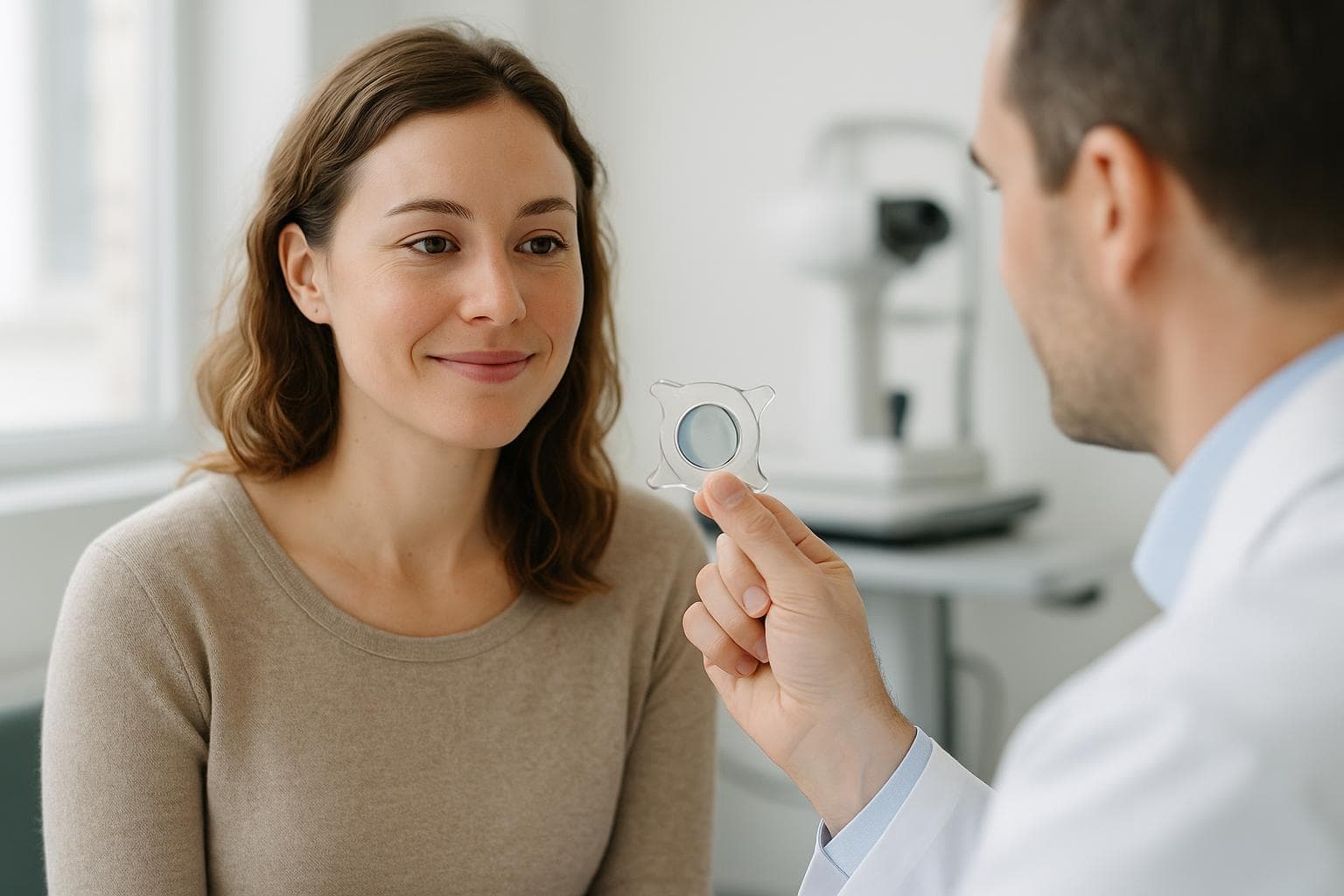
LASIK corrects vision by removing corneal tissue with a laser to reshape it. The stronger your prescription, the more tissue has to come off. ICL takes a completely different route: instead of reshaping the cornea, a thin collamer lens is placed inside the eye, in front of your natural lens, leaving the cornea fully intact. So as prescriptions climb, the tissue you have to spare becomes the deciding factor — and that's exactly where the comparison stops being abstract.
For high myopia, the real question isn't "which procedure is best?" — it's "does my cornea have enough tissue to spare for a strong LASIK correction, or should the cornea be left untouched with ICL?"
If your cornea is thin
This is the most common reason I steer a high-myopia patient toward ICL.
A strong LASIK correction needs a cornea thick enough to remove tissue safely and still leave a stable structure behind. If your corneal map shows you're already on the thinner side, a high correction can take you below the margin I'm comfortable with — and a structurally weakened cornea is not a trade I'll make for anyone, however much they want LASIK.
For these eyes, ICL is often the safer, more stable answer precisely because it never touches the cornea. The strong prescription gets corrected by the lens inside; the cornea stays exactly as it was. If "thin cornea" has come up in any previous consultation you've had, this is the branch you'll likely be looking at.
If your prescription is very high
Sometimes the cornea is fine, but the prescription itself is extreme.
There's a point where reshaping the cornea enough to correct the vision starts to compromise either safety or the quality of vision — particularly at night, where very large corrections can leave more glare and halos. ICL tends to hold up better at the high end of the prescription range, giving sharper, more stable vision without asking the cornea to do something near its limit.
That said — and this is important — a very high prescription does not automatically rule out LASIK. If your cornea is genuinely thick and healthy, LASIK can still deliver an excellent result. This is the branch where measurements matter most, because two people with identical prescriptions can land on opposite procedures.
If you struggle with dry eyes
Dryness is the third fork, and it's one people underestimate.
Reshaping the cornea in LASIK temporarily affects the surface nerves that drive your tear reflex, which can mean a stretch of dryness afterward — usually manageable, but more noticeable for someone who's already dry, wears contacts all day, or lives on screens. ICL, by leaving the corneal surface alone, tends to be gentler on those nerves. So if dry eye is already part of your daily life, it earns a real place in the ICL-vs-LASIK conversation — not as the only factor, but as one that can tip a close call.
I always check your tear film as part of the exam for exactly this reason. It's not a footnote; for the right person it's the deciding detail.

What ICL gives, and what LASIK gives
Stepping back, here's the honest character of each, without crowning a winner:
ICL leaves the cornea intact, tends to handle very high prescriptions and dryness gracefully, and is reversible — the lens can be removed or exchanged later, which matters for younger eyes that may still shift. Its trade-offs are that it's an intraocular procedure and sits at a higher price tier because of the lens itself.
LASIK, when your cornea allows it, is quick, has a famously fast recovery, and is beautifully predictable for suitable eyes. Its limit is simply tissue: it permanently reshapes the cornea, so it asks for enough to spare and can't be undone.
Neither is "better." One is right for your eyes; the exam tells us which.
Why we won't push you toward the pricier option
I should say this plainly, because high-myopia patients are sometimes nudged toward the more expensive procedure: we don't do that here.
At Healing Eye Clinic, international patients pay exactly the same as Korean locals for either ICL or LASIK — no foreigner mark-up, no tourist surcharge. And because of that, we have no financial reason to point you anywhere but where your eyes need to go. If your cornea is fine for LASIK, I'll tell you, even though ICL would cost you more. For context, we hold a 4.8-star Google rating across 154-plus reviews; my own field is cornea and cataract, with specialist training at the Catholic Medical Center, a clinical professorship in cornea and cataract at Uijeongbu St. Mary's, and ESCRS membership.
The exam is what actually decides
If you've read this far hoping I'd finally just declare a winner — I understand the impulse, but I'd be lying to you. For high myopia, the choice between ICL and LASIK genuinely comes down to measurements: corneal thickness, topography, your exact prescription, your tear film, and the internal anatomy of your eye. Two strong-prescription patients can leave my clinic with opposite plans, and both be exactly right.
So here's the useful next step. Message us on our official WhatsApp or LINE — no appointment needed, no pressure. Tell us your prescription, your age, whether you've ever been told your cornea is thin, and whether dry eyes trouble you. We'll reply in English, give you a realistic sense of which branch you're likely on, and confirm it properly with a full exam — telling you honestly if neither is right just yet. We're one minute from Sinnonhyeon Station in Gangnam, about 70 minutes from Incheon Airport, whenever you're ready.
I'd be glad to measure those eyes myself and give you a straight answer.
— Dr. Kim Sun-young, Medical Director, Healing Eye Clinic
Frequently asked questions
For high myopia, is ICL or LASIK better?
There's no universal winner — it depends on your specific eyes. As a rough guide, the higher your prescription and the thinner your cornea, the more ICL tends to make sense, because it doesn't remove corneal tissue. LASIK can still work well for high myopia if your cornea is thick enough to do it safely. The only honest answer comes from measurements: corneal thickness, topography, prescription, and the space inside your eye.
Why might LASIK not work for very high myopia?
LASIK corrects by removing corneal tissue, and a higher prescription removes more. If your cornea is already on the thinner side, a strong correction can leave too little tissue behind to be safe long-term. That's the main reason I steer some high-myopia patients toward ICL, which leaves the cornea untouched.
Is ICL reversible if my prescription changes?
Yes — that's one of its quiet advantages. The lens sits inside the eye and can be removed or exchanged by a surgeon if your needs change. LASIK permanently reshapes the cornea, so it can't be undone, though it can sometimes be enhanced. For a young, high-myopia patient whose eyes may still shift, that reversibility matters.
Do foreigners pay more for ICL or LASIK in Korea?
Not at Healing Eye Clinic. International patients pay exactly the same as Korean locals for either procedure — no foreigner mark-up, no tourist surcharge. We also won't push you toward the pricier option; the exam decides what your eyes actually need.
How do I find out which one I qualify for?
You can't settle this online, and you shouldn't decide on price. We measure corneal thickness, corneal topography, your prescription, pupil size, tear film, and the internal anatomy of your eye. Message us on WhatsApp or LINE to start, and we'll confirm the safe choice at a full exam.
Message us on official LINE / WhatsApp for a special offer
Your exact candidacy and cost are confirmed in a free 1:1 consultation.