Korea Clear LASIK Cost for Astigmatism? Reviews & Recovery
Korea Clear LASIK cost for astigmatism depends on the method your corneal map points to. A Seoul cornea specialist explains methods, reviews, recovery.

Medically reviewed byDr. Kim Sun-young, Director· Medical Director
Edited by: Dr. Kim Sun-young
Contents
Is the Korea Clear LASIK cost for astigmatism going to climb once a clinic sees the cylinder number on your prescription, and can you settle everything in one short trip to Seoul? Read this before you price flights. You'll know which method your astigmatism tends to point to, what actually moves the cost, which review claims hold up, and how recovery fits a short stay, so you can judge which option suits your eyes and your budget.
Hello, I'm Dr. Kim Sun-young, Medical Director at Healing Eye Clinic in Gangnam, and my specialty is the cornea, along with glaucoma and cataract. At Healing Eye, one dedicated doctor stays with you from the exam through surgery and aftercare, international patients pay exactly what Korean patients pay, and we hold interpreter consultations in English. Clear SMILE LASIK is the procedure most people mean when they search for Clear LASIK with us.
I'm writing this because people with astigmatism often assume one of two things: that it automatically means a pricier surgery, or that it rules out small-incision correction. Usually neither is what decides it. Your corneal map does.
Clear SMILE LASIK corrects nearsightedness together with astigmatism, and our price list shows it as one item for both eyes. What changes your own total is the method your exam points to, the detailed pre-op exam (charged separately), and how many days you spend in Seoul. Exact costs are confirmed in a 1:1 consultation after that exam.
If you'd like to start somewhere concrete, take a photo of your latest glasses prescription, the line showing the CYL and AXIS numbers, and send it on WhatsApp with one question: which method does this much astigmatism usually lead to?
How does Clear SMILE LASIK correct astigmatism?
The US National Eye Institute describes astigmatism as a curve problem: the cornea or lens is shaped more like a rugby ball than a basketball, so light focuses unevenly and things look blurry or stretched at every distance. On your prescription, CYL tells you how strong that unevenness is, and AXIS gives its direction in degrees.
In Clear SMILE LASIK, a femtosecond laser shapes a thin, lens-shaped piece of tissue called a lenticule inside the cornea, sized to your prescription. A small opening is made at the edge, the lenticule is taken out, and the corneal curvature changes. At Healing Eye this is done with the Ziemer FEMTO LDV Z8 laser, and every setting is based on your own pre-op exam data.
For astigmatism, the lenticule is shaped to remove more tissue along one direction than the other, which is why the axis matters as much as the amount. Many people's eyes rotate slightly when they lie down, so lining the treatment up with the true axis is a known point of care in small-incision surgery. A 2014 review of SMILE in the journal Eye and Vision describes the technique as treating myopia and myopic astigmatism through a small incision.
Which method fits your astigmatism?
I don't recommend a surgery for its own sake. I choose it with you, from your exam data and the way you live. With astigmatism, these are the four options on our menu that usually come up.
| Method | Tends to suit | What to weigh |
|---|---|---|
| Clear SMILE LASIK | Myopia or myopic astigmatism, stable for about a year; active jobs or sports; some existing dryness | Needs enough cornea and a regular corneal map |
| Personal Custom LASIK | Pronounced higher-order aberrations, frequent night driving, glare sensitivity | Needs a stable cornea thick enough for LASIK; not needed if aberrations are low |
| Perfect Healing LASEK | Thinner corneas, contact sports, physically demanding jobs | The first few days are usually more uncomfortable, and recovery is slower |
| Toric ICL | Very high myopia with astigmatism, or a cornea too thin for laser | A lens placed inside the eye, so it carries the rare risks of intraocular surgery |
The first thing I look at isn't the prescription. It's the corneal topography map. Regular astigmatism shows up as a fairly symmetrical bow-tie pattern, and laser correction is designed for that. Steepening toward the bottom of the cornea, or a lopsided bow-tie, can be an early sign of keratoconus, and then LASEK or ICL may be the safer conversation, or waiting if it is progressing. If Clear SMILE isn't right for your eyes, I'll say so clearly and explain the alternatives.
If your cylinder is large, comparing options for high astigmatism goes deeper into each one, and if the procedure names confuse you, what each Clear SMILE LASIK name means sorts them out.
What decides the Korea Clear LASIK cost for astigmatism?
Five things move the figure for someone with astigmatism, and only some of them have to do with the astigmatism itself.
First, the method. Clear SMILE, Custom LASIK, LASEK and toric ICL are separate items on our price list, so the method your corneal map points to matters more than the cylinder number alone. Second, the detailed pre-op exam, which is charged separately from surgery. Third, extras: our Premium LASIK and LASEK package bundles corneal cross-linking, autologous serum and SCOUT, and whether anything like that applies to you is a medical question for the exam rather than a menu choice.
Fourth, your age. If you're past your early forties and reading has started to need arm's length, our list has a separate presbyopic Clear SMILE option, and choosing between that and standard correction changes the total. Fifth, the trip itself: nights in Seoul, flights and meals. We have a partner hotel, O'Cloud Hotel in Seocho-gu, if you'd rather not search for one.
One thing doesn't change. Every price on the list on our English homepage applies equally to Korean and international patients. For how quotes are put together, see how to compare SMILE LASIK quotes in Korea and what a LASIK quote in Korea includes and leaves out. For your own figure, ask on WhatsApp what Clear SMILE, or the alternative your eyes may need, would cost for your case.
What do reviews say about Clear LASIK for astigmatism?
Forum threads about astigmatism and small-incision surgery tend to repeat three claims. Here is how they hold up medically.
'SMILE-type surgery can't treat astigmatism.' For nearsighted astigmatism this isn't accurate; correcting it is part of what Clear SMILE is used for. The claim has a point for farsighted or mixed astigmatism, which usually falls outside Clear SMILE's range, so other methods come into the conversation.
'You're back to normal the next day.' Close, with a caveat. Most people are back to daily life within one to two days after Clear SMILE, but vision often keeps sharpening over the following weeks, and long screen sessions can feel dry and tiring at first.
'Astigmatism comes back.' Partly true for some people. A small amount of residual astigmatism, or slight drift during healing, can happen, which is one reason a prescription that has been stable for about a year matters before surgery. If it does happen, a second treatment is sometimes possible, and we run a dedicated LASIK and LASEK revision center.
A worked example: astigmatism in your mid-forties
Say you're 46, living in Vancouver, with -2.75 and -1.50 of astigmatism in both eyes. You've worn glasses for 25 years, and lately you hold restaurant menus a little farther away.
Here is how I'd reason. Has your prescription been stable for about a year? Is the astigmatism regular on the topography map, and is there enough corneal thickness for a small-incision procedure? If those answers are yes, Clear SMILE is a reasonable conversation for your astigmatism.
The part people in their forties don't expect is reading. The American Academy of Ophthalmology explains that presbyopia, the age-related loss of near focus, usually starts to show in the early to mid-forties. Laser correction doesn't stop that process. If I fully correct your distance vision, you may reach for reading glasses sooner, so we'd talk about whether the presbyopic Clear SMILE option fits how you read, work and drive. If the map showed irregular steepening or a thin cornea instead, I'd set Clear SMILE aside and talk about LASEK or toric ICL, or about waiting.
How long is recovery, and how many days in Seoul?
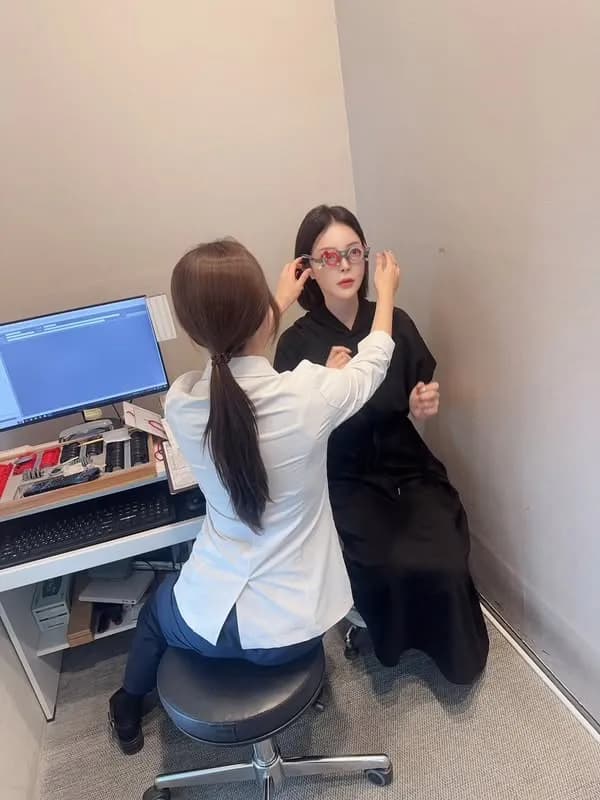
The surgery itself takes about 10 minutes for both eyes. The detailed exam before it is around 20 tests, and afterward your surgeon goes through the results and the plan with you, with an interpreter. When the results allow it, the exam is in the morning, surgery in the afternoon and a check-up the next day, so the shortest plan is two days. For a less rushed trip we suggest two to three days, and your exact schedule is confirmed in consultation.
That first evening, expect watery, scratchy eyes and hazy vision. For many people, vision is clearer by the next morning and keeps improving over the following days.
Plan around the clinic's hours: Monday to Thursday 10:00 to 18:30, Friday until 21:00, Saturday 10:00 to 14:00, lunch from 13:00 to 14:00, and closed on Sundays and public holidays. Keep the next-day check off a Sunday or holiday. The clinic is a one-minute walk from Sinnonhyeon Station. How many days to leave your contact lenses out before the exam, and when you can fly, are both confirmed in consultation.
If a family member back home reads Korean, our Korean-language Clear SMILE LASIK page covers the same procedure for them.
Who should wait, and what can go wrong?
Risks and side effects to know
Common and temporary: dry, gritty eyes and glare or halos around lights at night are common in the first weeks, and vision can fluctuate while the cornea settles. For most people these ease over weeks to a few months.
Specific to astigmatism: the correction can land slightly under or over target, or a little residual astigmatism can remain. If it still bothers you once healing is complete, an enhancement may be possible; after small-incision surgery this is commonly done as a surface treatment. Rare but serious: infection or significant inflammation, which need prompt treatment.
Who should wait or choose differently: the US Food and Drug Administration lists situations where laser vision correction may not suit you, including a prescription that is still changing, pregnancy or breastfeeding, and some conditions that affect healing. For Clear SMILE, I'd steer you toward LASEK or ICL if your cornea is thin or the topography shows irregularity or signs of keratoconus, toward an implantable lens if your myopia is very high, and toward treating severe dry eye first.
If something feels wrong after you fly home, such as sudden pain, redness that gets worse instead of better, or a drop in vision, see a local ophthalmologist the same day and bring your surgery records. Before booking, ask what our lifetime surgery responsibility program covers in your case, so you know your follow-up path. Healing differs from person to person, which is why the exam matters more to me than any review.
What to send before you book
If you have a corneal topography printout or a recent eye-exam report, send a photo of it with the dates you could travel, and ask one thing: for my astigmatism, which method should I plan for, and what would it cost? When you come to Seoul, I'll examine your eyes, go through the results with you and an interpreter, and recommend the method that fits your eyes and your life.
Frequently asked questions
Do international patients pay more for Clear SMILE LASIK?
No. All prices apply equally to Korean and international patients. Exact costs are confirmed in a 1:1 consultation after the detailed exam.
Is the pre-op exam included in the surgery price?
The detailed pre-op exam is charged separately. It is around 20 tests, and afterward your surgeon explains the results and the plan with an interpreter.
Can Clear SMILE correct farsighted astigmatism?
Clear SMILE is used for nearsightedness and nearsighted astigmatism. If your astigmatism is farsighted or mixed, other methods are discussed after your exam.
Do I need to stop wearing contact lenses before the exam?
Usually yes, because lenses, especially rigid ones, can temporarily change the shape of the cornea and distort the astigmatism reading. How many days depends on your lens type and is confirmed in consultation.
Does Clear SMILE LASIK hurt?
Numbing drops are used, so most people feel pressure rather than pain during the roughly 10 minutes the surgery takes for both eyes. Scratchiness and watering are common that first evening.
Will my astigmatism stay corrected after surgery?
For most people the correction stays stable once healing is complete, though small changes can occur and the eye keeps aging. If vision drifts, a second treatment is sometimes possible, and Healing Eye runs a dedicated LASIK and LASEK revision center.
Message us on official LINE / WhatsApp for a special offer
Your exact candidacy and cost are confirmed in a free 1:1 consultation.