LASIK in Korea vs US: What Actually Differs, Honestly
LASIK in Korea vs US: a Seoul surgeon compares what is the same, what really differs, what the US does better, and how to frame the total trip cost.

Dr. Kim Sun-young, Director
Cornea · Glaucoma · Cataract
Contents
I'm Dr. Kim Sun-young, medical director of Healing Eye Clinic in Sinnonhyeon, Gangnam, Seoul. I was a clinical professor of cornea and cataract surgery at a university hospital, and I now see international patients every week, with an English interpreter in the room.
American patients often open the conversation the same way: "Dr. Kim, is it actually worth flying to Korea, or am I just chasing a cheaper price?"
If you're searching lasik in korea vs us, that's probably your question too. It's a fair one, and I'd rather answer it straight than sell you a plane ticket.
So here is my honest starting point: the surgery itself is not what differs most between Korea and the US — the system around it is. I'll go through what's the same, what really changes, and where the US simply wins.
LASIK in Korea vs US: what is actually different?
Most comparisons online argue about lasers. That's the wrong place to look.
1. The technology is largely the same
The main laser platforms and the EVO ICL lens are made by international manufacturers and used in both countries.
Think of it like a commercial airliner: the same aircraft model flies for many airlines. What changes your experience is the crew, not the plane. In eye surgery, the crew is the exam and the surgeon reading it.
2. The price structure is different
In Korea, clinics usually publish one price per procedure for both eyes, and competition in Seoul is dense. Our list is public, and international patients pay exactly what Korean patients pay.
I won't quote American prices here, because I'd only be repeating numbers I can't verify for your city. Compare the written quote you get at home with ours, line by line: exam, surgery, drops, follow-up visits.
3. Exam to surgery is faster
In Seoul, the full exam, the decision and the surgery can happen within a few days. That speed is why the trip is practical at all.
It also carries a risk: speed is only good if the exam is not rushed. If a clinic decides before the exam is finished, slow down, wherever you are.
4. One surgeon from start to finish — if you choose that
At our clinic, the doctor who examines you is the doctor who operates and the doctor who sees you the next day. Many patients tell me that at home they met a coordinator first and the surgeon only on surgery day.
Both systems exist in both countries. Ask the question directly, wherever you book.
Korea vs the US is not "better lasers vs worse lasers." It's price structure, speed, and who stays with you — and the US has real advantages of its own, covered below.
If you want the full picture of how candidacy is decided before any of this matters, start with my LASIK in Korea surgeon guide.
Why I want the examining surgeon to be the operating surgeon
This is the principle I don't bend.
The person who decides how much cornea can be treated has to be the person who studied your corneal map. So here, you are never handed between doctors — exam, surgery and next-day check are the same person.
A few things you can verify yourself, not as boasting but as evidence. We hold 4.8 stars from 154 Google reviews. I'm a full member of the European Society of Cataract and Refractive Surgeons (ESCRS). My background is on the Korean site's doctor introduction page.
So should I have LASIK at home or in Seoul?
Here's how I'd frame it if you were my own family.
| Factor | Korea | US |
|---|---|---|
| Equipment | International platforms | International platforms |
| Price | Published per procedure, same for everyone | Varies by city and clinic |
| Exam → surgery | Usually within days | Often spread over weeks |
| Follow-up | Local doctor at home, with our record | Same clinic, any time |
| Enhancement later | Another trip | Short drive |
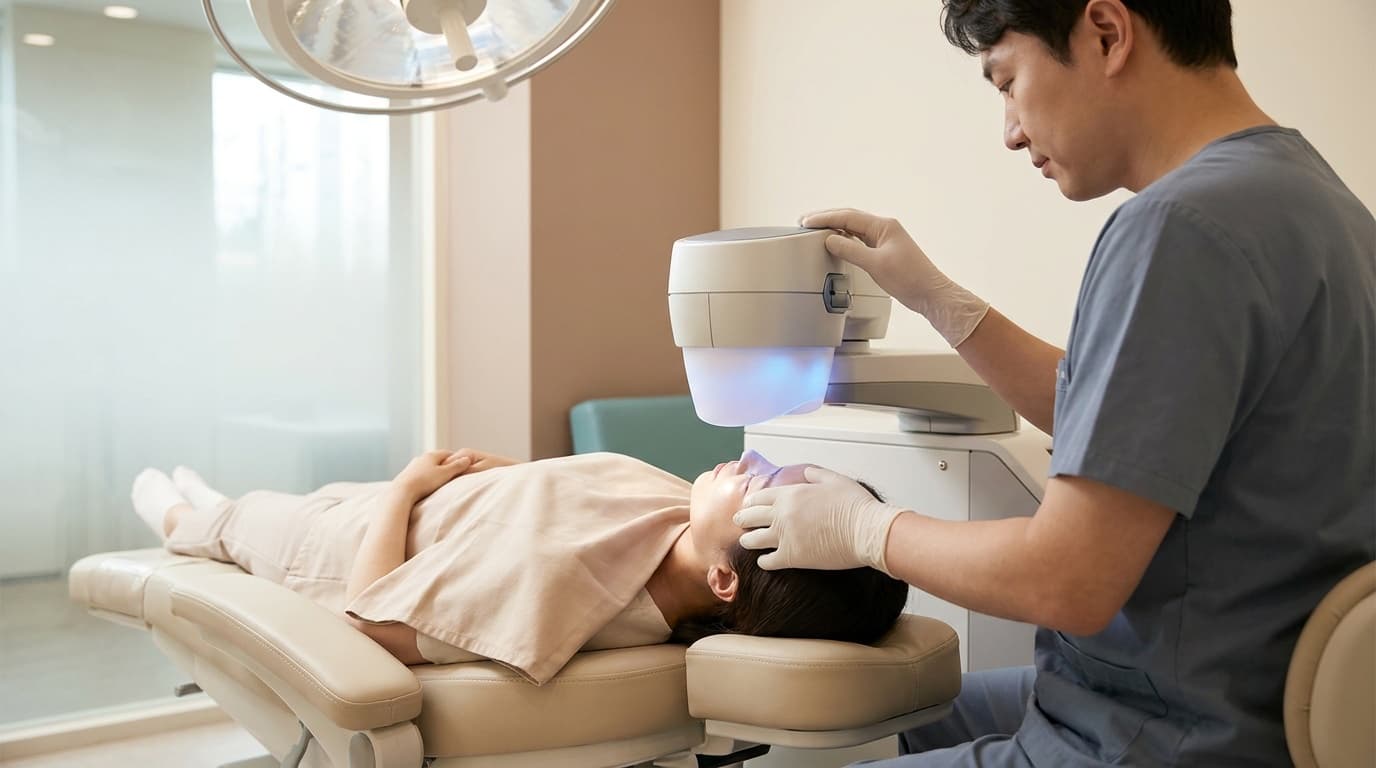
What the trip actually costs. Our published prices: full exam ₩150,000; Premium LASIK or LASEK ₩1,990,000 (both eyes); Clear LASIK ₩2,700,000 (both eyes); EVO ICL ₩5,500,000 (both eyes). Everything is on our price page.
To compare honestly, add your flight, at least three to four nights of hotel, meals, and the cost of three check-ups back home. Then compare that total with your US quote. If the gap is small, stay home — the convenience is worth it.
How Korea compares with other destinations is in LASIK in Korea vs Singapore and Korea vs Japan LASIK quality. Why so many clinics exist here in the first place is in is LASIK common in Korea.
Side effects, and who I tell to stay home
Laser surgery is the same surgery in either country, with the same possible side effects.
- Dryness for weeks to months, managed with drops.
- Night glare and halos, usually easing as the eye heals.
- Regression or residual prescription, which may need an enhancement later.
I'd tell you to have it at home if your cornea is borderline, if you have untreated dry eye, if you can't stay at least three nights, or if you already know you'll want the same surgeon nearby for years. Results and recovery vary from person to person.
Planning the trip from the US
- Three nights minimum, four recommended for LASIK or SMILE; about a week for LASEK.
- Stop contact lenses first: at least one week for soft lenses, longer for rigid ones.
- Book a flight you can change — the exam can change the plan.
- We're one minute from Sinnonhyeon Station, about 70 minutes from Incheon Airport.
- Find a local eye doctor at home for the one-week, one-month and three-month checks before you fly.
Don't decide on the country yet — decide on the exam
The real question isn't Korea or the US. It's: who will examine your eyes properly, and who will be there afterwards?
If a US clinic answers that well and the cost gap is small, I'd honestly tell you to stay home. If you'd like a second view, send us your prescription, age and travel window on WhatsApp — and if surgery doesn't suit your eyes, I'll say so plainly.
I hope this helps you choose with a clear head.
— Dr. Kim Sun-young, Medical Director, Healing Eye Clinic (Sinnonhyeon, Gangnam, Seoul)
Frequently asked questions
Is LASIK in Korea better than in the US?
Not as a rule. The lasers, lenses and techniques are largely the same in both countries; what differs is price structure, how quickly you go from exam to surgery, and whether one surgeon follows you throughout. The better place is the one where your exam is thorough and your follow-up is realistic.
How much does LASIK cost in Korea?
At our clinic, Premium LASIK or LASEK is ₩1,990,000 for both eyes and Clear LASIK is ₩2,700,000 for both eyes, after a ₩150,000 full exam. International patients pay the same price as Korean patients. SMILE is quoted after the exam.
Do Korean clinics use the same lasers as American clinics?
Largely, yes. The main laser platforms and the EVO ICL lens are made by international manufacturers and used in both countries. The equipment is rarely the deciding difference; the exam and the surgeon's judgment are.
What does the US do better than Korea for LASIK?
Convenience and continuity. There is no long flight, you can return to the same surgeon for every check, and an enhancement later is a short drive instead of another trip. If those matter most to you, having LASIK at home is a reasonable choice.
How many days do I need in Korea for LASIK?
At least three nights: the exam, the surgery and the next-day check. I recommend a fourth night as a buffer. LASEK needs about a week, and ICL may need one or two extra days if the lens has to be ordered.
Who checks my eyes after I fly home to the US?
A local eye doctor does the one-week, one-month and three-month checks. We give you a written record of the procedure, prescription, amount of tissue treated, corneal thickness and your drops, so they can read your case properly.
Message us on official LINE / WhatsApp for a special offer
Your exact candidacy and cost are confirmed in a free 1:1 consultation.