SMILE LASIK Korea Reddit Questions, Answered by a Surgeon
The SMILE LASIK Korea Reddit questions that keep coming up — price, clinic choice, pain, recovery, was it worth it — answered by a Seoul eye surgeon.

Dr. Kim Sun-young, Director
Cornea · Glaucoma · Cataract
Contents
I'm Dr. Kim Sun-young, medical director of Healing Eye Clinic in Sinnonhyeon, Gangnam, Seoul. I was a clinical professor of cornea and cataract surgery at a university hospital, and I now see international patients every week with an English interpreter in the room.
Many people who message us have clearly spent nights reading forums first. The question usually arrives as: "Dr. Kim, I've read a dozen threads. Can you tell me what's actually true?"
If you're searching smile lasik korea reddit, you're doing sensible homework. I understand — a stranger's honest story often feels more trustworthy than a clinic's website.
So let me be honest in return: forum threads are good at telling you what the trip felt like, and poor at telling you whether SMILE suits your eye. Below are the questions those threads keep circling, answered the way I answer them in clinic. I won't quote anyone; I'll just describe what people commonly ask.
The SMILE LASIK Korea Reddit questions, one by one
When I read through these discussions, the same five questions come up again and again.
1. "Why are the price quotes all different?"
Because SMILE price depends on your prescription, astigmatism and corneal measurements — and on what the quote includes. One person's number may cover the exam and drops; another's may not.
Comparing quotes without the breakdown is like comparing hotel prices without knowing if breakfast is in. Ask every clinic for the same line items before comparing anything.
2. "Which clinic should I pick?"
Threads tend to rank clinics by how popular they are. Popularity tells you a clinic is busy, not that your exam will be thorough.
Ask instead: Who reads my corneal map? Is that the person who operates? Who sees me the next day? A clinic that answers clearly is worth more than a clinic with the most mentions.
3. "Does it hurt?"
Numbing drops are used, and most people describe pressure more than pain during the procedure. Afterwards, a few hours of tearing, grittiness and blur are common.
Pain is personal, so I won't promise how it will feel for you. What I can tell you is that nobody is rushed on the table.
4. "How fast will I see?"
Most people manage daily life and light work the next day. Sharpness keeps settling over one to four weeks.
Posts saying "perfect the next morning" and "blurry for a week" can both be true. Two corneas heal at two speeds.
5. "Was it worth it?"
The happy posts are real, and so are the disappointed ones. When I read the disappointed ones closely, the common thread is usually a procedure chosen before the eye was fully measured.
Use forum threads for logistics — hotels, timing, what the clinic visit felt like. Use your own exam for the medical decision. One person's eye is not your eye.
A broader look at how to read patient threads about Korean eye surgery is in getting LASIK in Korea on Reddit.
Why I won't decide your surgery from a thread
The principle is simple.
The person deciding how much tissue SMILE can remove must be the person who studied your corneal data. So here, the doctor who examines you is the doctor who operates and the doctor who checks you the next day.
What you can check for yourself, offered as evidence rather than boasting: 4.8 stars from 154 Google reviews, the same prices for international and Korean patients, and my full membership of ESCRS, the European Society of Cataract and Refractive Surgeons.
So is SMILE the right choice, or just the one people talk about?
A rough guide. The exam gives the real answer.
| If this is you | Usually consider |
|---|---|
| Moderate myopia, thick enough cornea | SMILE |
| Very high myopia or thin cornea | ICL |
| Farsighted or early presbyopia | LASIK / LASEK |
| Untreated dry eye | Treat the surface first |
What goes into a SMILE quote
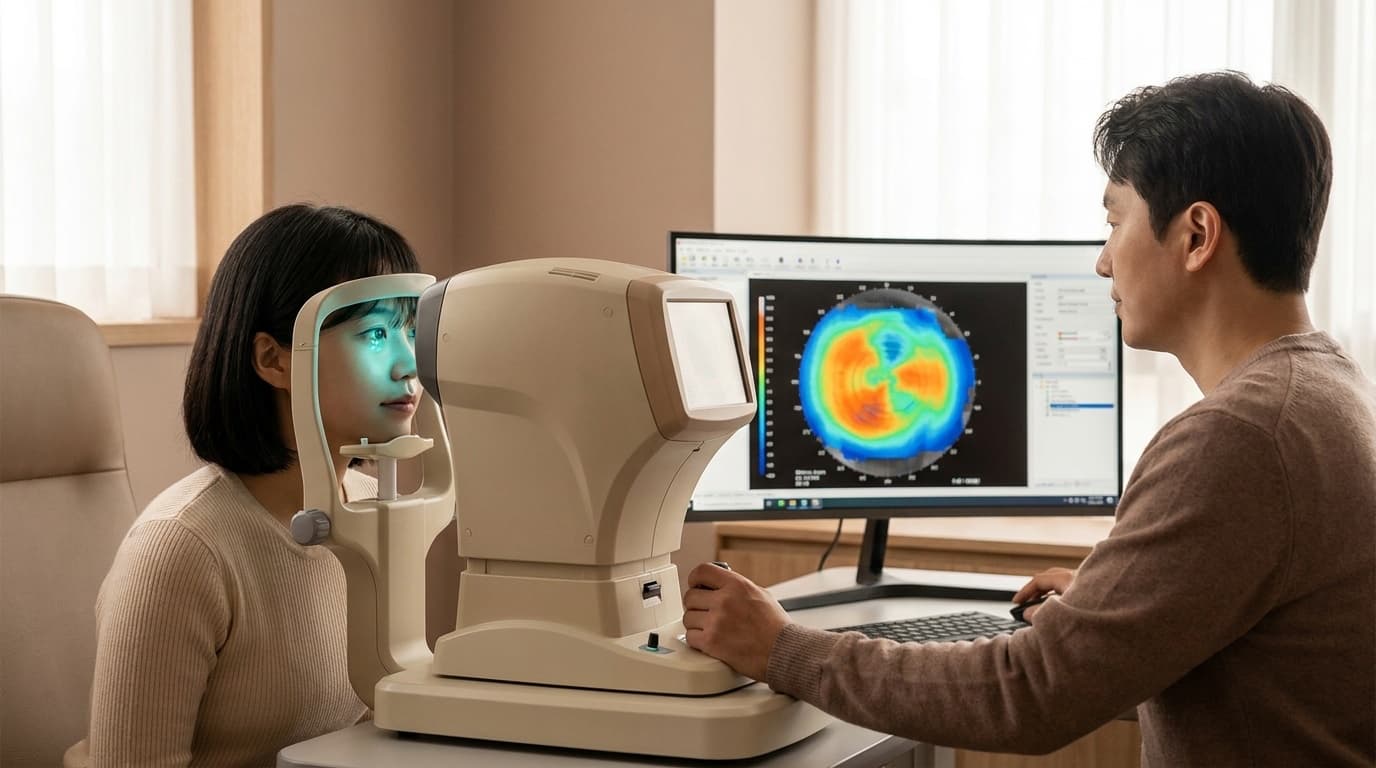
We don't publish a single SMILE figure; we give it after the exam. It depends on your prescription and astigmatism, your corneal thickness and map, and what's included (drops, follow-up visits, the written record for your doctor at home). As a range it usually sits above standard LASIK and below ICL. The full exam is ₩150,000, listed on our price page.
How SMILE and LASIK differ for someone flying in is in SMILE vs LASIK in Korea, and the safety question people ask most is answered in is SMILE safer than LASIK. My full walkthrough is the SMILE LASIK Korea surgeon guide.
Side effects the happy threads leave out
- Temporary dryness — often milder than after flap-based LASIK, but real.
- Night glare and halos, more likely with large pupils, usually easing as the eye heals.
- Residual prescription, and enhancements after SMILE work differently from LASIK touch-ups.
I don't recommend SMILE for very high prescriptions, thin corneas, signs of keratoconus, untreated dry eye or a prescription that's still changing. Results and recovery vary from person to person. The Korean site's pre- and post-op precautions page lists what we ask of every patient.
Practical notes forum readers ask about
- At least three nights (exam, surgery, next-day check); four recommended.
- Stop soft contacts at least a week before the exam, rigid lenses longer.
- We're one minute from Sinnonhyeon Station, about 70 minutes from Incheon Airport.
- No swimming, sauna or eye makeup for about a week.
- After you fly home, the one-week, one-month and three-month checks can be done locally with our written record.
Read the threads — then book the exam, not the surgery
Forum stories are honest about one experience each. Your decision needs your own measurements.
It doesn't have to be our clinic. Just choose one where the surgeon reading your map is the one who operates. If you'd like, send us your prescription, age and travel window on WhatsApp — and if SMILE isn't right for you, I'll tell you plainly and explain what is.
I hope your own story ends up being a calm one.
— Dr. Kim Sun-young, Medical Director, Healing Eye Clinic (Sinnonhyeon, Gangnam, Seoul)
Frequently asked questions
Are Reddit reviews of SMILE in Korea reliable?
They are useful for logistics and atmosphere, not for deciding whether SMILE suits your eye. Each post describes one cornea, one prescription and one clinic visit; your corneal thickness and map can point to a different answer entirely.
How much does SMILE cost in Korea?
We quote SMILE after the exam, because the figure depends on your prescription, astigmatism and corneal measurements. As a range it usually sits above standard LASIK and below ICL. The full exam is ₩150,000, and international patients pay the same price as Korean patients.
Does SMILE hurt?
Most people describe pressure rather than pain during the procedure, because numbing drops are used. Afterwards, tearing, grittiness and slight blur for a few hours are common; how it feels varies from person to person.
How fast is recovery after SMILE?
Most people manage daily life and light work the next day, and visual quality settles over one to four weeks. Avoid swimming, saunas and eye makeup for about a week.
How long should I stay in Korea for SMILE?
At least three nights — exam, surgery and next-day check — and I recommend a fourth as a buffer. Keep your flight changeable, because the exam can change the plan.
Why did someone online get SMILE while I was told LASEK or ICL?
Because the decision follows the measurements, not the forum. Thin corneas, very high prescriptions, farsightedness or an unstable tear film can all point away from SMILE, even for someone with a similar prescription number.
Message us on official LINE / WhatsApp for a special offer
Your exact candidacy and cost are confirmed in a free 1:1 consultation.