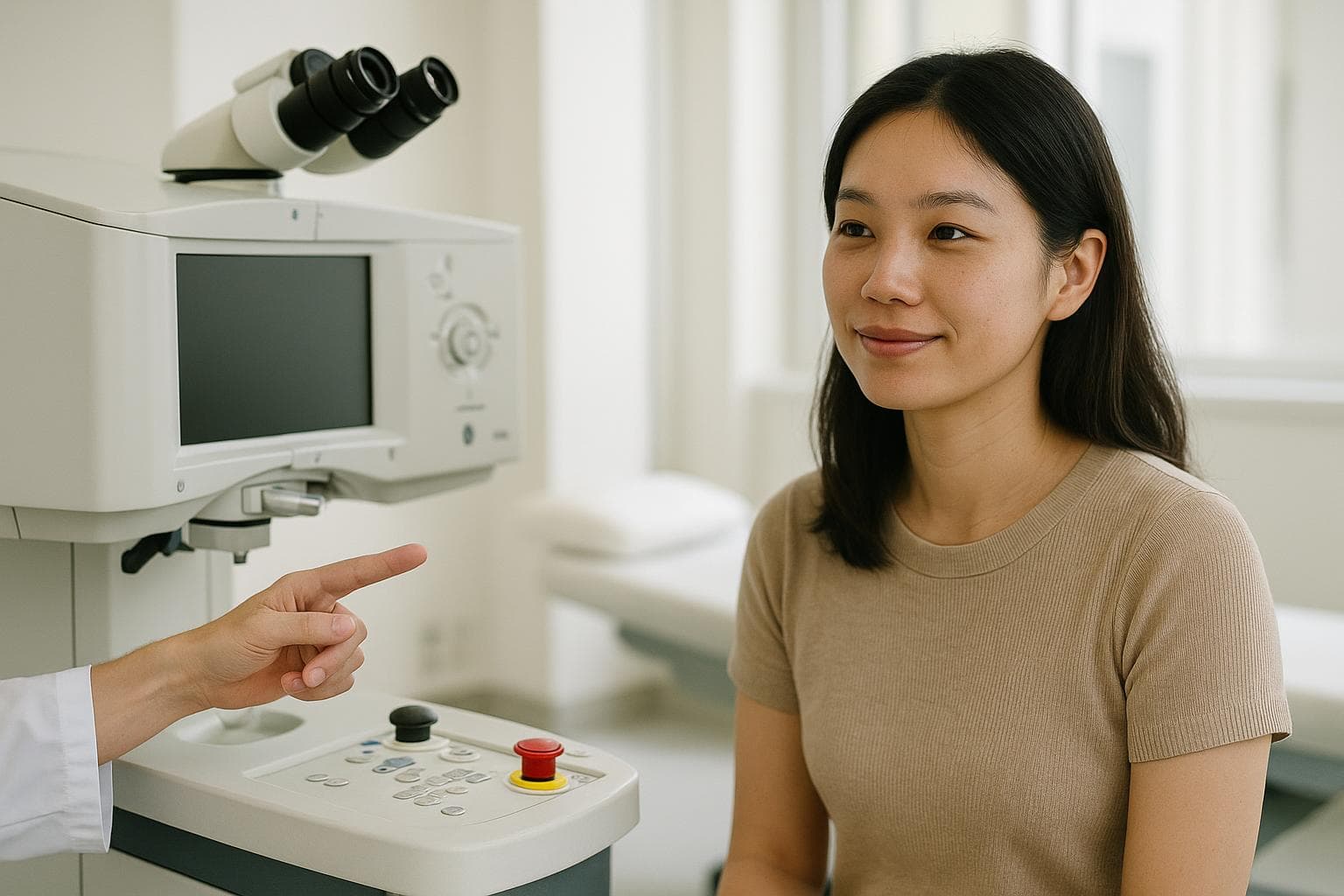
Is SMILE Safer Than LASIK? An Honest Answer From a Surgeon
Is SMILE safer than LASIK? A Seoul cornea surgeon explains what SMILE avoids, where LASIK still wins, and why your corneal data decides which is safer.

Dr. Kim Sun-young, Director
Cornea · Glaucoma · Cataract
Contents
I'm Dr. Kim Sun-young, medical director of Healing Eye Clinic in Sinnonhyeon, Gangnam, Seoul. I spent years as a clinical professor of cornea and cataract surgery at a university hospital, and today I see international patients every week with an English interpreter alongside me.
One question comes up in nearly every SMILE consultation: "Dr. Kim, I've read that SMILE has no flap. Doesn't that make it the safer one?"
If you're searching is smile safer than lasik, that's probably your question too. It makes sense — "no flap" sounds like "less can go wrong."
But here's my honest answer first: SMILE is not safer than LASIK for everyone. It's safer for some corneas, and LASIK is the safer choice for others. Let me show you how I tell them apart.
Is SMILE safer than LASIK? Four things that decide it
Safety isn't a property of the procedure alone. It's the procedure meeting your particular cornea.
1. The flap: what SMILE genuinely avoids
LASIK lifts a thin flap, treats the tissue underneath, and lays the flap back. SMILE removes a small lens of tissue through a 2–4mm opening, with no flap at all.
That matters if you play contact sports, serve in the military or do physical work. With no flap, there is no flap edge that can shift after a hard blow years later.
2. Nerves and dryness: usually milder with SMILE
The smaller opening in SMILE leaves more corneal nerves intact. Those nerves help keep the eye's surface moist.
So dryness after SMILE is usually milder. Usually — not never. If your tear film is already unstable, I treat that first, whichever procedure you have.
3. Speed and enhancements: where LASIK wins
LASIK tends to give sharp vision a little sooner. And if some prescription remains, a LASIK touch-up is often simple: the flap can be lifted again.
Enhancements after SMILE work differently and are less straightforward. Think of it as a sealed envelope versus one with a flap you can reopen — each has a trade-off.
4. Your corneal data: the real deciding factor
Thickness, shape on the corneal map, prescription and its stability, tear film. These numbers decide which procedure keeps the most safety margin for your eye.
For farsightedness or early presbyopia, LASIK or LASEK is usually more predictable. For very high myopia or a thin cornea, neither laser may be the safe choice — that's where ICL comes in.
SMILE avoids flap problems and usually means less dryness. LASIK gives faster sharp vision and simpler touch-ups. The safer procedure is the one your corneal measurements support — not the one with the better reputation.
The full checklist I use is in am I a candidate for SMILE surgery.
Why the surgeon who reads your map should be the one who decides
This is the principle I hold most firmly.
Deciding how much tissue can safely come out is a judgment made from your data. So here, the doctor who examines you is the doctor who operates and the doctor who checks you the next day. There's no hand-off where context gets lost.
Evidence you can check, not boasting: 4.8 stars from 154 Google reviews, the same prices for international and Korean patients, and my full membership of ESCRS, the European Society of Cataract and Refractive Surgeons. Our pre- and post-op rules are on the Korean site's precautions page.
So which one is safer for me?
A rough guide; your exam gives the real answer.
| If this is you | The safer fit is usually |
|---|---|
| Contact sports, moderate myopia, healthy cornea | SMILE |
| Want the fastest sharp vision, enhancement may be needed | Clear LASIK |
| Farsighted or early presbyopia | LASIK / LASEK |
| Very high myopia or thin cornea | ICL |

A side-by-side of the two procedures beyond safety is in SMILE vs LASIK, and what forum threads say about SMILE in Korea is in SMILE LASIK Korea Reddit questions.
Price. Premium LASIK or LASEK is ₩1,990,000 and Clear LASIK ₩2,700,000 for both eyes. SMILE is quoted after the exam, usually above standard LASIK and below ICL. The full exam is ₩150,000. Everything is on our price page.
Side effects of both, and who I turn away
Neither is free of risk, and I'd be wary of any clinic that says otherwise.
- Dryness — both, usually milder after SMILE.
- Night glare and halos — both, more likely with large pupils, usually easing over time.
- Residual prescription or regression — both; the fix differs between them.
- Flap-related problems — LASIK only.
I don't operate when the map shows signs of keratoconus, when the cornea is too thin for the planned correction, when dry eye is untreated, or when the prescription is still changing. Results and recovery vary from person to person.
If you're flying in for either one
- At least three nights for SMILE or LASIK (exam, surgery, next-day check); four recommended.
- Stop soft contacts at least a week before the exam, rigid ones longer.
- After SMILE, avoid swimming, saunas and eye makeup for about a week.
- We're one minute from Sinnonhyeon Station, about 70 minutes from Incheon Airport.
My full SMILE walkthrough is the SMILE LASIK Korea surgeon guide.
Don't pick the "safer" name — pick the safer fit
If you remember one thing, make it this: no procedure is safe in general; it's safe for a particular eye.
Choose a clinic where the surgeon who reads your map makes the call and will tell you "not this one" when that's true. Send us your prescription, age and travel dates on WhatsApp — if neither SMILE nor LASIK suits your eyes, I'll tell you plainly and explain the alternative.
I hope to help you choose with confidence.
— Dr. Kim Sun-young, Medical Director, Healing Eye Clinic (Sinnonhyeon, Gangnam, Seoul)
Frequently asked questions
Is SMILE safer than LASIK?
Not universally. SMILE avoids flap-related problems and usually causes less dryness, while LASIK gives faster sharp vision and simpler enhancements. The safer procedure for you is the one your corneal thickness, map, prescription and tear film support.
Why do people say SMILE is safer?
Because SMILE has no flap. There is no flap edge that could shift after a hard blow to the eye, and a smaller opening means more corneal nerves stay intact, which tends to mean less dryness. Those are real advantages, but they don't make SMILE right for every eye.
When is LASIK the better choice?
LASIK often suits farsightedness or early presbyopia, gives sharp vision a little sooner, and allows a straightforward touch-up by lifting the flap if some prescription remains. For some prescriptions and corneas, it is the more predictable option.
Does SMILE cause less dry eye than LASIK?
Usually somewhat less, because fewer corneal nerves are cut. It still happens, though, and anyone with existing dry eye should have it treated before either procedure.
What if my cornea is too thin for both?
Then neither laser is the safe choice, and ICL — a lens placed inside the eye that leaves the cornea untouched — is usually considered instead, after the exam confirms the eye's internal measurements.
How much do SMILE and LASIK cost at your clinic?
Premium LASIK or LASEK is ₩1,990,000 and Clear LASIK is ₩2,700,000 for both eyes. SMILE is quoted after the exam, usually above standard LASIK and below ICL. The full exam is ₩150,000.
Message us on official LINE / WhatsApp for a special offer
Your exact candidacy and cost are confirmed in a free 1:1 consultation.