
SMILE vs LASIK: Which Is Better? An Eye Surgeon's Honest Take
I'm asked SMILE vs LASIK almost daily. Honestly, there's no universal winner — it depends on your cornea, your eyes, and your life. Here's how I decide.

Dr. Kim Sun-young, Director
Cornea · Glaucoma · Cataract
Contents
"Doctor, I keep reading that SMILE is the newest and best — should I just do that instead of LASIK?"
I hear some version of this almost every day from patients who message us. And I understand why. SMILE is newer, it sounds more advanced, and the internet loves a clear winner. So let me be honest with you right at the top, the way I would in my exam room: when it comes to SMILE vs LASIK, which is better depends entirely on your eyes — there is no single right answer for everyone. Anyone who tells you one procedure always beats the other, before they've even looked at your cornea, is selling something.
This article is how I actually think it through, patient by patient.
What SMILE and LASIK really are (in plain terms)
Both reshape your cornea with a laser so light focuses correctly and you can drop your glasses. The difference is how the surgeon gets there.
With LASIK, I create a thin flap on the surface of the cornea, lift it, reshape the tissue underneath with an excimer laser, then lay the flap back down. It heals fast and the vision the next morning is often startlingly clear.
With SMILE, there's no flap. Instead, the laser shapes a tiny lens-shaped piece of tissue inside the cornea, and I remove it through a very small incision — just a few millimetres. Because that incision is small, more of the corneal nerves on the surface are left undisturbed.
That last detail is the whole reason SMILE became popular. But popular isn't the same as right-for-you.
LASIK lifts a flap; SMILE works through a tiny incision with no flap. The smaller incision is SMILE's real advantage — but only for the right cornea.
When I lean toward SMILE
There are patients I see and quietly think, this person is a good SMILE candidate.
If you have moderate myopia and your eyes already feel dry — you wear contacts and they get scratchy by evening, or you stare at screens all day — SMILE's smaller incision tends to disturb fewer of the surface nerves that drive your tear reflex. Many of these patients are simply more comfortable afterward.
People with active or contact-heavy lifestyles sometimes prefer SMILE too, because there's no flap that could, in theory, be disturbed by a hard knock to the eye years later. It's a small risk with LASIK, but for a boxer or a rugby player, small still matters.
When I lean toward LASIK
Now the other side, because this is where the internet's "SMILE is always better" story falls apart.
If you have significant astigmatism, LASIK — especially a custom, wavefront-guided LASIK — can correct a wider, more precise range than SMILE currently handles well. I won't push someone toward SMILE just because it's trendy if their astigmatism is better served by LASIK.
If predictable fine-tuning matters to you, LASIK has an edge. Should your prescription ever drift slightly years later, lifting the existing flap for a small touch-up is straightforward. Adjusting after SMILE is possible but less simple.
And for some prescriptions, LASIK simply gives the cleanest, fastest result. I've done both for thousands of eyes, and I genuinely don't have a favorite child. I have the right tool for the cornea in front of me.
The honest caveat nobody likes to say out loud
Here's the part I have to be straight about. No vision-correction surgery is risk-free, and neither SMILE nor LASIK is "100% safe." Dry eye in the first months, some glare or halos at night, the rare need for a touch-up — these can happen with either one. They're usually temporary and manageable, but you deserve to hear it plainly before you decide.
What lowers that risk isn't picking the trendiest procedure. It's the exam. A careful measurement of your corneal thickness, your topography map, your pupil size and your tear film is what tells me whether you're a candidate at all — and if you are, which procedure protects your eyes best over the long run.
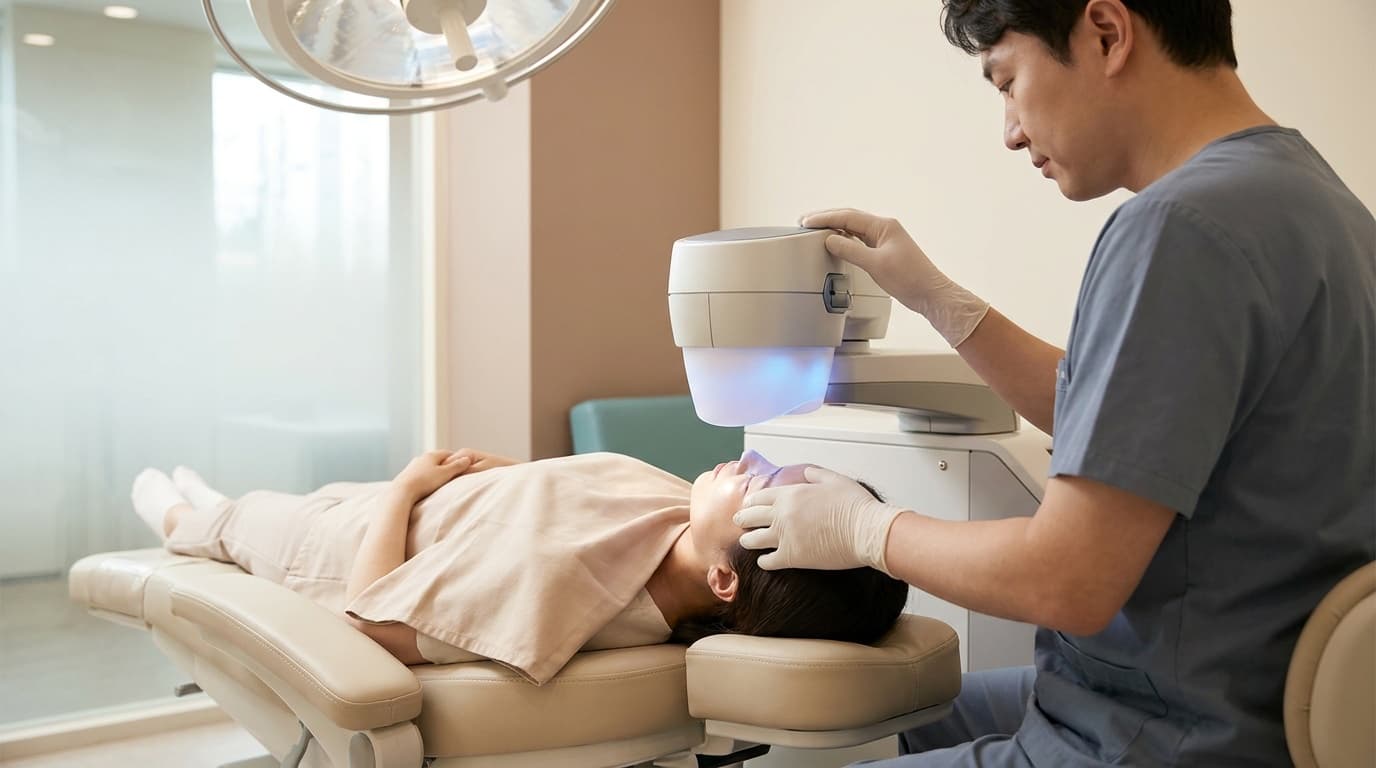
So when someone asks me, point blank, SMILE vs LASIK, which is better — my honest answer is: let me see your eyes first. I can't responsibly choose for you over the internet, and I'd be wary of anyone who claims they can.
How we make it easy for patients coming to Seoul
We're right in front of Sinnonhyeon Station in Gangnam — a one-minute walk — and about 70 minutes from Incheon Airport, so getting here is simple. You'll have an English interpreter on-site for the whole visit, from your exam through the surgery explanation, and your prices are exactly the same as what Korean patients pay. The same surgeon who examines you is the one who operates and follows you afterward, not a rotating cast.
But none of that is the point yet. The point, today, is getting you an honest answer about which procedure — if any — fits your eyes.
Talk to us before you book a flight
If this article leaves you with one thing, let it be this: don't let a headline pick your surgery. SMILE and LASIK are both excellent. Which one is better is a question only your cornea can answer.
Message us for free on our official WhatsApp or LINE — no appointment needed, no pushy sales. Tell me your prescription, your age, what you do for work, and whether your eyes feel dry. I'll give you an honest first direction, and if your situation actually suits the other procedure — or if surgery isn't right for you at all right now — I'll tell you that too.
I'd be glad to look at your eyes properly here in Seoul.
— Dr. Kim Sun-young, Medical Director, Healing Eye Clinic
Frequently asked questions
Is SMILE always better than LASIK?
No. SMILE has a smaller incision and tends to be gentler on the corneal nerves, which often helps people prone to dry eye. But LASIK still gives excellent, fast results and is sometimes the better choice — for example, if you have astigmatism beyond SMILE's treatable range, or if a future fine-tuning touch-up matters to you. There is no procedure that wins for everyone. The exam decides.
Which one has a faster recovery?
Both are quick. With LASIK most people see clearly the morning after surgery. SMILE recovery is also fast, sometimes a touch slower in the first day or two but with less of the dry, gritty feeling some LASIK patients notice early on. Individual variation is real, so I never promise a fixed timeline.
I have thin corneas. Can I still do SMILE or LASIK?
Maybe one, maybe neither — it depends on exactly how thin and on your prescription. If your cornea is too thin for a flap-based procedure, I'd look at LASEK or, for higher prescriptions, ICL. I can only answer this responsibly after measuring your corneal thickness and topography.
Does SMILE hurt less than LASIK?
Neither is painful during surgery — your eye is numbed with drops. Afterward, LASIK is usually very comfortable from day one, while flap-free procedures can feel more irritated early on. SMILE sits comfortably in between for most people. Comfort varies person to person.
How do I find out which is right for me?
You can't decide this from a blog or a price list, and you shouldn't. It comes down to your corneal thickness, prescription, topography, pupil size and tear film. Message us for free on WhatsApp or LINE first — tell us your prescription and what you do for work, and we'll give you an honest direction before you ever fly to Seoul.
Message us on official LINE / WhatsApp for a special offer
Your exact candidacy and cost are confirmed in a free 1:1 consultation.