Who Does Cataract Surgery? An Ophthalmologist, and Who Else
Asking who does cataract surgery? An ophthalmologist. Here is who else is involved, the real risks, and who checks your eye once you fly home.

Dr. Kim Sun-young, Director
Cornea · Glaucoma · Cataract
Medically reviewed byDr. Kim Sun-young, Director· Medical Director
Edited by: Dr. Kim Sun-young
Contents
An ophthalmologist does cataract surgery: a medical doctor who trained in eye surgery after medical school. If you're asking who does cataract surgery because you're weighing a trip to Seoul, the question that matters just as much is who looks after that eye once you've flown home, and it should be settled before you book anything. The same applies in Korea, where the surgeon should hold an ophthalmology specialist title.
I'm Kim Sun-young, Medical Director at Healing Eye Clinic in Gangnam, and cataract care sits inside my specialty of cornea, glaucoma and cataract.
Here, the surgeon who examines you is the surgeon who operates and the one who sees you afterwards: one dedicated surgeon owns your case from the first exam to aftercare. Consultations run with Japanese, Traditional Chinese and English interpreters, so you hear your measurements and your risks in your own language before deciding. Wherever you end up, ask any clinic three things first:
- Is the doctor who examines me the doctor who operates and does the next-day check?
- Which lens do you suggest for my eyes, and what finding would change that choice?
- Who checks my eye after I'm home, and which records do I leave with?
If you already have a cataract diagnosis from home, send a photo of that report and your rough travel dates on WhatsApp.

Who does cataract surgery, and who else touches your case?
The operation itself is done by an ophthalmologist. Around it, other people do real work: staff who run the measuring devices, nurses who prepare the eye, and in some countries an optometrist who handles routine checks on either side of the operation. Knowing who does which part tells you where a mistake could slip in.
In the US and the UK, you may have met an optometrist first, and it's common for optometrists to share pre- and post-operative checks with the surgeon. The lens removal and implant are still the ophthalmologist's job. When you look at a clinic abroad, the credential to check is the ophthalmology specialist title and where it was earned.
Mine reads: MS, Catholic Univ. College of Medicine · Ophthalmology specialist, Catholic Medical Center. I also hold the role of Clinical Professor (Cornea & Cataract), Uijeongbu St. Mary's Hospital, and I'm a member of KOS, KEEDS, KCLSS & ESCRS, the last being the European cataract and refractive surgery society. My colleague Dr. Choi Geun-hye is a board-certified ophthalmologist whose specialty is cataract, presbyopia and oculoplasty. Both of us are listed on the doctor introduction page of our Korean site.
What each station on exam day is for
Every test on exam day feeds one decision: which artificial lens goes in, and at what power. The cataract treatment page covers the operation; here is what the measurements are doing.
- Vision and refraction. Your current prescription and what the cataract is taking from your sight, eye by eye.
- Eye pressure. A raised reading points toward glaucoma, which changes how the eye is watched after surgery.
- Biometry. The length of the eye and the curvature of the cornea. The lens power is calculated from these numbers.
- Tear film and corneal surface. A dry, patchy surface can distort the curvature reading.
- Dilated retina exam. The drops blur your near vision for a few hours, so don't plan to drive or read fine print afterwards.
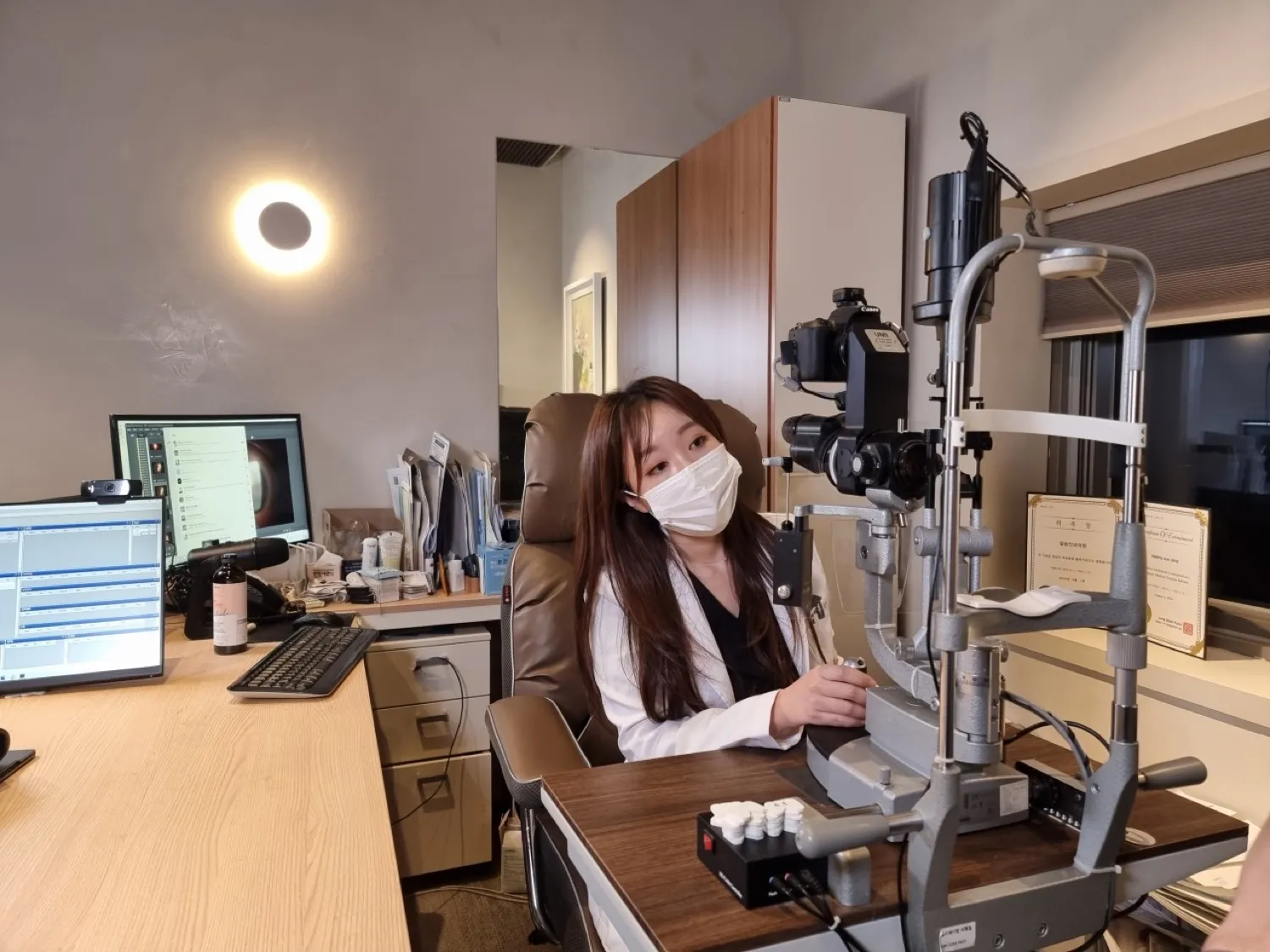
The judgment call most patients never see sits between the tear film and biometry. When curvature readings disagree between two measurements, or the tear film breaks up quickly, the sensible move is to treat the surface and measure again. A lens power calculated from a shaky number stays in the eye. That's why a dry-eye finding can move your surgery date, and it's worth knowing before you fix flights.
What are the risks of cataract surgery?
Most people see better; some don't. The US National Eye Institute calls cataract surgery one of the most common operations in the United States, very safe, with 9 out of 10 people seeing better afterwards. The tenth person is the reason this section is long.
| When | What can happen | What it usually means |
|---|---|---|
| First days | Grittiness, watering, light sensitivity, blur | Expected; settles with drops |
| First weeks | Inflammation, raised pressure, swelling at the centre of the retina | Needs a check and adjusted drops |
| Months to years | Clouding of the capsule behind the new lens | A short laser treatment clears it |
| Any time, rare | Infection inside the eye, retinal detachment | Urgent; same-day care |
The rare rows are the ones to memorise as warning signs: pain that gets worse instead of better, vision that drops suddenly, a new shower of floaters, or a shadow like a curtain across part of your view. Any of those means an eye doctor the same day, wherever you are.
Lens choice adds its own trade-offs. Multifocal and extended-range lenses on the presbyopia and cataract page can reduce reliance on reading glasses, but some people notice halos or rings around lights at night. If you drive a lot after dark, say so at the exam. Whether any lens suits your eye is decided at the in-person exam, after the measurements above.
When surgery should wait, or a different plan fits
Some eyes are better served by waiting or by a simpler lens. The National Eye Institute notes that most people don't need to rush, and that surgery is usually suggested once the cataract gets in the way of everyday activities such as reading or driving.
The situations where I'd slow things down:
- The cataract is mild and your glasses still work. A new prescription may buy you time. The timing guide goes through how that call is made.
- Something else limits your vision. Macular disease, advanced glaucoma or diabetic changes in the retina mean a clear lens won't give you everything you hope for.
- The surface isn't ready. Untreated dry eye or eyelid inflammation can be calmed first and measured again.
- You hope to drop reading glasses, but the retina or cornea won't support a multifocal lens. A monofocal lens with reading glasses can be the better plan.
- No one at home can see you after the trip. That is a planning gap, and it's fixable before you fly.
Who looks after the eye once you fly home?
Two people should: your surgeon in Seoul for the early checks, and an ophthalmologist at home for anything after that. The US Centers for Disease Control and Prevention advises medical travellers to arrange follow-up care at home before leaving and to carry copies of their records.
The operation takes about 15 to 20 minutes per eye, and most people are back to daily life within days while vision settles gradually. The next-day check matters more than the operation length when you plan a trip, and the number of days you stay is confirmed at the consultation. The day-by-day stay guide and the recovery timeline lay out what usually happens in that window.
Before leaving Seoul, ask for the lens model and power, your biometry printout, the operation summary and your drop schedule. Your local ophthalmologist can then pick up where we left off without guessing. Our clinic offers lifelong check-ups after surgery, but I can't examine your eye from Seoul once you're back in Toronto or Sydney. That's why the local appointment belongs on your calendar before the flight to Korea.
If follow-up is your main worry, send your home city and the name or type of eye practice you'd see there on WhatsApp, along with your diagnosis report. I review it, and you'll know what the hand-off needs to include and how early the local appointment should be.
Getting to the clinic and fitting visits around flights
The clinic is at 470 Gangnam-daero, 10–11F, Gangnam-gu, Seoul, a one-minute walk from Sinnonhyeon Station. Hours are Mon–Thu 10:00–18:30, Fri 10:00–21:00 and Sat 10:00–14:00, with lunch 13:00–14:00 and closed Sundays and holidays.
The Friday evening hours help if you land in the afternoon. Healing Eye Clinic is a Ministry of Health and Welfare registered medical institution for international patients.
If you're still deciding, send two things on WhatsApp: a photo of your latest eye report or glasses prescription, and a line about whether you'd like to keep using reading glasses. I review them, and you'll know whether cataract surgery looks like a realistic plan for this trip, what the exam has to confirm, and which week makes sense to come.
Frequently asked questions
Can an optometrist perform cataract surgery?
Cataract surgery is performed by an ophthalmologist, a medical doctor with surgical training in eye disease. Optometrists often handle eye tests and routine checks around the operation in shared-care arrangements. The removal of the cloudy lens and the implant of the new one is the surgeon's job.
Will the doctor at my exam in Seoul be the one who operates?
At Healing Eye Clinic, one dedicated surgeon owns your case from the exam through surgery to aftercare. At any clinic, ask this directly before you book, because it tells you who knows your measurements when the lens power is chosen.
Does cataract surgery hurt?
The eye is numbed with drops, so most people describe pressure and bright light rather than pain during the operation. Grittiness and watering are common for the first days. Pain that gets worse after surgery is a warning sign and needs a same-day check.
What should I bring home for my local eye doctor?
Ask for the implanted lens model and power, the biometry printout, the operation summary and your drop schedule. With those, a local ophthalmologist can follow your eye without repeating guesswork. Book that local appointment before you travel.
How soon is cataract surgery needed once it's diagnosed?
Most people don't need to rush. Surgery is usually suggested when the cataract starts getting in the way of daily activities such as reading or driving. A dilated exam also checks whether something else is limiting your vision.
Message us on official LINE / WhatsApp for a special offer
Your exact candidacy and cost are confirmed in a free 1:1 consultation.