
How to Book Eye Surgery in Korea From Abroad: The Order I'd Do It In, and How to Judge the Clinic First
How to book eye surgery in Korea from abroad: what to send before you fly, how to judge a Seoul clinic, and how follow-up works after you go home.

Contents
A patient in Melbourne emailed me at what must have been 2 a.m. her time: "I have eleven days off in March. Can I fly in, have surgery, fly home — and what happens if something goes wrong once I'm back in Australia?" That is the right question, and it is not really a question about lasers.
How to book eye surgery in Korea from abroad is, in practice, a sequence rather than a booking form: send your existing eye data first, get a provisional plan and the name of the surgeon who will actually operate, judge the clinic on how it answers, and only then buy the flight. Patients who do it in that order almost never get an unpleasant surprise on exam day. Patients who book the flight first sometimes arrive having committed a week of annual leave to a procedure their cornea was never suited for.
Send your data, get a named surgeon and a provisional plan, then book the flight — never the reverse.
Step one: what to email before you commit to a date
You can get a surprisingly useful preliminary opinion from documents you already have or can obtain locally in an hour. What I ask for:
- Your glasses prescription from the last 2–3 years — I am looking for stability, not just the current number. A prescription that moved 0.75 D in a year is a reason to wait.
- Corneal topography and pachymetry (corneal thickness) if your local optometrist or ophthalmologist can print them. This is the single most decisive file.
- Your history: dry eye symptoms, autoimmune disease, previous eye surgery, how many hours a day you wear contacts, and whether you drive at night.
With that, I can usually tell you whether laser correction, an implantable lens, or neither is the realistic direction — and roughly what the figure and the trip length would be. What I cannot judge from abroad is tear film quality, pupil diameter in the dark, and anterior chamber depth. Those get measured in Seoul and they can still change the plan.
One practical thing that trips up almost every overseas patient: contact lenses distort the cornea, and the measurements taken on exam day are the ones your surgery is designed from. Soft lenses need to be out for at least a week, rigid lenses for at least three weeks — I set out the specific windows in our guide on stopping contacts before an eye exam, and I would read that before you book anything, because it sets your earliest possible exam date.
How to judge a Seoul eye clinic when you are 5,000 miles away
You cannot walk in and look around. So judge the correspondence — the way a clinic answers email is a fair proxy for how it will behave when something is complicated. Here is the table I would use if I were the patient.
| What to ask by email | An answer that should reassure you | An answer that should worry me |
|---|---|---|
| "Who will perform my surgery, and will that same doctor do my exam and follow-up?" | A named surgeon, with a profile and credentials you can verify | "Our surgical team" / no name until you arrive |
| "What are the published prices, and do foreigners pay the same?" | A public price list and a clear yes | A quote only after you send flight details |
| "What would make me not a candidate?" | A specific list — thin cornea, unstable prescription, keratoconus, shallow anterior chamber | "Almost everyone qualifies" |
| "What happens if I need follow-up after I fly home?" | A written schedule, a surgical summary for your local doctor, a named contact | "Just email us if there's a problem" |
| "What are the realistic downsides for my eye specifically?" | Named risks with rough frequency | Reassurance with no downside mentioned |
That last row matters most. A clinic that cannot name a downside is selling, not consulting. I go deeper into the questions that separate the two in my piece on how to choose an eye clinic in Korea, including the ones that are uncomfortable to ask out loud.
Verify people, not slogans. Our surgeons' training and society memberships are listed on the Korean head office's medical staff page, and the diagnostic and laser platforms we actually own are listed on the equipment page — use a browser translation and check that what you were told by email matches what the Korean-language site says to Korean patients. Public review volume is another sanity check rather than proof: ours currently sits at 4.8 from 154 Google reviews, and you can read the patient reviews we publish yourself.
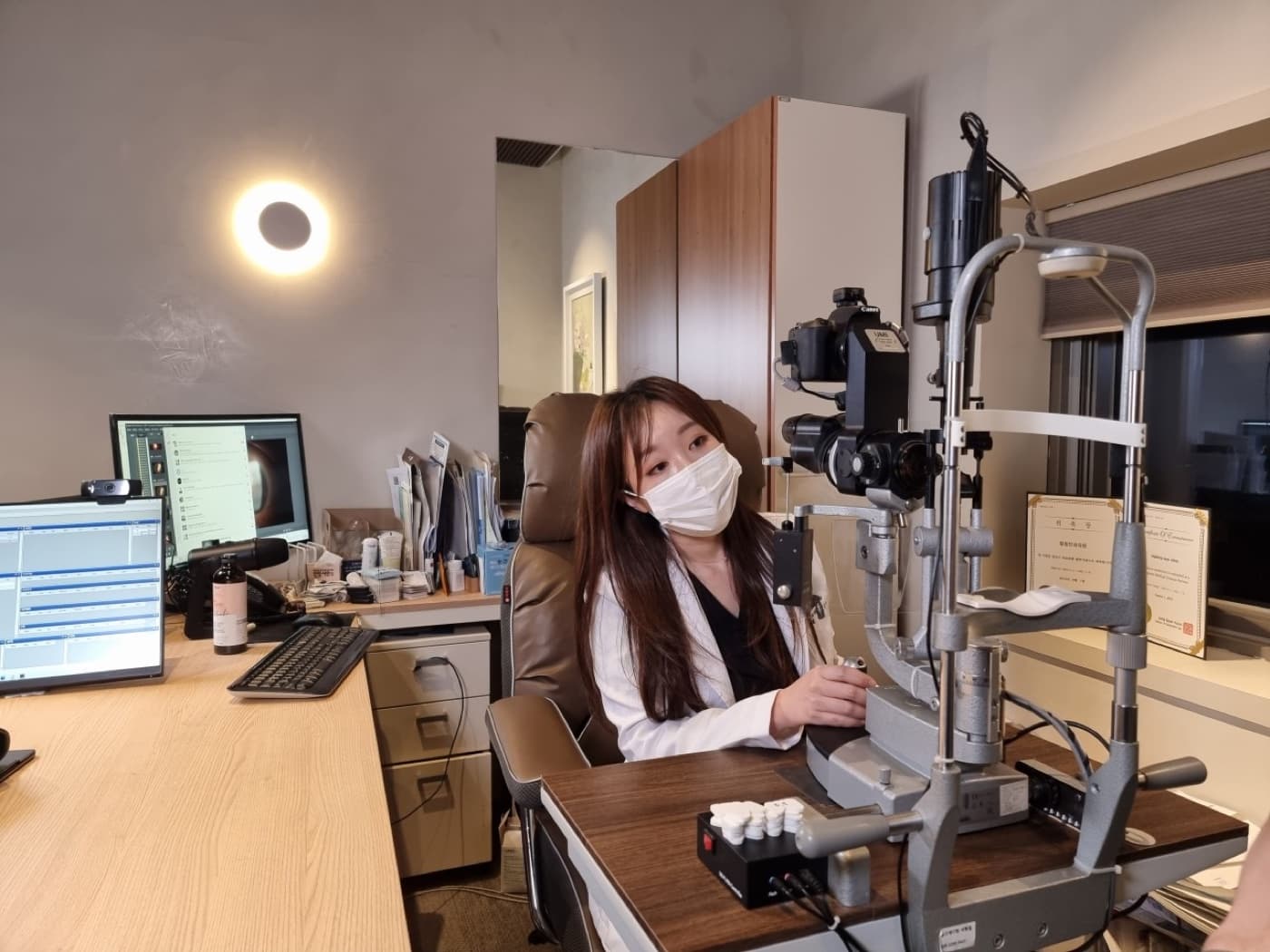
What "interpreter support" should actually mean
Many clinics say they support English. Ask what that means at three specific moments, because those are the moments where mistranslation costs you:
- When your numbers are explained. Corneal thickness, residual stromal bed, anterior chamber depth, pupil size — you should hear those figures and understand why they push toward one method over another.
- When consent is taken. You are signing a document about risk. It should be explained in your language, with room to ask something awkward.
- When post-op instructions are given. Drop schedules are easy to get wrong. You need them written, in English, with times.
We keep Japanese, Traditional Chinese and English interpreters on site, which means the interpreter is in the consulting room with the surgeon rather than on a phone line afterward. I wrote separately about what to test before you trust a clinic's language support in our article on eye surgery in Korea with an interpreter — including the trick of asking a technical question by email and seeing whether the answer is specific or generic.
One surgeon from exam to aftercare, and why I insist on it
Our 1:1 dedicated surgeon policy exists because information gets lost in handoffs. The person who noticed your topography was very slightly asymmetric should be the person deciding your optical zone, and the person you speak to at three months. For an overseas patient this matters more, not less: you get one chance in the building, and you should not be re-explaining your history to a third face.
Practically, it also means I am the one who has to live with an over-ambitious plan. If your cornea gives me a thin safety margin, the responsible choice may be a different procedure entirely — a flapless surface method, or an implantable lens that leaves the cornea alone. That comparison is the substance of our treatment overview, and the individual pages for 3rd-generation Clear SMILE LASIK and the implantable collamer lens (ICL) set out candidacy honestly, including who each one excludes.
Same price as locals — and what legitimately moves the number
Our policy is straightforward: international patients pay exactly what Korean patients pay. There is no interpreter fee and no foreigner rate. What does move your figure is the method and, for lens surgery, the lens model itself.
Published prices, the same for every patient
Budget for the boring items too: a few days of hotel near Gangnam, and the fact that you should not plan a hiking day or a swimming pool into the first two weeks after surgery.
The trip itself, and follow-up after you fly home
We are one minute from Sinnonhyeon Station and about 70 minutes from Incheon Airport, which keeps the logistics simple. A workable Clear SMILE LASIK trip is 1 night, 2 days: full examination and decision in the morning, surgery that afternoon, then the next-morning check, after which you can fly. Arriving the evening before, or adding a spare day, makes it more relaxed. ICL needs a longer window because I want to recheck pressure and lens position. If you want the day-by-day version with the realistic buffer built in, read how many days you actually need in Korea for eye surgery before you lock flights.
Book a flexible return ticket; the day I want to re-examine you is not always the day you planned to leave.
After you go home, follow-up is a documented process, not a hope. You leave with a written surgical summary — procedure, laser or lens parameters, drops and schedule — meant for a local eye doctor, plus the check timeline — after Clear SMILE LASIK, one week and one month, then within the first year. You have those exams done where you live; the report comes back to me; we go through it by email or video with an interpreter. Our pre- and post-operative precautions are published in full on the Korean head office's aftercare page, and our lifelong check-up policy means you are welcome back whenever you are in Seoul.
The honest downsides
Dry eye is the most common complaint in the first months after laser correction, and for some patients it lasts longer than they expected. Night glare and halos occur, more often in large pupils and higher prescriptions. Undercorrection or residual astigmatism can require an enhancement, which is only possible if the cornea has the thickness to spare. ICL carries its own specific risks — elevated eye pressure, rare lens repositioning or exchange, and endothelial cell loss over time — which is exactly why anterior chamber depth and cell count are measured so carefully. Any intraocular surgery carries a small risk of infection. None of this is a reason not to proceed; it is the reason to proceed with data.
Who I tell not to get on the plane
If your prescription moved meaningfully in the past year, wait. If your topography suggests keratoconus, no laser. If you have uncontrolled autoimmune disease, significant untreated dry eye, or you are pregnant or breastfeeding, not now. If your anterior chamber is shallow or your endothelial cell count is low, ICL is off the table. And if your trip has no room for the next-day check, come another time — I would rather lose the booking than lose sight of your eye in week one.
Send me your prescription history and topography before you look at flights. If your eyes are suited to this, I will tell you which method and why, with the numbers in front of both of us. If they are not, I will tell you that too — and you will have saved yourself a very long flight.
— Dr. Kim Sun-young, Medical Director, Healing Eye Clinic, Sinnonhyeon, Seoul
Frequently asked questions
Can I book eye surgery in Korea before I arrive, or do I have to be examined first?
You can reserve a date, but treat it as provisional until your full examination in Seoul is done. I can give you a preliminary opinion from your overseas prescription, corneal topography and corneal thickness, and that is usually accurate enough to plan flights around. What I cannot do from abroad is confirm tear film quality, pupil behavior in the dark, anterior chamber depth or subtle topographic irregularity — those decide the method. So the honest sequence is: send data, get a provisional plan, book a flexible flight, then confirm on exam day.
How many days should I stay in Seoul for laser vision correction?
For Clear SMILE LASIK the core schedule is 1 night, 2 days: the detailed exam in the morning, surgery that afternoon, and the next-morning check, after which flying is allowed — cabin air is dry, so keep artificial tears with you. Return to daily life is generally 1–2 days, but vision fluctuates in the first week and drops are frequent, so I would rather you not board a plane the same evening. If the exam changes the plan or you want a more relaxed trip, 2–3 days is fine. For ICL I prefer a longer window because I want to recheck intraocular pressure and lens position. If your schedule is tighter than that, tell me before you book — sometimes the answer is to come another time.
Do international patients pay more than Korean patients at your clinic?
No — our policy is the same price for all, so an international patient pays exactly the published Korean price for the same procedure and lens. There is no interpreter surcharge and no separate foreigner rate. What can legitimately change your figure is the method itself, the lens model in ICL or cataract surgery, or an added treatment such as cross-linking if your cornea warrants it. Our published list is on the price page, and I will tell you which line you fall under before you commit.
What happens with follow-up once I have flown home?
Before you leave I set out the schedule — after Clear SMILE LASIK, one week and one month, then a check within the first year (after flap LASIK, one month and three months) — and give you a written summary of your surgery, the exact drops used and the findings I want your local eye doctor to check. You have those checks done where you live, and the report comes back to me; we then review it together by email or video with an interpreter, in your own language. If something is off, I would rather hear about it in week one than in month six. Our lifelong check-up policy also means you are welcome back whenever you are in Seoul, at no consultation cost.
What if my vision is not where we hoped, or I need an enhancement?
No surgeon can guarantee a particular visual acuity, and I never quote one. A minority of eyes undercorrect, overcorrect or heal with residual astigmatism, and some patients notice night glare, halos or dry eye that takes months to settle. If an enhancement is appropriate, I first confirm the refraction is stable and that residual corneal thickness is safe — sometimes it is not, and then the honest answer is glasses for night driving rather than more laser. Our responsibility guarantee covers continued care and re-evaluation; it is not a promise of a number on the chart.
Who should not fly to Korea for this surgery?
If your prescription has shifted meaningfully in the last 12 months, if you have keratoconus or suspicious corneal topography, if you have uncontrolled autoimmune disease or severe untreated dry eye, or if you are pregnant or breastfeeding, I would not operate and I would tell you before you buy a ticket. For ICL specifically, a shallow anterior chamber or a low corneal endothelial cell count rules it out. I also turn away patients whose trip is so compressed that there is no room for the next-day check. It costs you nothing to find that out by email; it costs a great deal to find it out at the gate.
Message us on official LINE / WhatsApp for a special offer
Your exact candidacy and cost are confirmed in a free 1:1 consultation.