
Eye Surgery in Korea With an Interpreter: How I'd Judge a Seoul Clinic Before You Book the Flight
Eye surgery Korea with interpreter: how I'd judge a Seoul clinic — interpreter access, one dedicated surgeon, same price as locals, follow-up from home.

Contents
A patient in Vancouver ended her first email to me with a line I still quote to my staff: "I'm not worried about the laser. I'm worried that on the day something feels wrong, nobody will understand what I'm trying to say."
Eye surgery in Korea with an interpreter — the phrase most of my international patients type into a search bar — should mean far more than a translated consent form and a friendly greeting in English at reception. It should mean that the person who reads your corneal topography, the person who designs your surgical plan, and the person who answers your message six weeks after you have flown home are all connected to you through a language you can actually think in. Below is how I would judge a Seoul clinic on that, using evidence you can check before you book anything.
Judge a clinic by which appointments the interpreter attends, not by whether the website is in English.
What interpreter support should cover — and the three moments it matters most
Most clinics can get you through booking and reception in English. That is the easy part. The language load in vision correction is concentrated in three moments, and those are the ones worth asking about specifically.
The first is the results review: corneal thickness, topography patterns, pupil diameter in the dark, tear break-up time, intraocular pressure, endothelial cell count. These numbers are the entire basis of your surgical decision, and if they arrive as a shrug and a thumbs-up, you have not been consulted — you have been processed.
The second is the risk and consent conversation. I need you to understand, in your own words, what night glare feels like at week three, what an enhancement would involve, and what would make me stop mid-plan.
The third is aftercare instruction: which drop, how many times, for how long, and which symptoms mean go to a doctor today rather than wait and see. Our Korean head office keeps the full pre- and post-operative precautions published for reference, and our interpreters walk through them with you in Japanese, Traditional Chinese or English.
Four questions, and what the answers reveal
| Ask this | A thin answer | An answer you can work with |
|---|---|---|
| Will an interpreter sit in for the exam results and consent, not just reception? | "Yes, we welcome foreigners." | "Yes — for the results review, the plan discussion and the day-after check; here are the hours they're on site." |
| Who examines me, who operates, and will I meet them beforehand? | "Our specialist team." | A named surgeon, with the same name at exam, surgery and follow-up. |
| Do international patients pay a different price? | "We'll prepare a personal quote." | A published price list identical to the one Korean patients see. |
| What happens if something changes in week three, at home? | "Contact us anytime." | Records in English, messaging in your language, and a local doctor you lined up before flying. |
If you want a longer version of this interrogation, I wrote one in our guide to choosing an eye clinic in Korea — it lists the questions that make a clinic uncomfortable, which is exactly why they work.
One dedicated surgeon, or a relay of strangers?
In a high-volume clinic it is entirely normal for one doctor to run your exam, a second to operate, and a third to see you the next morning. Nothing about that is illegal, and the surgery may go perfectly well. But it costs you something specific: nobody holds the whole story of your eye.
When I design a correction, I am also making judgment calls that never appear on the receipt — how wide to set the optical zone for a patient whose pupils open unusually far in the dark, how much residual cornea I insist on keeping, whether the tear film needs treating for a month first. If you report halos at week three, the value of my answer depends entirely on my remembering why I made those choices.
That is why we run a 1:1 dedicated surgeon policy: the same surgeon from exam through surgery through aftercare. You can verify who that person is before you fly — our head office publishes the surgeons' profiles and credentials, and our patient feedback is visible on our reviews page alongside a Google rating of 4.8 from 154 reviews. I would rather you check both than take my word for it.
"Same price as locals" is a checkable claim, not a slogan
The most common quiet overcharge in medical tourism is not a fake procedure; it is a different price list. Our policy is that international patients pay exactly what Korean patients pay, and the way you test that is simple: compare the emailed quote against our published price list.
Published figures, same for everyone
What legitimately moves a number is clinical: a thin cornea that warrants cross-linking, a dry ocular surface that needs treating first, a toric lens because your astigmatism demands one. What should never move it is your passport.
The exam is the product — and it must be allowed to say no
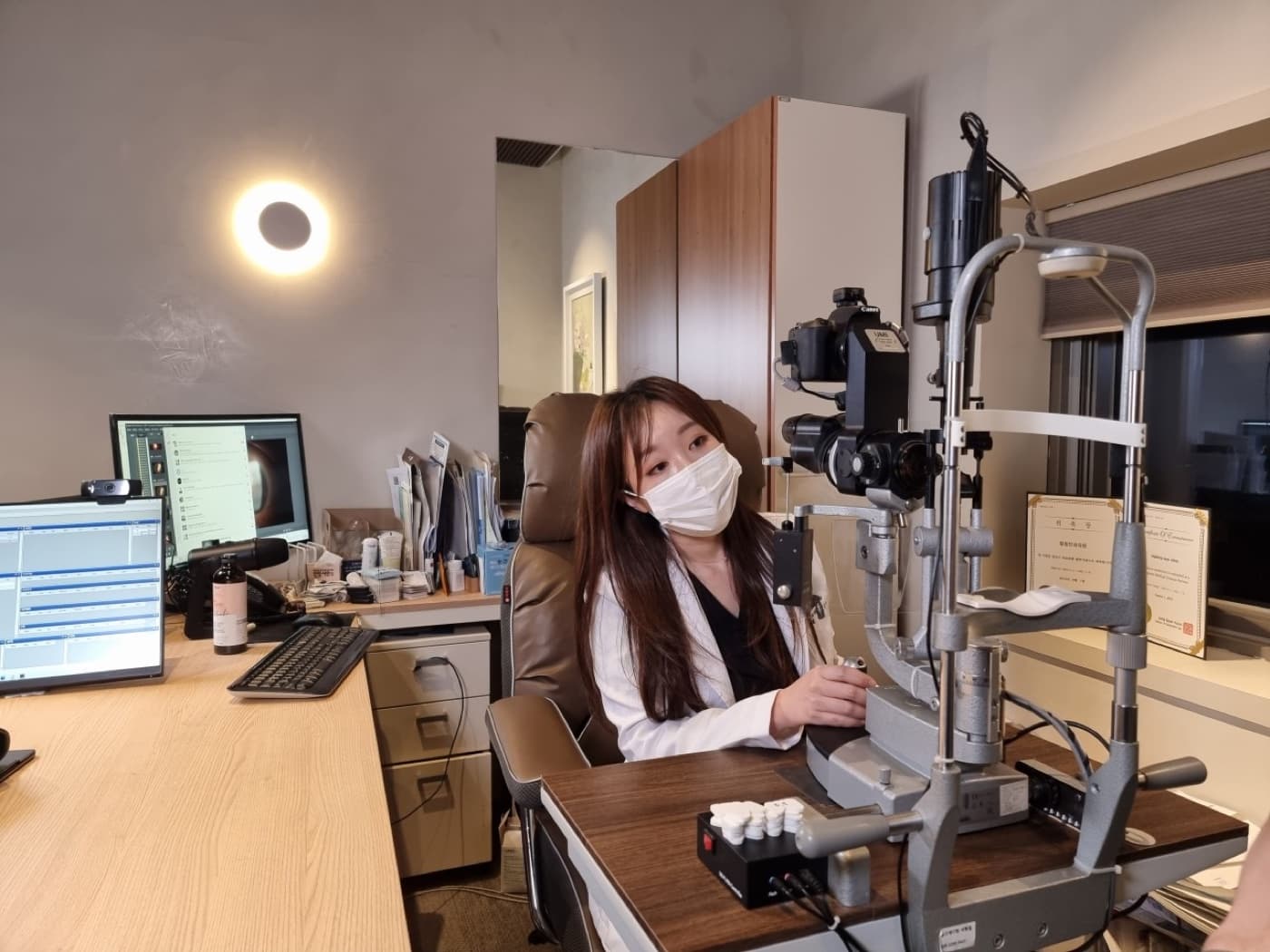
Patients often think they are buying surgery. They are buying a decision, and the decision is made in the exam room. I assess corneal thickness and topography, pupil size, tear film, intraocular pressure and endothelial cells, and I look hard for the subtle topographic irregularity that would make me refuse laser correction entirely.
One practical thing to get right before you board: contact lenses reshape the cornea, and testing on a distorted cornea produces a distorted plan. Soft and rigid lenses need different washout periods, which I break down in our guide on when to stop wearing contacts before an eye exam. Patients who ignore this often have to repeat the exam, and a repeated exam on a five-day trip is an expensive mistake.
The exam is also where the procedure gets chosen rather than assumed. If your cornea is thick enough and your prescription moderate, 3rd-generation Clear SMILE LASIK may be the straightforward route, with most people back to daily life in one to two days. If your prescription is very high or your cornea is thin, an implantable collamer lens preserves corneal tissue and can be removed again if that ever becomes necessary. Since the price is the same to me either way, I have no reason to steer you.
Who I tell not to fly
This is the section that will annoy the marketing industry, and it is the reason I wrote the article. I decline surgery for patients whose prescription has still been shifting over the past year; for corneal topography suspicious for keratoconus; for corneas too thin for the correction requested; for active or poorly controlled ocular surface disease; during pregnancy and nursing; and for some autoimmune conditions. For implantable lenses, a shallow anterior chamber or a low endothelial cell count can rule the procedure out on measurement alone.
The risks in a well-selected patient are uncommon, but they exist and you should hear them before you pay a deposit: dry eye lasting weeks to months, night glare and halos, undercorrection or regression that may warrant an enhancement, flap-related complications with LASIK, and the small risk of infection or inflammation with any intraocular procedure. With an implantable lens, add the possibility of lens repositioning or exchange and lifelong monitoring of the endothelium. No surgeon can promise you a particular line on the chart, and anyone who does is selling rather than examining.
A clinic that confirms you are a candidate before testing you is not confident — it is not examining you.
Follow-up once you're home: what we can do, and what we can't
Before you leave Seoul I want to have seen the eye at least the day after surgery, and preferably once more. Compressing that is the single most common scheduling error I see — I lay out realistic itineraries in our breakdown of how many days you need in Korea for eye surgery, and our late Friday hours until 21:00 and Saturday morning clinic exist partly to make short trips workable.
After that, you leave with your operative record, exam figures and drop schedule in English, and our interpreters remain reachable in your language. We provide lifelong check-ups whenever you return to Seoul. But I will be direct about the limit: I cannot measure your pressure or examine your cornea through a video call. Identify a local ophthalmologist before you fly, and go to them the same day for sudden pain, a sudden drop in vision, worsening light sensitivity or discharge.
One more practical point patients underestimate — cabin air is very dry and the timing of your return flight is a clinical question, not just a booking one. I explain how I think about it in our article on flying after LASIK.
If you take one thing from this: choose the clinic on the quality of its examination and the honesty of its refusals, not on the fluency of its brochure. Send us your current prescription and any recent exam data, and I will tell you plainly whether the trip is worth making — including when the answer is no.
— Dr. Kim Sun-young, Medical Director, Healing Eye Clinic, Sinnonhyeon, Seoul
Frequently asked questions
Is an interpreter actually in the room, or only available by phone?
At our clinic, Japanese, Traditional Chinese and English interpreters are on site during clinic hours, and I ask them to sit in for the parts that matter most: the results review, the surgical plan discussion, the consent conversation about risks, and the day-after check. Phone or app interpreting is workable for booking a taxi; it is not adequate when you are deciding between a corneal procedure and an intraocular lens. When you contact any clinic, ask specifically which appointments the interpreter attends and what hours they are physically present. A clinic that answers with a schedule rather than a slogan is telling you something real.
Do international patients pay more than Korean patients in Korea?
At Healing Eye, international patients pay exactly the same as Korean patients, and our prices are published rather than quoted case by case. That matters because an unpublished, personalized quote is where foreigner pricing hides. Ask any clinic for its standard price list and compare it against the figure in your email. If the two do not match, ask what the difference buys — sometimes it is a legitimate extra such as corneal cross-linking or autologous serum drops, and sometimes it is nothing you needed.
How many days should I plan to stay in Seoul?
For laser correction such as Clear SMILE LASIK, I generally ask patients to allow enough time for a full exam day, a surgery day, and at least the next-day check, with a buffer day in case the exam changes the plan. For an implantable lens, the lens is ordered to your measurements, so the gap between exam and surgery can be longer and I prefer you not to compress it. I also do not like patients flying out within 24 hours of surgery, because that removes my chance to see the eye when early problems are easiest to treat. Build the trip so that the exam is allowed to say no without wrecking your itinerary.
What happens with follow-up after I fly home?
You leave with your operative record, your exam figures and your drop schedule written in English, and our interpreters stay reachable in your language for questions. We also offer lifelong check-ups whenever you are back in Seoul. What I cannot do from a distance is measure your eye pressure, examine your cornea under a slit lamp, or treat an infection — so I ask every overseas patient to identify a local eye doctor before flying, not after a symptom starts. Remote support is real support, but it is not a substitute for an examination.
Who should not travel to Korea for vision correction?
I turn people away regularly: prescriptions that are still shifting, corneal topography that looks suspicious for keratoconus, corneas too thin for the correction requested, active or poorly controlled ocular surface disease, pregnancy or nursing, and some autoimmune conditions. For implantable lenses, a shallow anterior chamber or a low corneal endothelial cell count can rule the procedure out. I also decline patients whose expectations do not match what the measurements can support, because no surgery can promise a specific level of vision. If a clinic tells you before any testing that you are certainly a candidate, that is not confidence — it is a sales process.
What risks should I be told about before I agree to surgery?
For laser correction, the honest list includes dry eye that can last weeks to months, night glare and halos, undercorrection or regression that may call for an enhancement, flap-related complications, and the small but real risk of infection or inflammation. For implantable lenses, add lens sizing issues that can require repositioning or exchange, a rise in eye pressure, and long-term monitoring of the endothelial cells and the natural lens. None of these are common in a properly selected patient, but none of them are zero, and any clinic that says otherwise is not describing surgery. You should hear this list in your own language, with time to ask questions, before the day of the procedure.
Message us on official LINE / WhatsApp for a special offer
Your exact candidacy and cost are confirmed in a free 1:1 consultation.