How to Choose an Eye Clinic in Korea: Questions That Reveal the Truth
Glossy websites all look the same. Here are the questions I'd ask — and the red flags I'd watch for — if I were choosing an eye clinic in Korea from abroad.

Dr. Kim Sun-young, Director
Cornea · Glaucoma · Cataract
Contents
Every eye clinic website in Seoul looks impressive. Sleek photos, confident numbers, smiling patients. From another country, with a different language and no way to walk through the door, how are you supposed to tell them apart? That's the real problem when you're working out how to choose an eye clinic in Korea — not a lack of options, but a lack of a way to see past the polish.
I'm going to do something a little unusual here and hand you the questions I'd ask if I were the patient, plus the red and green flags I'd watch for. Some of these will reflect well on my clinic and some clinics won't like that I'm publishing them — but you deserve a way to judge, not just be marketed to.
Ask: who actually holds the scalpel?
Start here, because it's the most revealing and the most overlooked. In some larger operations, one doctor examines you, another operates, and a third sees you for follow-up. You never quite know who's responsible for your result.
So ask plainly: Will the surgeon who examines me also perform my surgery and see me afterward? A clear, named answer — "yes, Dr. So-and-so, start to finish" — tells you a single person owns your outcome. A vague answer — "one of our experienced doctors" — tells you no one quite does.
For something as personal as your vision, I believe in a 1:1 dedicated-surgeon model: the surgeon who examines you operates and follows you afterward. If a clinic can't tell you who that person is, that's a flag.
Green flag: a named surgeon who examines, operates, and follows up. Red flag: "one of our doctors" with no name attached.
Ask: do foreigners pay the same as locals?
This one quietly reveals how a clinic sees you. In some places, international and "medical tourist" patients are quoted higher numbers than locals for the identical procedure. It's hard to detect from abroad, so just ask the question directly: Do foreigners pay the same price as Korean patients?
I'll be blunt about how we answer it: at our clinic, international patients pay 100% the same price as Korean patients — no foreigner surcharge, no tourist markup. I'm not asking you to take my word for it; I'm asking you to put the same question to every clinic you're considering. An honest one answers without flinching. A defensive answer is itself an answer.
I won't print specific prices here, because your real number depends on the procedure and your exam — and any clinic quoting you an exact figure before examining your eyes is guessing.
Watch how they handle "no"
Here's a test most patients never think to apply. A clinic that says yes to everyone isn't really examining anyone.
Not every eye suits LASIK. Some corneas are too thin; some prescriptions are better served by ICL; some dry eyes need treating before any surgery is wise. A trustworthy clinic will sometimes look at your scans and say not this procedure, or not yet, or even not at all. I've said all three to patients who travelled here hoping otherwise — because protecting your eyes is the job, not booking a surgery.
So when you talk to a clinic, notice whether they ever mention the possibility that you might not be a candidate. The ones who never raise it aren't being optimistic; they're not examining you closely enough.
Read reviews like an investigator, not a fan
Reviews matter, but read them critically. A handful of glowing posts means little; what you want is volume and consistency over a long stretch of time, and ideally reviews from patients of your own nationality who faced the same language and travel hurdles you will.
For transparency: we hold a 4.8-star rating across more than 150 Google reviews, many left by patients from Japan, Taiwan, and the United States. I mention the number not to boast but because it's the kind of evidence you can verify yourself — and I'd still tell you to read the actual reviews rather than trust the score alone.
Check the credentials behind the marketing
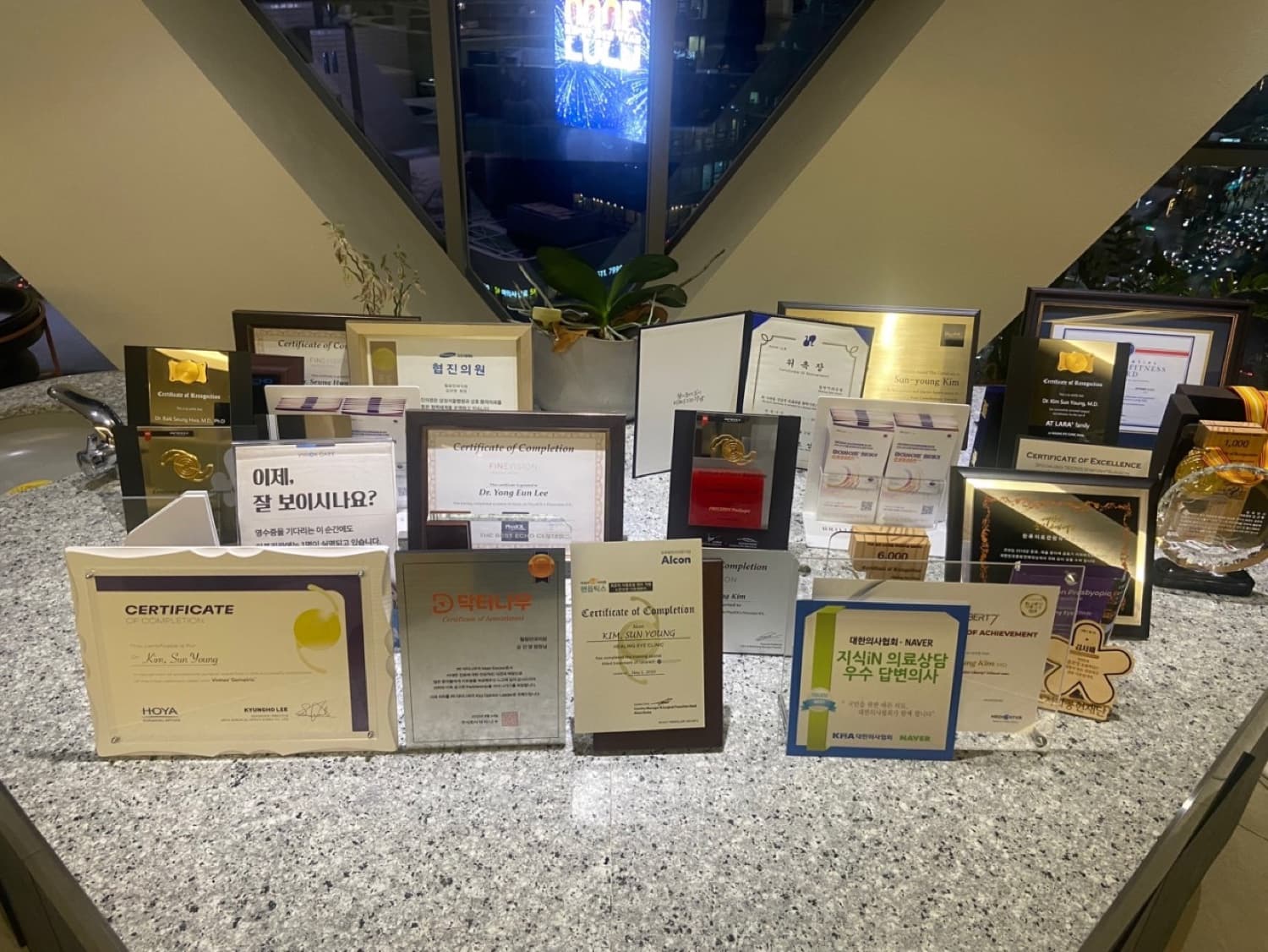
Marketing language is cheap; training is not. It's reasonable to want to know who is operating on your eyes. My own focus is cornea and cataract — I trained at the Catholic Medical Center, served as a clinical professor in cornea and cataract surgery, and I'm a member of the European Society of Cataract and Refractive Surgeons. Our second surgeon focuses on cataract, presbyopia, and oculoplasty.
You don't need to memorise credentials. You just need to confirm there are real, verifiable ones behind the website, and that the clinic is registered to treat international patients.
Test the conversation before you commit
Finally, judge a clinic by how it talks to you before you've paid anything. Can you have a genuine conversation in your own language? Is there an interpreter for the exam and the surgery explanation — not just the brochure? What does follow-up look like after you fly home?
You shouldn't have to consent to eye surgery in a language you only half understand, and you shouldn't have to commit to find out whether a clinic is right for you.
One honest limitation
I can give you these questions, but I can't choose your clinic for you, and I'd be wary of anyone who claims to — including me. The right clinic depends on your eyes, your procedure, and how comfortable you feel with the people answering your questions. Use these tests on every clinic you consider, mine included, and trust the ones who answer straight.
If you'd like to run these questions past us, message us free on WhatsApp or LINE. Tell us your prescription and concerns, and judge us by how honest the answers are — not by how nice the website looks. That's the standard I'd want my own family to use.
— Dr. Kim Sun-young, Medical Director, Healing Eye Clinic
Frequently asked questions
What's the single most important question to ask a Korean eye clinic?
Ask who actually performs your surgery and whether that same surgeon examines you and follows up afterward. If the answer is vague — 'one of our doctors' — that's a sign no single person owns your result. A clear, named answer tells you a lot.
Do foreigners pay more at Korean eye clinics?
Some places quietly add a markup for international or tourist patients. It's worth asking directly: 'Do foreigners pay the same as Korean patients?' At our clinic the answer is yes — international patients pay 100% the same as locals. An honest clinic won't dodge this question.
How do I judge online reviews from another country?
Look for volume and consistency over time, not a handful of glowing posts. Reviews from patients of your own nationality are especially useful. We hold a 4.8-star rating across more than 150 Google reviews, many from Japanese, Taiwanese and US patients — but I'd still tell you to read them critically.
Is a clinic that offers a same-day surgery a red flag?
Not by itself — same-day laser surgery is common when the exam confirms you're a candidate. The red flag is a clinic that promises surgery before examining you, or never mentions the possibility you might not be suitable. Willingness to say 'no' is a green flag.
What should I ask before I even travel?
Ask whether you can have a real conversation in your language before booking, whether there's an interpreter for the exam and surgery, and what their follow-up looks like once you're home. Message us on WhatsApp or LINE and judge us by how straight the answers are.
Message us on official LINE / WhatsApp for a special offer
Your exact candidacy and cost are confirmed in a free 1:1 consultation.