
Can LASIK Fix Astigmatism? A Seoul Surgeon's Complete First-Time Guide
Can LASIK fix astigmatism? Usually yes — but not every type or degree. A Seoul cornea surgeon explains the limits, the exam, and who should not have it.

Dr. Kim Sun-young, Director
Cornea · Glaucoma · Cataract
Contents
A patient from Melbourne slid her glasses across my desk last spring and said, "Three optometrists have told me my astigmatism is 'too complicated' for laser. Is that true, or are they being careful?" She had flown fourteen hours partly to hear a straight answer.
Can LASIK fix astigmatism? In most cases with regular astigmatism, yes — the excimer laser corrects cylinder just as it corrects short-sightedness, by reshaping the cornea in a specific meridian rather than uniformly. But "most cases" is doing real work in that sentence. Whether laser is right for your astigmatism depends on the type (regular or irregular), the amount, the thickness of your cornea, and whether your topography shows any hint of instability. This guide walks through all of it in the order I actually assess it in clinic.
What astigmatism really is — and why "correcting" it isn't the same as erasing it
A perfectly spherical cornea focuses light to a single point. An astigmatic cornea is shaped more like the back of a spoon: steeper in one direction than the other, so light focuses to two points instead of one. That is why astigmatic blur has a smeared, ghosted, streaky quality rather than the simple softness of myopia — headlights grow tails at night, and small text doubles slightly rather than just fading.
The laser addresses this by removing tissue asymmetrically: more along the steep meridian, less along the flat one, flattening the cornea toward a rounder profile. The correction is anatomical, not magical. Two things follow from that. First, we are limited by how much tissue can be safely removed. Second, we are correcting the cornea — if part of your astigmatism originates in the lens inside your eye, corneal surgery only addresses the corneal portion.
Laser surgery reshapes corneal astigmatism; it does not change the rest of the optical system, which is why a small residual cylinder afterward is normal rather than a failure.
Regular vs irregular — the fork in the road
Regular astigmatism has two clean perpendicular meridians. The laser is built for this, and results are predictable. Irregular astigmatism means the surface is distorted in ways that don't follow that pattern — from keratoconus, previous injury, scarring, or a prior surgery that healed unevenly. Standard LASIK is generally the wrong tool there, and in keratoconus or keratoconus-suspicious eyes a corneal flap can make the cornea less stable over time. I decline those cases. It is not caution for its own sake; it is the one scenario where surgery can leave someone worse off years later.
How much astigmatism is too much for LASIK?
There is no single diopter number I can print here honestly, because the ceiling is a relationship, not a threshold. High cylinder combined with high myopia consumes far more corneal tissue than either alone. A 520-micron cornea and a 570-micron cornea with the same prescription give different answers. Pupil size in the dark matters too, because a large pupil with a high astigmatic correction raises the odds of night glare and halos.
Here is roughly how I sort options in clinic once the numbers are on screen:
| Astigmatism level | Cornea thick & topography normal | Cornea thin, irregular, or very high total prescription |
|---|---|---|
| Low (mild cylinder) | Clear LASIK or Premium LASIK — straightforward | Surface ablation (LASEK) often a better fit |
| Moderate | Custom/wavefront-guided laser, axis-tracked | LASEK, or toric implantable lens if myopia is also high |
| High | Possible, but tissue budget decides — I may still say no | Toric ICL is usually the safer route |
| Irregular / keratoconus-suspicious | Not a LASIK candidate | Cross-linking, specialty lenses, or no surgery at all |
If you are sitting in the bottom half of that table, the more useful reading is our deeper comparison of real options for high astigmatism correction, which goes through the trade-offs case by case.
Which laser procedure suits an astigmatic eye
People arrive asking for "LASIK" the way they'd ask for a brand. Inside that word there are meaningful differences.
Clear LASIK (4th generation) builds a thin, uniform flap and maps your exam data into the laser profile. Flap uniformity matters more for astigmatism than for plain myopia, because an uneven flap introduces its own low-grade irregularity on top of the correction you wanted. Details of how the flap and correction profile are designed sit on our Clear LASIK procedure page.
Personal Custom LASIK uses wavefront and topographic mapping to tailor the ablation to your individual corneal fingerprint rather than a generic cylinder value. For eyes with a slightly asymmetric but still regular pattern, this is often where I get the cleanest visual quality; the custom LASIK page explains what the mapping actually captures. Our Korean head office also publishes a technical breakdown of astigmatism correction on 퍼스널커스텀 라식 페이지 if you want the source material.
Perfect Healing LASEK removes the surface epithelium instead of cutting a flap. Slower, more uncomfortable in the first days, but it preserves more structural cornea — which is exactly what a thin astigmatic cornea needs. See our LASEK surface-ablation page.
Toric ICL doesn't touch the cornea at all. A lens with the astigmatic correction built in is placed inside the eye and rotationally aligned to your axis. For high cylinder with high myopia, this is frequently the better engineering answer, and I explain the alignment and rotation question in our guide to toric ICL for astigmatism.
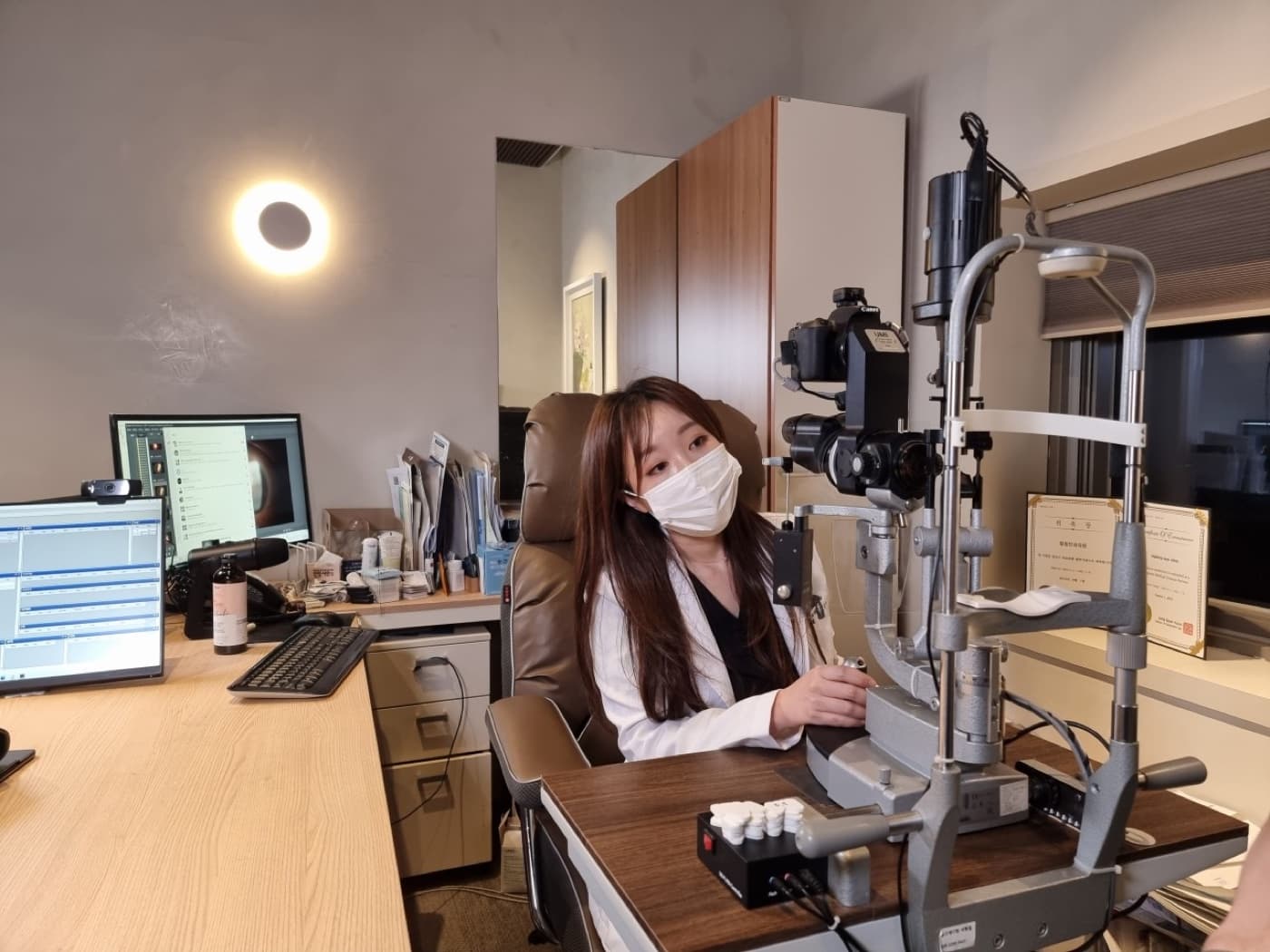
What the exam day actually involves
Allow two to three hours. We measure corneal thickness across the whole surface, run topography and tomography to map both the front and back curvature, check pupil diameter in dim light, assess tear film, measure intraocular pressure, and count corneal endothelial cells. For astigmatism specifically, the axis must be measured repeatedly and consistently — a wandering axis between measurements is itself a warning sign.
One practical thing that ruins more international exams than anything else: contact lenses. Toric soft lenses in particular reshape the cornea and skew the axis reading. Soft lenses out for roughly one to two weeks, rigid lenses considerably longer. If you arrive with lenses worn the previous day, we may have to repeat the scans mid-trip, and that eats your schedule.
The exam decides the surgery; the surgery is just the execution of what the exam found.
Surgery day, and the recovery you should actually plan for
Clear LASIK takes around ten minutes for both eyes. Numbing drops only, no needles, no general anesthesia. You are awake, asked to look at a fixation light, and the eye-tracker follows micro-movements including the rotational component that matters for astigmatism. It is not a comfortable ten minutes — there is pressure, and vision goes dim during the flap step — but it is short, and your surgeon talks you through it with an interpreter present.
The clinic's authoritative recovery figure for Clear LASIK is return to daily life in one to two days. Realistically: blurred and watery for the first evening, functional the next morning, and then a period of fluctuation. Astigmatic eyes often notice this fluctuation more, because cylinder is the last component to settle — text may be sharp at 10am and slightly ghosted by 8pm for the first couple of weeks. Night glare and starbursts are common early and typically reduce over weeks to months, but I will not tell you they always disappear entirely. Dry eye is the other honest downside: corneal nerves are cut during flap creation and take months to recover, and some patients need drops well beyond the first month.
If your prescription is strong as well as astigmatic, it is worth reading how I weigh ICL against LASIK for high myopia before you settle on a laser plan.
Who I say no to
Unstable prescription in the past year. Keratoconus or a suspicious topography pattern. Cornea too thin for the required ablation. Significant untreated dry eye — that has to be settled before, not after. Active ocular inflammation or uncontrolled systemic autoimmune disease. Pregnancy or breastfeeding, because refraction shifts. Under 18, and often under 20 if the prescription is still moving. And occasionally, someone whose expectations I cannot meet honestly: if you need absolute perfection in low-light precision work, I will say so rather than sell you a procedure.
What astigmatism correction costs at Healing Eye
Astigmatism is not the obstacle it was twenty years ago, but it is also not a footnote. Bring your old prescriptions, stop your contact lenses in good time, and let the scans decide. If the answer for your eyes is yes, I will tell you which version of yes. If it is no, I will tell you that too, and explain what else is on the table.
— Dr. Kim Sun-young, Medical Director, Healing Eye Clinic, Sinnonhyeon, Seoul
Frequently asked questions
Can LASIK fix astigmatism completely, or only reduce it?
For most people with regular astigmatism, the laser can reduce the cylinder substantially — often to a level where glasses are no longer part of daily routine. But I never describe the result as total elimination, because a small residual cylinder is common and normal, and the eye continues to change slowly over a lifetime. What I can tell you honestly is the statistical range for your specific measurements, based on your topography and prescription. Anyone promising you a fixed number before they have seen your scans is guessing.
What level of astigmatism is too high for laser surgery?
In practice, the laser handles low and moderate regular astigmatism well, and my caution rises sharply as the cylinder climbs into the high range — especially when it is combined with strong myopia, because the two together consume a lot of corneal tissue. The real ceiling is not a single number but the relationship between your cylinder, your sphere, your corneal thickness and your topography pattern. Two people with identical prescriptions can get different answers from me for that reason. When laser is not the safe route, a toric implantable lens usually is.
Is irregular astigmatism treatable with LASIK?
Irregular astigmatism — where the corneal surface is distorted rather than evenly oval — is a different problem, and standard LASIK is generally not the answer. If the irregularity comes from keratoconus or a keratoconus-suspicious topography, a flap-based laser procedure can worsen corneal instability, so I decline it. Depending on the cause, options may include surface ablation in carefully selected cases, corneal cross-linking, or non-surgical management with specialty contact lenses. The exam, not the prescription on your glasses, tells us which category you are in.
Does astigmatism come back after LASIK?
The corneal shape created by the laser is stable in most eyes, but the eye as a whole is a living organ that keeps changing. A small amount of astigmatism can appear again over years, particularly if your prescription was still drifting before surgery or if the lens inside the eye changes with age. This is why I ask for a stable prescription over roughly the past year before I operate, and why we schedule long-term check-ups rather than discharging you after a month. If a meaningful change appears later, we assess whether an enhancement is appropriate or whether glasses for specific tasks make more sense.
How long should I stay in Seoul for astigmatism laser surgery?
For Clear LASIK or Premium LASIK, the clinic record is return to daily life in one to two days, and I ask international patients to plan for several days in total: a full exam day, the surgery day, and at least one post-operative check before flying. If your exam points toward LASEK instead, the surface heals more slowly and you should plan a longer stay. I would rather you book a flexible return ticket than compress the schedule and skip a check. Flying itself is not dangerous to the healing eye, but cabin air is dry, so lubricating drops in hand luggage matter.
Do I need to stop wearing contact lenses before the astigmatism exam?
Yes, and this is the single most common reason a traveling patient's data comes back unusable. Contact lenses mold the corneal surface, and with toric lenses for astigmatism the effect on axis measurement can be significant. I generally ask for soft lenses to be out for about one to two weeks and rigid or hard lenses for considerably longer, with the exact period confirmed by our coordinators for your lens type. If you arrive having worn lenses the day before, your topography may need to be repeated later in your trip.
Message us on official LINE / WhatsApp for a special offer
Your exact candidacy and cost are confirmed in a free 1:1 consultation.