Am I a Candidate for LASIK? The Exam Findings That Make Me Say No
Am I a candidate for LASIK? A Seoul cornea surgeon on the exam findings that rule you out, who LASIK genuinely suits, and the risks worth knowing.

Dr. Kim Sun-young, Director
Cornea · Glaucoma · Cataract
Contents
"I've worn contacts since I was fifteen, I've already booked four days in Seoul in March, and I just need to know before I pay for the flight — will you actually be able to do it?"
A version of that message lands in my inbox most weeks. It's a fair question and a reasonable way to think about a trip. It's also the one question I refuse to answer casually.
"Am I a candidate for LASIK" is not a question your prescription can answer, and any clinic that answers it from a photo of your glasses receipt is selling you a booking, not an assessment. Your prescription tells me how much corneal tissue would need to be reshaped. It tells me nothing about how much tissue you have, what shape it's in, how your tear film behaves, or how wide your pupils open in the dark — and those are the findings that decide. Below is exactly what I measure, exactly which results make me say no, and the risks I go through with every patient before they sign anything.
Candidacy is decided by corneal thickness, corneal shape, tear film, pupil size and prescription stability — not by how badly you want to stop wearing contacts.
The measurements that decide it, before I say a word
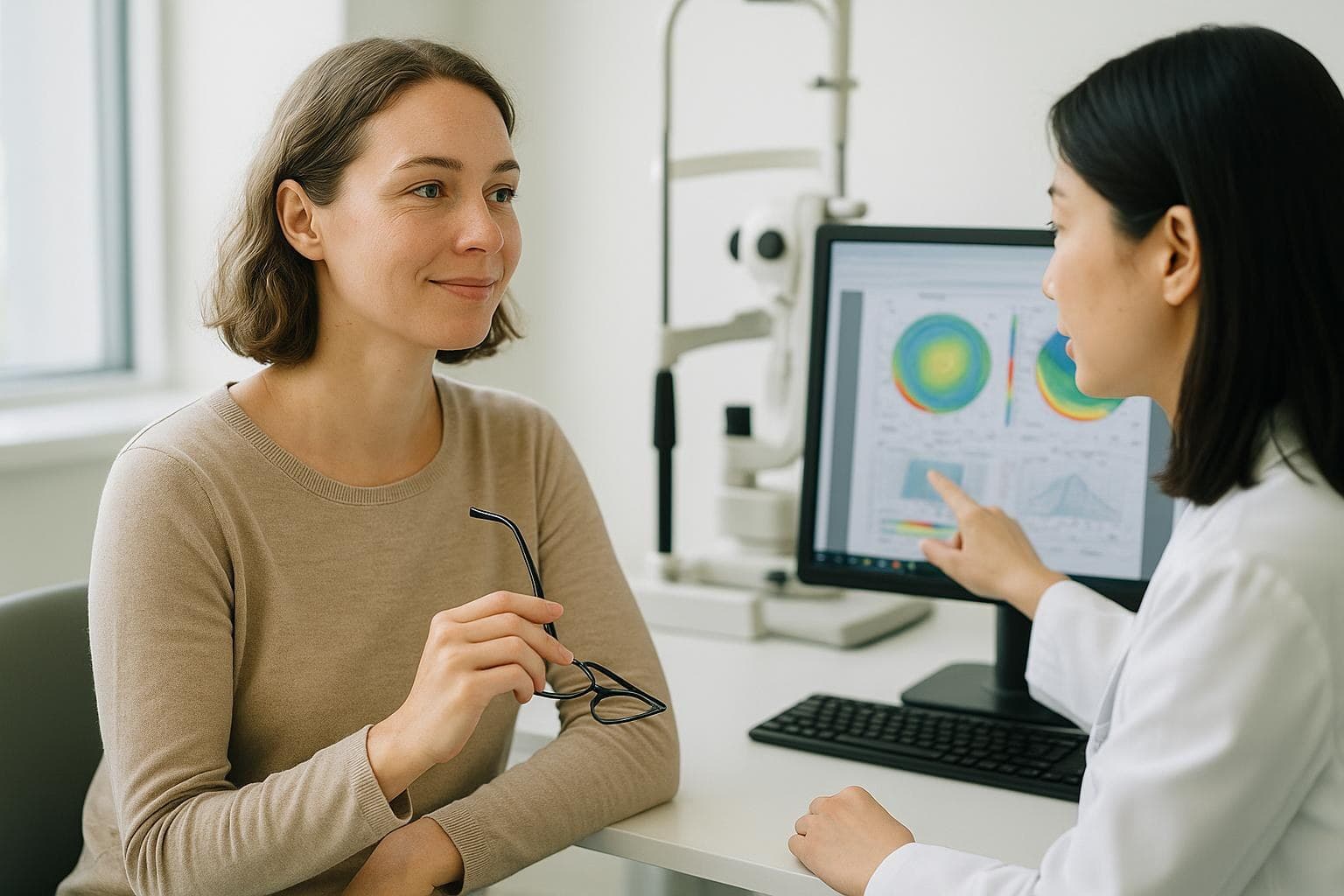
A good outcome begins in the exam room, not the laser room. When you come in for a full workup, I'm not confirming a decision you've already made — I'm looking for reasons not to operate. Here is what I actually read:
- Corneal thickness (pachymetry). I need to know what's left underneath after a flap is created and tissue is removed. That residual stromal bed is the structural floor of your eye.
- Corneal topography and tomography. The shape map. This is where keratoconus and subtle asymmetric steepening show up — sometimes in a patient with no symptoms at all and 20/20 corrected vision.
- Refraction stability. I want a prescription that hasn't moved meaningfully in about a year. If it's still drifting, surgery is chasing a moving target.
- Tear film and meibomian glands. Dry eye is the most common post-LASIK complaint worldwide, and I'd rather find it before than after.
- Pupil diameter in dim light. Large scotopic pupils correlate with glare and halos at night, and that changes how I design the optical zone — or whether I operate at all.
- Intraocular pressure, endothelial cell count, and a dilated retinal check. Undiagnosed glaucoma, an early cataract, or a retinal problem changes the entire plan.
Who LASIK genuinely suits
LASIK does its best work in a fairly specific person: over 18 and ideally in their twenties or older, with a stable myopic or astigmatic prescription, a cornea of adequate thickness and normal shape, a healthy tear film, and expectations grounded in reality rather than in someone else's Instagram post. Add one more thing — a life that rewards fast recovery. Clear LASIK takes about ten minutes for both eyes and most patients are back to daily life in one to two days, which is why it fits people flying in with a limited number of days off.
If your night vision matters more than average — you drive at night for work, or you're simply fussy about contrast — the aberration-mapped approach on our Personal Custom LASIK page is usually the more sensible design, because it accounts for the higher-order aberrations a standard prescription test never sees. The technical detail of the fourth-generation flap design is set out on our Clear LASIK treatment page, and our Korean head office covers the same procedure in more depth on the 클리어라식 page at healingeye.co.kr.
Age is its own conversation. In your late forties, correcting distance perfectly can make reading harder sooner than you expected, which is a trade-off you should choose deliberately — I've written about where the boundaries sit in my honest take on the LASIK age limit.
The findings that make me say no
This is the part of the article I care most about. Being able to say "not you" is the whole reason a surgical consultation exists.
Findings where I will not operate
Keratoconus or suspicious topography. Even a forme fruste pattern — subtle inferior steepening, asymmetric astigmatism — is a hard stop for flap-based LASIK. Cutting a flap in a biomechanically weak cornea risks progressive ectasia, meaning the cornea bulges and vision deteriorates over months or years. There is no undo for that.
Insufficient residual cornea. If the arithmetic between your thickness and your prescription doesn't leave a conservative margin, the answer is no, regardless of how much you want it.
Established dry eye disease or an autoimmune cause. Sjögren's, significant meibomian gland dropout, or severe evaporative dry eye that hasn't responded to treatment. LASIK temporarily reduces corneal nerve function and tear production; an eye with no reserve has nowhere to go.
Uncontrolled glaucoma, a visually significant cataract, or a history of herpetic keratitis. Each of these changes the risk calculation entirely, and the first two mean a different procedure is the correct treatment, not laser correction.
Expectations I can't meet. If a patient tells me they need a guaranteed result to keep a job or a visa, I decline. Nobody can guarantee a visual outcome, and a surgeon who implies otherwise is the risk.
Findings where the answer is "wait," not "never"
| Exam finding | What it usually means | My typical answer |
|---|---|---|
| Prescription changed in the last 12 months | Refraction hasn't settled | Recheck in 6–12 months |
| Contact lenses worn up to the exam | Cornea is warped; maps unreliable | Re-measure after 1–2 weeks off soft lenses, longer for RGP |
| Mild dry eye from years of lens wear | Treatable tear film problem | Treat first, reassess, then decide |
| Pregnant or breastfeeding | Hormonal refractive shift | Postpone |
| Large dark-adapted pupils, moderate myopia | Higher glare risk | Discuss honestly; consider a different optical zone design or a different procedure |
| Thin cornea, moderate prescription | LASIK margin too tight | Consider a surface procedure or lens-based option |
The risks I say out loud, every time
LASIK is a well-studied procedure with a strong safety record, and it is still surgery on a healthy organ. These are the realistic downsides:
Dry eye. The most common complaint after surgery. For most patients it's a matter of weeks to a few months of drops; for a minority it lingers longer and needs active management. If you already have symptoms, read my honest talk about LASIK and dry eye risk before you book anything.
Night glare, halos and starbursts. Usually most noticeable in the first weeks and typically settling, but not guaranteed to disappear entirely — and more likely with larger pupils and stronger corrections. I've written about what this genuinely looks like behind the wheel in our piece on LASIK and night driving glare.
Under- or overcorrection and regression. Some eyes drift back toward myopia over the years, particularly higher prescriptions. Enhancement is sometimes possible, sometimes not, depending on how much cornea remains — which is why I calculate the margin for a possible future re-treatment on day one. Our LASIK and LASEK revision page explains where the limits of re-correction sit.
Flap-related problems. Rare, but real: microstriae, epithelial ingrowth, or flap displacement after a blow to the eye. If you box, do judo, or play contact sport for a living, I'll steer you away from a flap procedure entirely.
Infection or inflammation. Uncommon, treatable when caught early, and the main reason I want to see you for a post-op check before you fly home rather than after.
When the cornea says no, there is usually another road
Being turned down for LASIK is not the end of the conversation. A borderline-thickness cornea may suit a surface procedure such as LASEK, where no flap is made; a cornea with adequate thickness but a preference for a smaller incision may suit our SMILE procedure. A very high prescription, or an eye where I don't want to thin the cornea at all, often points toward an implantable lens instead — the ceiling for laser correction is a real one, and I've mapped out where it sits in our guide to the high prescription LASIK limit. You can see the full range side by side on our treatments overview.
What the assessment itself costs
A candidacy exam you can fail is the only kind worth paying for.
Making one trip count
Stop soft lenses one to two weeks before your exam — longer for toric or rigid lenses — and bring your glasses. Allow a few days in Seoul rather than a single afternoon: exam and discussion on one day, surgery, then a post-op check before you fly. We're one minute from Sinnonhyeon Station and roughly 70 minutes from Incheon, with Japanese, Traditional Chinese and English interpreters on site, so you'll go through your own scan data in your own language before you decide anything. One surgeon stays with you from exam through aftercare, and follow-up continues by video call once you're home.
I'd rather you flew home still wearing glasses than flew home with a cornea I shouldn't have touched. Send me your prescription by all means — but come for the exam with the possibility of a "no" already in your pocket. If the answer turns out to be yes, you'll trust it far more.
— Dr. Kim Sun-young, Medical Director, Healing Eye Clinic (Cornea · Glaucoma · Cataract)
Frequently asked questions
Can you tell me if I'm a candidate for LASIK from my glasses prescription over email?
No, and I'd be suspicious of any clinic that says yes. Your prescription tells me roughly how much tissue would need to be reshaped, but it tells me nothing about your corneal thickness, corneal shape, tear film, pupil size in the dark, or eye pressure. Those are the measurements that actually decide the answer, and they need instruments, not email. What I can do from a prescription is tell you in advance whether you're in a range where I'd expect a straightforward discussion or a difficult one.
What corneal thickness is too thin for LASIK?
There isn't a single number, because thickness only matters relative to how much correction you need and how thick the flap is. What I calculate is the residual stromal bed — the untouched corneal tissue left underneath after the flap and the laser treatment — and I keep a conservative margin. Someone with a thin cornea and a mild prescription may be fine; someone with an average cornea and a very strong prescription may not be. If the arithmetic doesn't leave a comfortable margin, I won't stretch it, because corneal ectasia is not a complication you can undo.
I have dry eyes. Does that automatically disqualify me?
Not automatically, but it changes the conversation and sometimes the timing. Mild dryness from years of contact lens wear is common and often improves once we treat the tear film for a few weeks before surgery. Established dry eye disease, meibomian gland dropout, or dryness linked to an autoimmune condition is a different matter, and in those cases I would either treat first and reassess or advise against laser correction entirely. LASIK temporarily reduces corneal nerve sensation and tear production, so an eye that is already struggling has less reserve to draw on.
How long do I need to stop wearing contact lenses before the candidacy exam?
Soft lenses distort the corneal surface, so I ask patients to stop for at least one to two weeks before the exam, and longer for toric or rigid gas permeable lenses — RGP wearers often need several weeks. This matters more than people expect: measuring a cornea that is still warped by a lens can produce a topography map that looks abnormal when the eye is actually healthy, or hide a real irregularity. If you're flying in for a short trip, plan the lens break around your flight dates, not around your arrival. Wear your glasses instead, even if you dislike them.
If I'm not a candidate for LASIK, what are my options?
Quite often there is one, which is why I don't like the word 'rejected.' A thin or borderline cornea may still suit a surface procedure such as LASEK, or SMILE if the numbers work; a very high prescription or a cornea I don't want to thin at all may point toward an implantable lens like ICL. Some patients are simply too young or their prescription hasn't settled, in which case the answer is 'not this year' rather than 'never.' And a small number of people are better off staying in glasses, and I will say so.
How many days should I plan in Seoul for the exam and surgery?
I recommend allowing a few days rather than treating it as a same-day errand. The full exam takes a couple of hours because of the number of measurements and the dilation, and I want time to discuss the findings with you through an interpreter before you decide. Clear LASIK itself takes around ten minutes for both eyes, and most patients are back to daily life in one to two days, but I want to see you for a post-op check before you fly. Booking your flight home for the day after surgery removes that safety margin, so I'd rather you didn't.
Message us on official LINE / WhatsApp for a special offer
Your exact candidacy and cost are confirmed in a free 1:1 consultation.