High Prescription LASIK Limit: How Strong Is Too Strong?
If your prescription is high, you've probably wondered where the LASIK limit really is. I'm Dr. Kim — here's what sets the ceiling, why it's your cornea not your diopters, and when ICL wins.

Dr. Kim Sun-young, Director
Cornea · Glaucoma · Cataract
Contents
"I'm a -9. Three clinics told me different things — am I even allowed to get LASIK?"
I hear this from strong prescriptions constantly, and there's real anxiety underneath it. People who've worn thick lenses since childhood often assume they're permanently locked out of laser surgery, or they've been quoted a flat diopter limit that contradicts the next clinic's. Let me explain where the ceiling actually sits, because it's almost never the number you're fixated on.
The limit isn't your diopters — it's your cornea
When you search for a high prescription LASIK limit, you're probably hoping for a clean cut-off like "-10 and you're out." I understand the appeal, but it's misleading.
Here's the physics in plain terms. LASIK corrects nearsightedness by removing corneal tissue to flatten the cornea. The stronger your prescription, the more tissue has to come off. But your cornea isn't infinitely thick, and we must leave a healthy, untouched layer beneath the treatment — the residual stromal bed. If correcting your full prescription would thin the cornea past that safety margin, then you're over the limit — even if your diopter number alone looked acceptable.
Two things set your real ceiling together: how much tissue your prescription needs removed, and how much cornea you started with. The diopter number on its own tells me almost nothing until I measure your thickness.
This is why a -7 patient can be turned away while a -9 patient is cleared. The -7 may have a naturally thin cornea with little margin to spare; the -9 may have a generous one. The chart-based "limit" you read online ignores the variable that actually decides it.
What I'm measuring when you walk in
For a strong prescription, the pre-op exam isn't a formality — it's the whole decision. I'm looking at:
- Central corneal thickness — your starting budget of tissue.
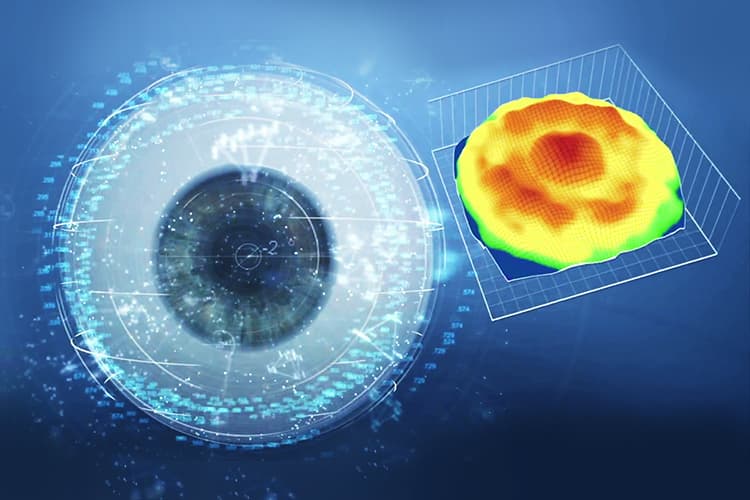
- Corneal topography and tomography — the shape and any subtle irregularity that would make thinning the cornea risky.
- The depth the laser would need to reach for your full correction, and whether that still leaves a safe residual bed.
- Pupil size, because larger pupils plus a high correction can mean more night-vision side effects.
Only once I have those numbers can I tell you honestly: yes, LASIK fits; or no, and here's the better route.
When the answer is ICL instead
If your prescription is very high, or your cornea is thinner than your correction needs, this isn't the end of the road — it's usually a redirection to ICL.
Instead of reshaping and thinning the cornea, ICL implants a thin, biocompatible lens inside the eye, in front of your natural lens. The cornea is left untouched. That's a profound advantage for strong prescriptions: there's no tissue ceiling to bump against, so ICL can correct levels of myopia well beyond the practical reach of laser surgery, and it does so without weakening the cornea.
For my very high myopes, ICL is frequently the more stable, more sensible answer — not a consolation prize.
What shapes the cost when your prescription is high
The procedure you actually qualify for (LASIK, SMILE, or ICL) is the biggest driver — and ICL, because of the lens itself, usually sits at a different price point than laser. Your prescription, corneal thickness, astigmatism, and the scope of follow-up all factor in. We give you an exact figure only after the exam, and international patients pay the same fee as Korean patients.
The long view: regression at high corrections
There's one more honest point about strong prescriptions. Because more tissue is reshaped, very high LASIK corrections carry a slightly greater chance of mild regression over the years than low ones — a small drift back toward myopia. It's usually minor and often correctable with an enhancement.
But it's part of why, for the strongest prescriptions, I often lean toward ICL, which doesn't depend on permanently reshaping the cornea. And it's why our lifetime surgery guarantee exists: if your eyes do shift over the long term, you're not on your own.
The honest limitation
I'll be direct about what I can't do. I cannot tell you from your prescription alone whether you clear the limit. A -10 with a thick cornea might be a fine LASIK candidate; a -6 with a thin one might not be. Anyone who clears you for high-prescription LASIK over chat, before measuring your corneal thickness and topography, is guessing — and with strong corrections, guessing is where harm starts.
What I can promise is a thorough exam, a straight answer, and a willingness to tell you "ICL suits your eyes better than LASIK" even though that's the more involved procedure. Your stable vision over the next twenty years matters more than fitting you into the technique you arrived asking for.
Planning your trip
If you're coming from abroad, plan at least 3 days and 2 nights in Seoul — the next-day check-up matters, and you shouldn't fly the same day. ICL sometimes needs its own short lead time, which we map with you. We're a one-minute walk from Sinnonhyeon Station in Gangnam, around 70 minutes from Incheon Airport. Stop your contact lenses for some days before the exam so we read your true cornea — message us first, since soft and hard lenses differ.
Write to me first, for free, in English on our official WhatsApp or LINE. Send your full prescription and, if you have it, any corneal thickness reading from a past exam. I'll give you an honest sense of whether you're looking at laser or ICL before you book anything.
— Dr. Kim Sun-young, Medical Director, Healing Eye Clinic
Frequently asked questions
What is the highest prescription LASIK can correct?
Many surgeons treat up to somewhere around -8 to -10 diopters of myopia with LASIK, but I won't hand you a fixed number, because the diopters alone don't set your limit. Your corneal thickness does. A -7 patient with a thin cornea may not qualify, while a -9 patient with a thick, healthy cornea sometimes does. We decide from your measurements, not from a chart.
Why does a high prescription matter for LASIK?
The stronger your prescription, the more corneal tissue the laser must remove to reshape the eye. Every cornea has a finite amount of tissue, and we must leave a safe untouched layer underneath — the residual stromal bed. High prescriptions push against that ceiling, which is why thickness becomes the deciding factor rather than the prescription number itself.
If my prescription is too high for LASIK, what are my options?
Usually ICL. Instead of reshaping and thinning the cornea, we implant a thin corrective lens inside the eye, leaving the cornea untouched. For very high myopia or thinner corneas, ICL is frequently the safer and more stable choice, and it can correct prescriptions well beyond the practical reach of laser surgery.
Is LASIK or ICL better for high myopia?
Neither is universally better — it depends on your cornea. If you have plenty of corneal thickness for your prescription, LASIK or SMILE can work well. If your prescription is very high or your cornea is on the thin side, ICL usually gives a more stable result without overthinning the cornea. The exam settles it.
Can a high prescription come back after LASIK?
Higher corrections carry a somewhat greater chance of mild regression over the years than low ones, because more tissue was reshaped. It's usually small and often manageable with an enhancement. This long-term picture is one more reason I sometimes prefer ICL for very strong prescriptions — and why our lifetime guarantee matters.
Message us on official LINE / WhatsApp for a special offer
Your exact candidacy and cost are confirmed in a free 1:1 consultation.