
Cataract Surgery Risks and Complications: The Patients I Tell Not to Book the Flight
Cataract surgery risks and complications, explained by a Seoul surgeon: real numbers, the exam findings that rule you out, and who I turn away.

Dr. Kim Sun-young, Director
Cornea · Glaucoma · Cataract
Contents
A patient in Melbourne wrote to me last month with a fair complaint: “Every website says cataract surgery is one of the safest operations in medicine. So why does your clinic want two hours of testing before you'll even give me a date?”
Cataract surgery risks and complications are small — genuinely smaller than most people fear — but they are not zero, and the size of your risk is set almost entirely by what your exam shows, not by how new the equipment looks or how many cases the surgeon has done. That is the whole reason for the testing. When an operation has a low baseline complication rate, the only meaningful way to improve your odds is to find, in advance, the eyes that sit outside that baseline — and to say so out loud. This article is the version of that conversation I would have with you across the desk in Sinnonhyeon, including the part where I tell some people not to book the flight.
The complication list I read out loud, with numbers attached
I don't hand patients a consent form and look away while they sign it. Here is the list, with the frequencies reported in the published literature for routine phacoemulsification. Your own numbers may be higher or lower depending on your exam — that is the point of the exam.
| Complication | Roughly how often | What you would notice | What is done about it |
|---|---|---|---|
| Posterior capsule opacification (“after-cataract”) | ~10–30% within 5 years | haze creeping back months or years later | YAG laser in clinic, a few minutes |
| Dry eye / ocular surface irritation | very common in the first weeks | grittiness, vision that fluctuates through the day | drops, and treating the surface before surgery |
| Refractive surprise (focus lands off target) | a small percentage | you still need glasses for the distance you wanted | re-measurement; glasses, or a discussion about further options |
| Glare, halos, starbursts (dysphotopsia) | common early; a minority persist, more often with multifocal IOLs | rings around headlights at night | neuroadaptation over months; rarely lens exchange |
| Cystoid macular edema | ~1–2%, higher with diabetes | central blur appearing at 4–8 weeks | anti-inflammatory drops, monitoring |
| Posterior capsule rupture during surgery | ~1–2% | longer operation, sometimes a changed lens plan | managed during the case |
| Pressure spike in the first days | uncommon | dull ache, haze | next-day pressure check, drops |
| Retinal detachment | well under 1% overall, higher in high myopia | flashes, a shower of floaters, a curtain | urgent referral to a retinal center |
| Endophthalmitis (infection inside the eye) | roughly 1 in 1,000–5,000 | pain and rapid vision loss days after surgery | emergency treatment; sight-threatening |
Almost every serious complication on that list is more likely in an eye that had a warning sign visible before surgery — which is why the exam, not the operation, is where safety is actually decided.
After-cataract deserves a word of reassurance, because patients often believe their cataract has “come back.” It hasn't; the implant stays clear, and it is the capsule holding it that hazes. Our head office in Korean explains it on the page about 후발성 백내장 and YAG laser treatment, and it is a clinic-room procedure, not a second operation.
The exam findings that make me say “no” — or “not yet”
Findings that stop the operation
A low corneal endothelial cell count, or Fuchs' dystrophy, is at the top of my list. Those cells keep the cornea clear, they do not regenerate, and phacoemulsification uses ultrasound energy inside the eye that stresses them. Operate on a borderline cornea and you can trade a cloudy lens for a cloudy cornea — a far harder problem, and one that we do not treat here, since Healing Eye does not perform corneal transplantation.
I also stop for active uveitis, uncontrolled eye pressure or advanced glaucomatous damage, untreated diabetic retinopathy, and any retinal pathology that needs attention first. We do not perform retina or glaucoma surgery at this clinic, so in those cases my job is to send you to the right subspecialist, not to squeeze you into a surgical slot.
Findings that don't stop surgery but change the promise
Macular degeneration, an epiretinal membrane, or old diabetic macular changes rarely forbid cataract surgery — but they put a ceiling on the result. Removing a cloudy lens cannot improve a macula. If your ceiling is limited, you need to hear the number before you spend money and holiday time, not after.
Pseudoexfoliation, weak zonules, a very dense white cataract, previous eye trauma, or a history of tamsulosin (Flomax) with floppy iris syndrome all raise the technical risk of capsule complications. They are not disqualifiers — they are reasons I plan the case differently and tell you the odds honestly.
Who should not choose a premium multifocal lens
This is the most common “no” I give, and it is a lens decision rather than a surgery decision. Large pupils, irregular corneal astigmatism, prior LASIK, any macular change, night-shift driving, and — honestly — a perfectionist temperament all push me toward a monofocal design. I walk through both sides of that choice in my comparison of monofocal and multifocal IOLs for cataract patients, and you can see the premium lens families we work with on our head office's Korean 프리미엄 인공수정체 page.
“Not yet” is a real answer
Some patients arrive with a cataract so early that surgery would be solving a problem they don't yet have. There is no medical reward for operating on a lens that hasn't touched your driving, reading or work. Equally, waiting indefinitely is not free: a rock-hard cataract needs more ultrasound energy and carries a higher chance of capsule trouble. The judgment sits between those two, and it is functional — how you live, not how the lens photographs. I lay out exactly how I weigh that in my article on when to have cataract surgery.
The risks that belong to the itinerary, not the eye
Flying for surgery adds a category of risk the brochures skip. Cabin pressure after routine phacoemulsification is not the issue; the calendar is. Pressure spikes, macular swelling and infection declare themselves over days to weeks, and a patient who is airborne on day two is a patient I cannot examine on day three.
So before any international patient books, I want three things: a stay long enough to cover the follow-up schedule we set, the name of an ophthalmologist reachable within 24 hours in your home city, and your operative records in hand when you leave. My day-by-day recovery timeline for cataract patients shows what the first week actually looks like so you can book the return flight around reality rather than hope.
What genuinely lowers your risk
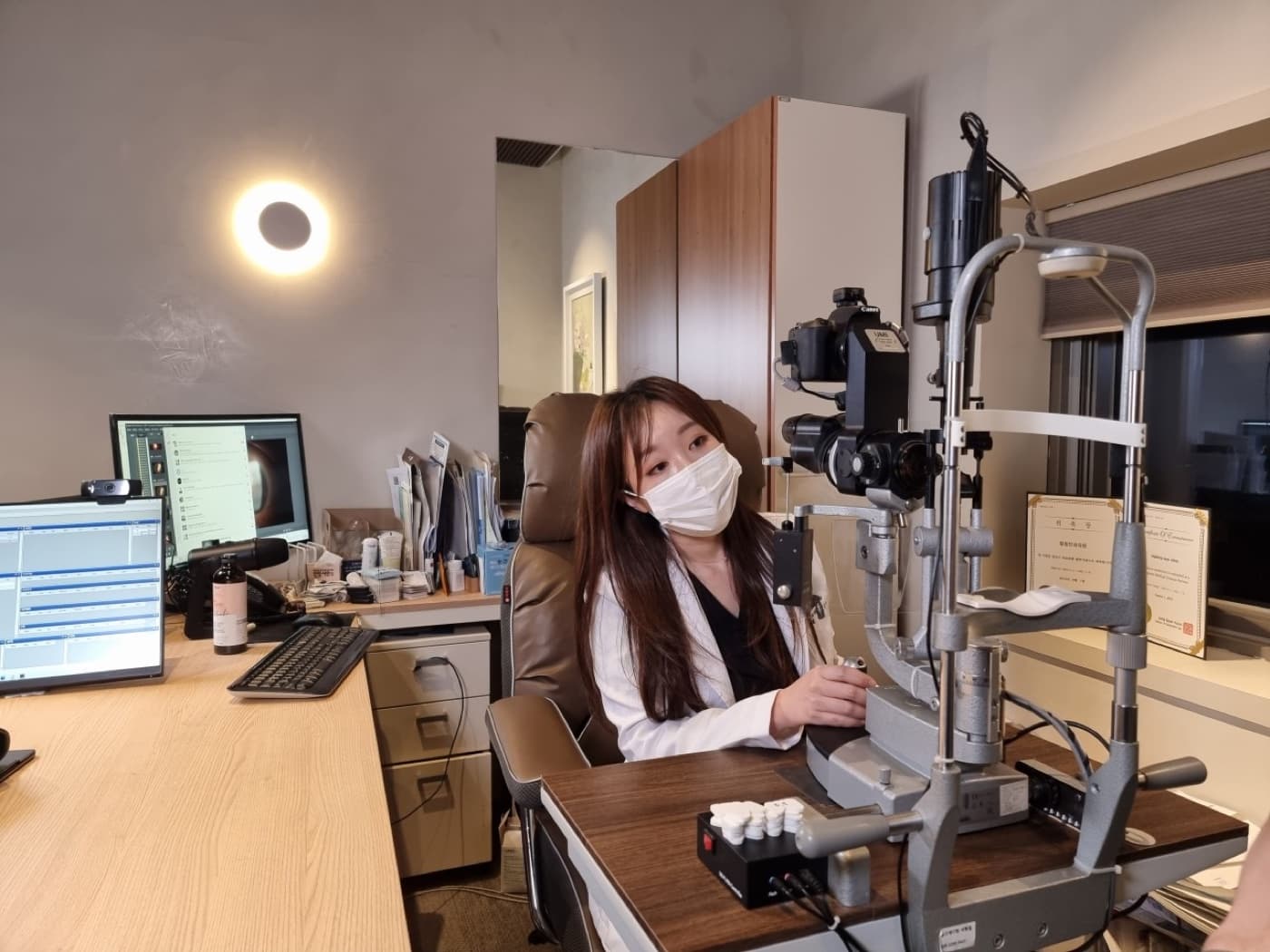
Precision before the incision. I scrutinize biometry more than I scrutinize my own hands: eye length, corneal curvature, astigmatism axis, pupil behavior, tear film, endothelial count, macula and optic nerve, both eyes. A tear film that is unstable will falsely shift your measurements, which is why we treat the ocular surface first rather than measuring through it. The diagnostic and surgical platforms we use for this work are listed on our head office's 백내장 검사·수술 장비 page, and the step-by-step procedure and lens options are set out on our cataract surgery treatment page.
The rest is unglamorous and matters enormously: stop contact lenses well before measurement, disclose every medication, take the post-op drops exactly on schedule, don't rub the eye, and keep the follow-up appointments. At this clinic one surgeon owns your journey from exam through surgery to aftercare, with lifelong check-ups and our responsibility guarantee — so the person who measured you is the person answering your email three months later.
Money, and why the cheapest lens is not the risky one
Cataract pricing at Healing Eye (per eye)
A monofocal lens is not a downgrade and it is not less safe — for some eyes it is the more appropriate optic, and it is the one I recommend when the exam doesn't favor splitting light. What you pay more for with a premium IOL is a different range of focus, not a lower complication rate. If you want the full breakdown of what moves the number, I wrote a surgeon's guide to cataract surgery cost in Korea.
What I say to the patient I turn away
I tell them the truth: that I could operate, that it would probably go fine, and that “probably fine” is not a good enough reason to take a knife to an eye whose exam is telling me to wait, or to refer, or to choose a different lens. Nobody has ever thanked me for an operation I shouldn't have done. Several people have thanked me for the one I didn't.
Come for the exam with your questions written down. If your eyes are right for this, I will tell you plainly — and if they aren't, I will tell you that just as plainly.
— Dr. Kim Sun-young, Medical Director, Healing Eye Clinic, Sinnonhyeon, Seoul
Frequently asked questions
What are the most common complications after cataract surgery?
The most common issue is not dramatic at all — it is posterior capsule opacification, where the thin membrane left behind to hold the implant gradually clouds months or years later. Published series put it somewhere in the region of 10–30% within five years, and it is treated with a YAG laser in the clinic in a few minutes. After that, the everyday complaints are dry eye and fluctuating vision in the first weeks, some glare or halos around lights at night, and a small refractive surprise where your final focus lands slightly off target. Serious complications — infection inside the eye, macular swelling, retinal detachment — are far rarer, but they are real and I go through each of them at the consultation.
Which exam findings would make you refuse to operate on me?
A corneal endothelial cell count that is too low, or Fuchs' dystrophy, because the surgery itself stresses those cells and the cornea can decompensate afterward. Active uveitis, uncontrolled eye pressure, advanced glaucoma damage, or untreated retinal disease also stop me — those need treatment first, and some of them need a subspecialty center, because we do not perform retina or glaucoma surgery at Healing Eye. Significant macular disease does not always rule surgery out, but it does cap how much vision can improve, and you deserve to hear that before you pay for anything. I would rather tell you 'not you' or 'not yet' at the exam than have that conversation after an operation.
Is a multifocal IOL riskier than a monofocal?
The surgery is the same; the trade-off sits in the optics. Multifocal and EDOF lenses split incoming light to give you distance, intermediate and near focus, and the cost of that split is lower contrast in dim conditions and a higher chance of noticing glare, halos or starbursts at night. Most patients neuroadapt over several months, but a minority stay bothered, and lens exchange is a second operation with its own risks. If your exam shows large pupils, irregular astigmatism, previous laser vision correction, macular change, or you drive for a living at night, I will usually steer you toward a monofocal or a monofocal-plus design.
Can I fly home the day after cataract surgery?
Physically, cabin pressure does not harm the eye after routine phacoemulsification, so a short flight is usually acceptable once I have seen you at the next-day check. The problem is not the flight, it is the calendar: the complications that need fast intervention — pressure spikes, macular swelling, and in rare cases infection — tend to declare themselves in the first several days to weeks. I ask international patients to plan their stay around the follow-up schedule we set at the consultation rather than around the cheapest return fare. Daily life comes back within days, but vision settles gradually, and I would rather you were still in Seoul while it does.
What happens if something goes wrong after I have already flown home?
Before you leave I want the name of an ophthalmologist you can reach within 24 hours in your own city, and I send you home with your operative details and lens data so that doctor is not working blind. Our policy is lifelong check-ups and a responsibility guarantee after surgery, and our interpreters keep working with you in Japanese, Traditional Chinese or English after you fly. For anything urgent — sudden pain, a rapid drop in vision, flashes and a curtain across your field — the correct answer is the nearest eye emergency department that night, not an email to Seoul. Long-term issues such as after-cataract or a residual refractive error can genuinely wait for your next trip or be managed locally with our records in hand.
I only have a mild cataract. Should I just wait?
Often, yes. A cataract that has not changed your driving, your reading or your work is not an emergency, and there is no medical prize for operating early. What shifts the balance is functional: night glare that makes you avoid driving after dark, needing a new glasses prescription every few months, or losing contrast on stairs and curbs. On the other hand, letting a cataract become rock-hard makes the operation longer and raises the chance of capsule complications, so 'wait forever' is not free either — the timing conversation is a real clinical decision, not a sales one.
Message us on official LINE / WhatsApp for a special offer
Your exact candidacy and cost are confirmed in a free 1:1 consultation.