
What Happens in a Free Eye Surgery Consultation in Korea
Nervous about a 'free consultation' being a sales trap? Here's exactly what happens in ours, step by step, and what you're under no obligation to do.

Dr. Kim Sun-young, Director
Cornea · Glaucoma · Cataract
Contents
There's a quiet suspicion many people carry into the words "free consultation," and I understand it completely: if it's free, I'm the product, and this is just a sales meeting in disguise. So before you book anything, let me walk you through what a free eye surgery consultation in Korea actually looks like at our clinic — step by step, including the parts where the honest answer might be "don't have surgery."
If you know exactly what's going to happen, the suspicion fades, and you can show up to learn rather than to defend yourself.
Before you travel: the conversation that costs nothing
For international patients, the consultation really begins before you board a plane. You can message us on WhatsApp or LINE with your current prescription, how long you've worn glasses or contacts, what you're hoping for, and anything you're nervous about.
We'll give you an honest first read in English — which procedures might suit someone with your prescription, roughly how long you'd need to plan in Seoul, what to prepare (including when to stop wearing contacts), and what we can't tell you until we've examined your eyes in person. None of this commits you to anything. It just means you arrive informed instead of anxious.
The consultation starts in your inbox, not the waiting room. A pre-travel chat on WhatsApp or LINE answers a lot before you ever book a flight.
Step one: arrival and the things that should be easy
When you arrive in person, the logistics shouldn't be the stressful part. We're directly in front of Sinnonhyeon Station in Gangnam — about a one-minute walk — and roughly 70 minutes from Incheon Airport. From the moment you're with us, an interpreter in your language is on hand, so you're not piecing together medical information through a translation app.
This matters more than it sounds. You're about to make a decision about your eyes; you should be able to ask questions in your own language and actually understand the answers.
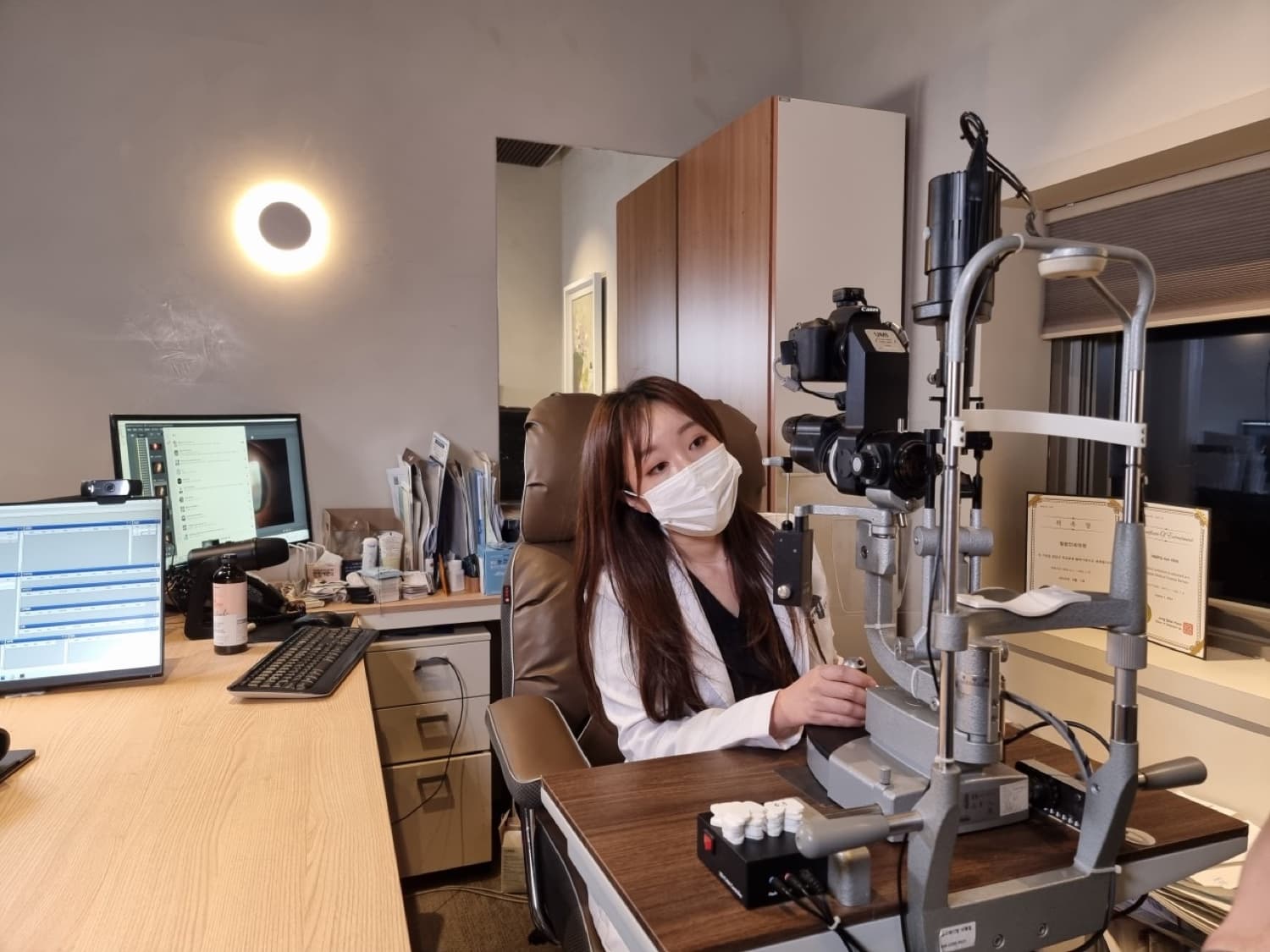
Step two: the detailed exam (this is the real heart of it)
Here's where a serious consultation separates itself from a sales meeting. The exam is thorough, and it's the part that genuinely decides everything:
- Corneal thickness and topography — a detailed map of the shape and thickness of your cornea.
- Refraction — your precise prescription, measured carefully rather than read off your glasses.
- Pupil size in dim light — important for night vision after surgery.
- Tear-film quality — because dry eyes affect both candidacy and recovery.
- Eye pressure and a look at the back of the eye — basic eye health that surgery shouldn't ignore.
- For ICL candidates, additional measurements of the internal dimensions of the eye to size the lens.
These aren't tests for show. Each one feeds the single most important question: which procedure, if any, is right for your eyes.
Step three: sitting down with the surgeon
After the exam, you sit down and we go through your actual results together — not a generic brochure, your maps and numbers. I'll explain what your cornea looks like, which procedures it could support, the trade-offs of each, and the honest risks. If two options both suit you, I'll tell you how they differ so you can choose, rather than steering you to the most expensive one.
This is also where we talk about cost. I won't print specific prices on a web page, because your real number depends on the procedure and your exam — but I can tell you how it's built: the surgical method, the examinations involved, and the aftercare. And I can tell you our pricing principle plainly.
How your cost is actually decided
Your price reflects the procedure you and I choose together, the examinations, and the follow-up care — not where you're from. International patients pay 100% the same as Korean patients: no foreigner markup, no tourist surcharge. The exact figure comes only after your free exam, never as a guess before it.
Step four: no decision under pressure
You will not be rushed. You can take everything home — the results, the options, the costs — and think it over. I'd genuinely prefer you didn't decide to have surgery on your eyes under time pressure, and a clinic that pushes you to commit on the spot is optimising for its calendar, not your vision.
The part most clinics skip: "you're not a candidate"
A free consultation has to be willing to reach an unwelcome conclusion, or it isn't really free — it's a funnel.
So I'll say it clearly: if your exam shows surgery isn't right for you, I'll tell you, and explain why. Maybe your cornea is too thin for LASIK and we'd discuss LASEK or ICL instead; maybe your tear film needs treating before any surgery is wise; maybe the honest answer is not now. You'll leave with a real answer rather than a booking you'll regret.
One honest limitation
Here's the boundary I want to be upfront about: a consultation — free or otherwise — can only tell you so much before the in-person exam. I can give you a useful first read by message, but I cannot responsibly decide your procedure, your candidacy, or your exact cost online. The measurements have to be real, and that means seeing your eyes. Anyone who promises you a final surgery plan and price before examining you is guessing with your vision.
So treat the free consultation for what it should be: a low-stakes way to get honest information and decide on your own terms. Message us on WhatsApp or LINE to start the conversation — in English, with no obligation — and let's make your first step a real exam and a straight answer, not a leap of faith.
— Dr. Kim Sun-young, Medical Director, Healing Eye Clinic
Frequently asked questions
Is the free eye surgery consultation really free, or a sales trap?
The consultation and the conversation about your options are free, and you're under no obligation to book anything. We'd rather you leave informed than pressured. If a clinic treats a free consultation as a closing pitch, that tells you how they see patients.
Can I have a consultation before I travel to Korea?
Yes. Message us on WhatsApp or LINE with your prescription and questions, and we'll give you an honest first read on your options in English before you book flights. The full exam needs you in person, but a lot can be clarified beforehand.
What tests are done during the in-person exam?
A full work-up: corneal thickness and topography, your refraction, pupil size in dim light, tear-film quality, eye pressure, and a look at the back of the eye. For ICL we also measure the inside of the eye. These results decide which procedure suits you — or whether surgery is wise at all.
Will I be pressured to decide on the same day?
No. You can take the information home and think it over. I'd actually prefer you didn't decide to operate on your eyes under time pressure. A good decision about your vision shouldn't be made in a hurry.
What if the consultation shows I'm not a candidate for surgery?
Then I'll tell you honestly, and explain why — too-thin cornea, a prescription better suited to ICL, dry eye that should be treated first. It's not in your interest or ours to operate on eyes that aren't suited to it. You'll leave with a clear answer rather than a sales pitch.
Message us on official LINE / WhatsApp for a special offer
Your exact candidacy and cost are confirmed in a free 1:1 consultation.