Gangnam LASIK Clinic Prices: What the Number Includes, and What Quietly Changes It
Gangnam LASIK clinic prices start at ₩1,990,000 for both eyes — here's what that includes, what changes it, and how to compare Seoul quotes honestly.

Dr. Kim Sun-young, Director
Cornea · Glaucoma · Cataract
Contents
"Can you tell me the real number — not the headline one?" A patient from Melbourne asked me exactly that on a video call last spring. She had four quotes from Seoul clinics saved in her phone, ranging from about a million won to nearly three million, all labeled "LASIK," and she could not work out whether she was comparing procedures, packages, or marketing.
Gangnam LASIK clinic prices at our clinic run from ₩1,990,000 for both eyes for Premium LASIK/LASEK up to ₩3,000,000 for presbyopia-correcting Clear LASIK, with the full pre-operative exam charged separately at ₩150,000. Those are published numbers, they are the same numbers a Korean patient sees, and I would rather explain what sits inside them than let you compare four headlines that describe four different operations.
A LASIK quote only means something once you know which procedure it names and where the aftercare stops.
What our published numbers actually name
The first thing to understand is that "LASIK" is a category, not a product. The price differences you see across Gangnam are mostly differences in how the flap is designed and how much of your individual corneal data goes into the laser profile — not differences in generosity.
| Procedure (both eyes) | Our published price | Typically considered when |
|---|---|---|
| Premium LASIK & LASEK | ₩1,990,000 | Straightforward myopia/astigmatism with healthy corneal measurements |
| Presbyopic LASIK & LASEK | ₩2,290,000 | Patients in their 40s–50s who also want near vision addressed |
| Clear LASIK (4th generation) | ₩2,700,000 | Thin, uniform flap design with correction mapped to individual corneal data |
| Presbyopic Clear LASIK | ₩3,000,000 | Both of the above together |
| EVO ICL | ₩5,500,000 | High myopia or corneas too thin for laser |
| EVO ICL Toric | ₩6,000,000 | The same, with significant astigmatism |
If you want the clinical detail behind the two-million-versus-2.7-million gap rather than just the figure, our 4th-generation Clear LASIK treatment page walks through the flap design and recovery timeline, and if night vision and contrast are your priority, the personal custom LASIK page explains what wavefront mapping adds. Our Korean head office keeps a fuller technical write-up on the same procedure on the 힐링안과 클리어라식 안내 페이지, which is worth a look if you read Korean or don't mind a translation tool.
Our current published prices
Why I charge for the exam — and why that protects you
The exam is the decision, not the paperwork
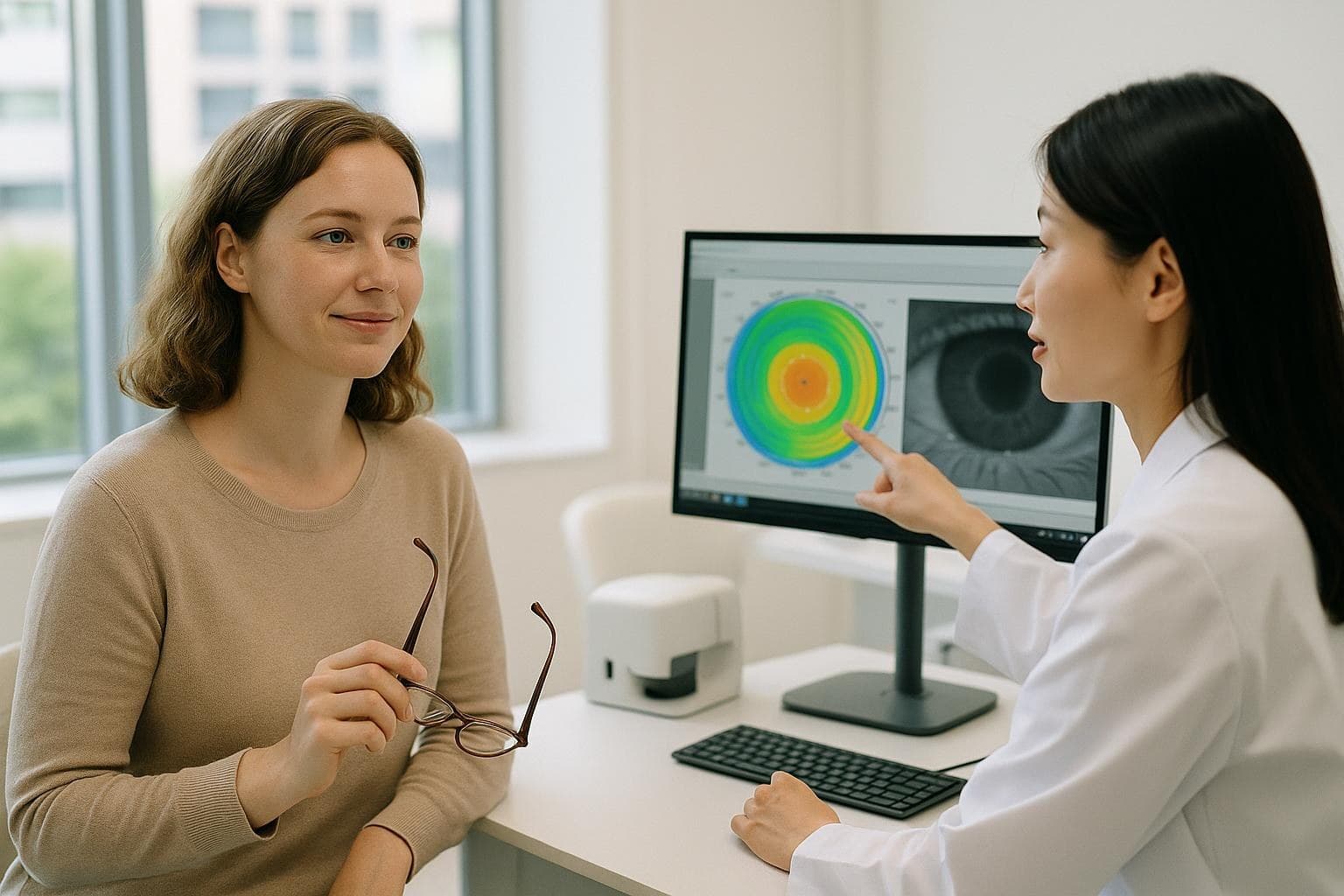
The pre-operative exam takes several hours. We measure corneal thickness and full topography, pupil diameter in the dark, tear film quality, intraocular pressure and corneal endothelial cell count, and I read all of it before anyone talks about a date. It is where I find out whether enough safe residual cornea remains beneath a flap, whether your topography shows a subtle irregularity that would make me stop, and whether your dark-adapted pupil is wide enough that I need to change the optical zone design.
Charging ₩150,000 for that work is deliberate. It means the exam pays for itself whether or not you have surgery, which is exactly what makes it possible for me to say no without the conversation costing the clinic anything. When an exam is free, its cost still exists — it is simply absorbed by the patients who go ahead.
The five things that move your number (nationality is not one of them)
- Which procedure your cornea allows. Thin corneas may point toward LASEK or an implantable lens rather than LASIK, and ICL sits at a different price level entirely.
- Whether presbyopia is part of the plan. Correcting near vision as well adds roughly ₩300,000 within the same family of procedures.
- Ocular surface treatment. If your tear film is poor, I treat that before I operate — autologous serum drops are ₩200,000 for both eyes, SCOUT ₩200,000. This is the most common add-on for contact lens wearers, and the reason I ask people to stop lenses well before the exam. Dry eye is also the side effect patients most underestimate, which is why I wrote an honest discussion of LASIK and dry eye risk rather than a reassuring paragraph.
- Corneal cross-linking, ₩500,000 for both eyes, where I judge additional corneal reinforcement appropriate. It is not routine and I do not add it by default.
- Your travel window. Clear LASIK typically has patients back to daily life in one to two days, but I ask international patients to allow a few days for the exam and the post-operative check. A rushed itinerary is not a discount; it is a compromise on follow-up.
Same price for all: what that policy does and doesn't mean
International patients at Healing Eye pay exactly what Korean patients pay. There is no foreigner tariff, no interpretation surcharge, and no separate price sheet — English, Japanese and Traditional Chinese interpretation is simply part of how the clinic runs, one minute from Sinnonhyeon Station and about seventy minutes from Incheon Airport.
Where international quotes genuinely inflate is upstream of the clinic. If an agency, broker or influencer is arranging your trip, someone is paying their commission, and it is worth asking plainly whether that is you. I go through the other signals worth checking — who performs the surgery, who you see at follow-up — in my surgeon's guide to choosing a LASIK clinic in Korea. Our own record is public: 4.8 from 154 Google reviews, and you can read the unedited patient reviews yourself.
Ask every clinic for one figure: the total from first exam through your final follow-up, in writing.
The part of the price that arrives later
A surgical fee buys a day. What you actually need is years of follow-up. Our policy is lifelong check-ups and a responsibility guarantee after surgery — and I want to be exact about what that sentence means. It is a commitment to keep caring for your eye. It is not a promise about your eyesight, and no honest surgeon can make one.
Regression matters here. Most corrected eyes stay stable, but some prescriptions drift back, more often in higher myopia, and enhancement is only possible if enough cornea remains and the corneal shape is stable. Sometimes it isn't, and further laser is not advisable — I explain the limits in our article on enhancement and regression after LASIK. Before you compare two quotes, ask each clinic what a re-treatment would cost and under what conditions they would decline to perform one. The answer to the second question is more informative than the first.
The other honest downsides belong in this section too, because they have a price: dry eye for weeks to months after surgery, halos and starbursts around lights at night that usually settle but occasionally persist, fluctuating vision in the early recovery period, and — rarely — flap complications or infection requiring further treatment. Surgery is never risk-free, and anyone telling you otherwise is selling.
Who I tell not to book
I will not operate on eyes with a cornea too thin to leave a safe residual bed, any topographic pattern suggesting keratoconus, an untreated or significant ocular surface disease, or a prescription that has moved meaningfully in the last year. Very large dark-adapted pupils combined with a high prescription push me toward a different conversation as well. For some of these patients an implantable lens is a reasonable route; for others, the right advice is to stay in glasses and contact lenses for now.
That is not a sales funnel with a detour. It is the reason the exam comes first and the reason it has a price attached.
If you send your recent prescription and any prior exam data before you fly, I will tell you honestly whether a trip is worth booking — including when the answer is no. I would rather lose a surgery than have you cross ten time zones for a procedure your eyes shouldn't have.
— Dr. Kim Sun-young, Medical Director, Healing Eye Clinic, Gangnam
Frequently asked questions
How much do Gangnam LASIK clinic prices come to in total for someone flying in?
At our clinic the surgical fee for both eyes runs from ₩1,990,000 for Premium LASIK/LASEK to ₩2,700,000 for 4th-generation Clear LASIK, plus ₩150,000 for the full pre-operative exam. On top of that you should budget for flights, four to five nights of accommodation, and any add-on treatment your exam turns up, such as autologous serum eye drops at ₩200,000 for both eyes. I cannot quote your final number before I have seen your corneal thickness, topography and tear film, because those findings decide which procedure is appropriate. What I can promise is that the surgical fee I quote after your exam is the fee you pay.
Why is the eye exam charged separately instead of being free?
Because the exam is a real diagnostic procedure, not a sales appointment. It takes a few hours and covers corneal thickness and topography, pupil size in the dark, tear film quality, intraocular pressure and corneal endothelial cell count. Charging ₩150,000 for it, discounted from ₩400,000, means I am free to tell you that laser surgery is not right for you without that conversation costing the clinic anything. A clinic whose exam is free has to recover that cost somewhere, and usually it is recovered from the patients who say yes.
Do international patients pay more than Korean patients at Healing Eye?
No. Our published price list is a single list, and international patients pay exactly what Korean patients pay for the same procedure. Interpretation in English, Japanese or Traditional Chinese is part of how the clinic runs, not a line item added to your bill. Where an international quote can inflate is through third-party agencies or brokers who take a commission, so if someone else is arranging your trip, ask them directly who pays their fee.
Is enhancement surgery included if my vision drifts back later?
Our policy is lifelong check-ups and a responsibility guarantee after surgery, and enhancement is assessed under that policy rather than sold as a new procedure. But I want to be precise: this is a commitment to keep caring for your eyes, not a promise about your eyesight. Whether a re-treatment is safely possible depends on how much cornea remains and how stable your corneal shape is, and in some eyes the honest answer is that further laser is not advisable. Regression is uncommon but real, and it is more likely in higher prescriptions.
Why do two Gangnam clinics quote such different prices for 'LASIK'?
Usually because the word LASIK covers several different designs. A basic prescription-only correction, a wavefront-customized correction that maps higher-order aberrations, and a 4th-generation thin-flap design are not the same operation and do not cost the same. Differences also come from whether the exam, medication, and follow-up visits are inside or outside the quoted figure, and from who actually performs your surgery. Ask each clinic for the total through your final follow-up, in writing, and compare those two numbers rather than the headline.
Who should not book laser vision correction, even at a good price?
Anyone with a cornea too thin to leave a safe residual bed, any topographic pattern suggesting keratoconus, an untreated or severe ocular surface disease, or a prescription that has shifted meaningfully in the past year. Very large dark-adapted pupils with a high prescription also raise the risk of night glare enough that I discuss alternatives instead. In these cases I will say no to laser surgery and, where appropriate, explain implantable lens options — or advise staying in glasses and contacts. Refunding a deposit costs far less than operating on the wrong eye.
Message us on official LINE / WhatsApp for a special offer
Your exact candidacy and cost are confirmed in a free 1:1 consultation.