
ICL Recovery Time? Usually 1–2 Days, Plus a Next-Day Check
ICL recovery time is usually 1–2 days for daily life, but the next-morning check decides your flight. A Seoul surgeon explains what shapes your plan.

Dr. Kim Sun-young, Director
Cornea · Glaucoma · Cataract
Medically reviewed byDr. Kim Sun-young, Director· Medical Director
Edited by: Dr. Kim Sun-young
Contents
ICL recovery time usually means 1–2 days before daily life feels normal again, but if a flight home is already pencilled in, the date that matters is the morning after surgery. I'm Dr. Kim Sun-young, an eye surgeon in Gangnam, Seoul. Vision keeps settling over the following weeks, and the lens inside your eye is something you keep having checked for years.
If you're fitting this into a long weekend or a short break from teaching somewhere in Asia, the 1–2 days are not the tight part of the plan. The tight part is the check the morning after surgery, and whether your flight sits before it or after it.
How long does ICL recovery actually take?
For most people, 1–2 days until work, screens and walking around feel normal again. According to the clinic's ICL treatment information, the operation takes about 15 minutes for both eyes under numbing drops, with no injection. Both figures describe the usual course, not a promise for your eyes.
In the first hours the numbing wears off, the eyes can feel scratchy or watery, and bright light may be uncomfortable. That is the evening to rest at the hotel, not to walk around Myeongdong.
The next morning you come back to the clinic, a minute's walk from Sinnonhyeon Station, and eye pressure and lens position are checked again. Many people notice by then that vision is already clear. I'll come back to this check, because it's the one appointment I don't want anyone to skip.
Over the following weeks, vision can fluctuate a little while the eye calms down, and light sensitivity or halos at night may still be noticeable. After that, eye pressure and the corneal endothelial cells are checked at regular follow-ups for as long as the lens is in place.
Why does ICL recovery often feel quicker than laser recovery?
The cornea is not reshaped. In ICL, a thin lens made of collamer is folded, passed through a very small incision at the edge of the cornea, and unfolded in the space between the iris and your own natural lens. The incision usually closes without stitches.
Compare that with surface laser correction, where the outer layer of the cornea has to regrow before vision clears. That is why a LASEK recovery timeline looks so different from an ICL one, even when both end in the same place. Because ICL leaves the corneal surface and most of its nerves alone, the dryness that some laser patients notice for weeks may weigh less after ICL, though not for everyone.
Still, ICL is surgery inside the eye. A quicker-feeling recovery does not make it the smaller operation, and that shapes everything about how the first day is checked.
The first fork: is ICL the right surgery for your eyes?
Recovery time only matters once measurements show ICL is the right choice for you. ICL is usually considered for very high myopia, for corneas too thin for laser correction, or for people who want the cornea left untouched. With astigmatism, a toric ICL corrects the axis as well.
If you're still weighing the two, the ICL surgery pros and cons post goes through the trade-offs in more detail, and the ICL treatment page explains the procedure itself.
Which exam numbers change your recovery plan?
Six measurements from the pre-op exam do most of the work. They decide whether ICL is suitable, which lens size and power you get, and what the early weeks are likely to feel like.
| Measurement | What it tells me | How it can change your recovery |
|---|---|---|
| Anterior chamber depth | Whether there's enough room in front of your natural lens | A shallow chamber is a reason to reconsider ICL altogether |
| Endothelial cell count | The health of the cornea's inner cell layer | A low count for your age shifts the decision toward other options |
| White-to-white diameter | The size of the eye, used to choose lens size | Lens size affects how the lens sits, which the next-day check confirms |
| Pupil size in dim light | How wide your pupil opens at night | Larger pupils raise the chance of noticeable halos in the early weeks |
| Eye pressure | Your baseline before surgery | Gives the next-day reading something to be compared against |
| Prescription and astigmatism | Lens power, and whether a toric lens is needed | A toric lens's position is checked so the axis stays where it was set |
The column people skip is the pupil one. If you drive at night or teach evening classes under bright lights, tell me during the consultation, because that is where an early halo is most likely to bother you. Glaucoma or a history of uveitis also changes the plan, and in those cases the exam decides the order of priorities before anything is booked.
The next-morning check decides your flight
Book the flight home after the next-day check, not before it. On the day of surgery, the same surgeon checks that the lens sits correctly and that eye pressure is stable. The next morning, that check is repeated.
The repeat matters because a pressure rise or early inflammation can show up within the first day.
The clinic is at 470 Gangnam-daero, one minute on foot from Sinnonhyeon Station, and roughly 70 minutes from Incheon Airport. The partner hotel, O'Cloud Hotel in Seocho-gu, is one option for the night between surgery and the next-morning check. Consultation is available with a Japanese, Traditional Chinese or English interpreter.
How many nights you need in Seoul, and how many days before the exam to stop wearing contact lenses, depend on your eyes and your lens type. Both are confirmed in the consultation rather than guessed online. If you want to see the whole route from exam to flight, ICL surgery in Korea as a first-timer walks through it.
What you can do in the first week after ICL
Most of the first week is daily life with a few rules. The details are set by your surgeon at discharge, but the pattern after intraocular surgery is broadly the same.
Screens and reading are usually fine from the next day, with breaks if your eyes feel tired or dry. Walking around the city is fine; sunglasses help with light sensitivity. Using the prescribed drops on schedule matters more than almost anything else that week.
The things to hold off on are the ones that put pressure on the eye or bring water and bacteria near a fresh incision: rubbing your eyes, saunas, swimming pools and the sea, eye makeup, and contact sports. How long each restriction lasts is set at the follow-up for your eyes, so it's worth writing the dates down before you fly.
Risks that can show up during recovery, and later
ICL is surgery inside the eye, so the risks are real even when they are uncommon. The U.S. Food and Drug Administration's patient information on phakic intraocular lenses lists the main ones plainly:
- raised eye pressure, which may need medication or, occasionally, further surgery;
- glare, halos, double vision or reduced vision in low light;
- a lens that needs to be repositioned, replaced or removed, including when the power turns out too strong or too weak;
- loss of corneal endothelial cells, which in some cases can cloud the cornea;
- cataract formation;
- retinal detachment, infection, bleeding or severe inflammation, which are rare but serious.
The FDA also notes that a narrow space between the cornea and iris, a low endothelial cell count and large pupils raise the risk of some of these problems. Those are exactly the measurements in the table above. The American Academy of Ophthalmology's technology assessment of phakic lenses concluded, on the evidence available at the time, that these lenses appear effective for high myopia, while noting that longer-term data on the cornea and the natural lens were still needed.
No one can promise a particular result or a course without complications. What can be done is to screen carefully before surgery, check pressure and lens position on day one, and keep the follow-ups going after that. If the lens itself needs changing, it can be removed or exchanged, although removal does not reverse effects such as endothelial cell loss or cataract.
Follow-up once you're home
The recovery you feel is over in days; the follow-up isn't. Regular checks of eye pressure and the endothelial cells matter for as long as the lens stays in place, and an ophthalmologist near home can carry out those checks.
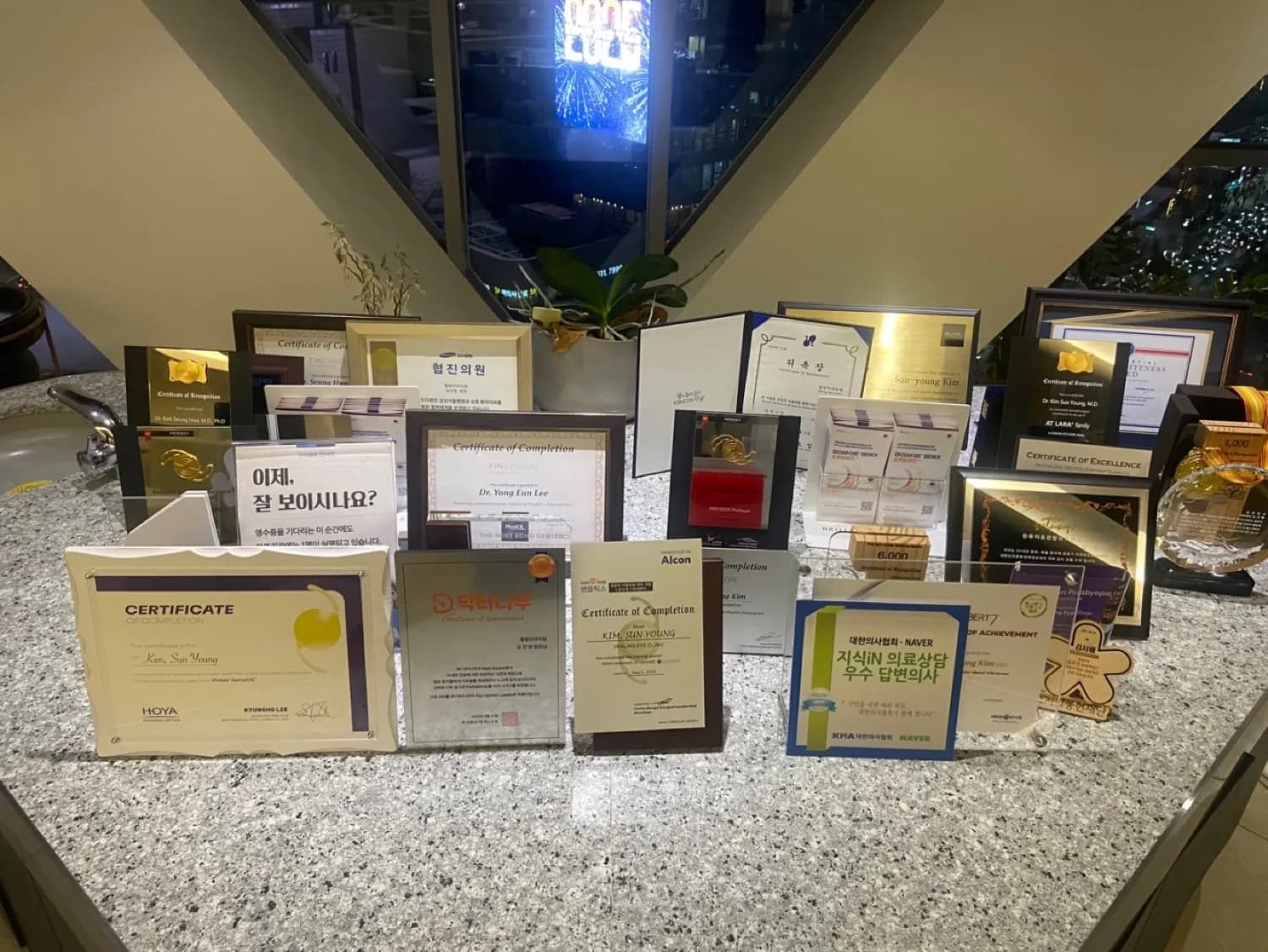
At Healing Eye Clinic, one surgeon follows you from the exam through surgery and aftercare, and the clinic runs a lifetime surgery responsibility program for follow-up care.
I previously served as Clinical Professor (Cornea & Cataract) at Uijeongbu St. Mary's Hospital and am a member of the Korean Ophthalmological Society and ESCRS, and the corneal side of these checks is the part of eye care I've spent my career on. The clinic is also registered with Korea's Ministry of Health and Welfare to treat international patients. More background on the procedure is on our Korean ICL information page, and clinic details are on the Healing Eye Clinic English homepage.
If you're planning around a short trip, send the dates you're considering and your current glasses or contact lens prescription on WhatsApp, so the exam, surgery and next-morning check can be planned around them.
Frequently asked questions
Does ICL surgery hurt, and what does the first evening feel like?
The eye is numbed with drops rather than an injection, and most people describe pressure rather than pain during the roughly 15-minute operation. That evening the eyes can feel scratchy, watery or sensitive to light. Rest and the prescribed drops are usually all that's needed, but sharp pain, worsening redness or falling vision should be reported right away.
Will I be able to feel or see the lens after ICL?
The lens sits inside the eye, between the iris and your natural lens, so it isn't visible from outside. In normal use most people don't feel it. If the lens ever needs changing, it can be removed or exchanged.
Can I go back to work or teaching the day after ICL?
Many people return to desk work or light teaching within 1–2 days, once the next-day check is done. Screen work is usually fine with breaks. Jobs involving dust, water or physical contact may need a longer pause, which your surgeon sets at follow-up.
Is recovery different with a toric ICL for astigmatism?
The day-to-day recovery is similar. The difference is that a toric lens has to stay aligned with your astigmatism axis, so its position is checked at follow-up. If it rotates enough to affect vision, it can be repositioned.
How soon can I fly after ICL surgery?
It's recommended to fly only after the check the morning after surgery, which confirms eye pressure and lens position. How many nights you need in Seoul overall depends on your eyes and is confirmed in the consultation.
Message us on official LINE / WhatsApp for a special offer
Your exact candidacy and cost are confirmed in a free 1:1 consultation.