
ICL Surgery Korea: A First-Timer's Route From Exam to Flight
ICL surgery in Korea for first-timers: who it suits, the two measurements that can stop it, and how lens ordering shapes your stay. From a Gangnam surgeon.

Dr. Kim Sun-young, Director
Cornea · Glaucoma · Cataract
Contents
I'm Dr. Kim Sun-young, medical director of Healing Eye Clinic in Sinnonhyeon, Gangnam, Seoul. I was a clinical professor of cornea and cataract surgery at a university hospital, and today I see international patients every week, with an English interpreter in the room from your first test to your last check.
The first message from an ICL patient is often a little nervous: "Dr. Kim, I was told I'm not a candidate for LASIK. Someone mentioned ICL. Can I really do that in Korea, on a short trip?"
If you're searching icl surgery korea, you may be in exactly that spot. I understand — being told "no" to laser can feel like being told "no" to clear vision.
So let me be honest first: ICL is often the right answer for those eyes, but it's decided by two measurements you can't see in your prescription. Here is the route I'd walk you through, start to finish.
ICL surgery in Korea: who is it actually for?
ICL places a thin lens inside the eye, between the iris and your natural lens. The cornea isn't reshaped, and the lens can be removed if it's ever needed.
That makes it the right tool for some eyes and the wrong one for others. Three groups usually find their way to it.
1. Very high prescriptions
Laser removes tissue to correct a prescription. The higher the prescription, the more tissue it needs.
Past a certain point, there simply isn't enough cornea to remove safely. That's often beyond -10D, and that's where ICL starts to make sense.
2. Corneas that laser shouldn't touch
Some people have a moderate prescription but a thin cornea, or a corneal map that puts them outside laser candidacy.
For them, ICL avoids the problem entirely. The cornea stays as it is.
3. People who want to keep the cornea untouched
Significant dry eye is one reason. Laser disturbs corneal nerves; ICL disturbs fewer.
Others simply value that the lens can come out again. That's a reasonable priority — but it isn't a reason to choose intraocular surgery when laser would do.
ICL in Korea is mainly for very high myopia, corneas unsuitable for laser, and some dry-eye cases. If LASIK or LASEK can correct you safely, that's usually the simpler path — and I'll tell you so.
The two measurements that can stop ICL
Most people arrive thinking their prescription decides everything. For ICL, two other numbers often matter more.
Chamber depth. The lens sits in a small space behind the iris. If that space is shallow, there may not be safe room for a lens, whatever your prescription.
The cornea's inner cell count. The inner layer of the cornea keeps it clear, and those cells don't regenerate. If the count is already low, I hold off.
I also measure the eye's diameter, pupil size and eye pressure. These set the lens size and power so it rests at the right distance from your natural lens and iris.
What you can check before trusting us: international patients pay exactly what Korean patients pay, we hold 4.8 stars from 154 reviews on Google, and I'm a full member of the European Society of Cataract and Refractive Surgeons (ESCRS). I'm not listing these to impress you — only so you have something to verify. The Korean head office lists the diagnostic equipment we measure with.
So what does the first trip look like?
Here is the usual route for a first-timer. Your exam can change it.
| When | What happens |
|---|---|
| Before you fly | Send prescription, age, dates; stop contact lenses |
| Day 1 | Full exam; we decide together if ICL fits |
| Lens ready | Plus one to two days if your lens is ordered |
| Surgery day | Both eyes in about 15 minutes; same-day check |
| Next day | Lens position and eye pressure checked |
| Home | Local checks with our written record |
The same surgeon examines you, operates and checks you afterwards — there's no hand-off. What happens inside the operating room, and what "EVO" means in the lens, is in EVO ICL surgery in Korea.
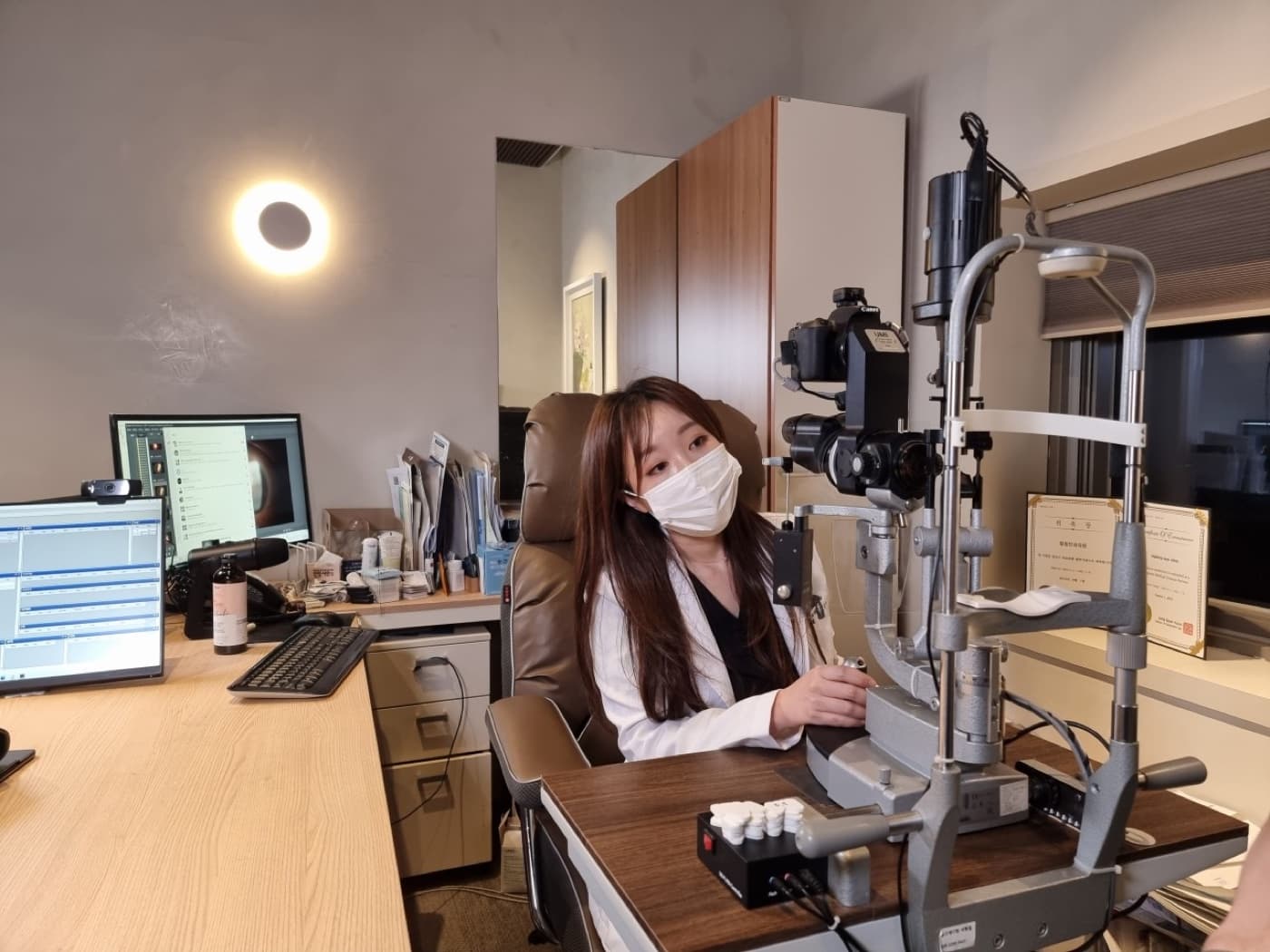
Price. EVO ICL is ₩5,500,000 for both eyes, Toric ₩6,000,000, and the exam ₩150,000. What that lens price pays for is in EVO ICL surgery cost in Korea; the full list is on our price page.
Side effects, and who I turn away
ICL is surgery inside the eye. Here are the risks I discuss with every patient.
- Night glare and halos. Common early on; many people adapt over weeks.
- Eye pressure changes. Checked the same day, the next day, and periodically after that.
- Inflammation or lens position. Uncommon, but the reason drops and long-term checks matter.
I hold off on ICL with a shallow chamber, a low inner cell count, or glaucoma or uveitis risk factors until we've examined closely. And if laser can correct you safely, I won't recommend ICL. Results and recovery vary from person to person.
Practical notes before you book
- Stay: three to four nights as a base, plus one to two days for lens ordering if needed.
- Contact lenses: stop at least a week before the exam for soft lenses, longer for rigid ones.
- Flights: changeable. The exam decides the plan, not the booking.
- After surgery: drops for one to two weeks, no eye rubbing, no knocks to the eye.
Where we are, how you get from the airport, and where to stay are in ICL surgery in Seoul.
Don't book ICL yet — book the measurements
If you take one thing from this page, let it be this: for ICL, the exam is the decision.
It doesn't have to be our clinic. But choose one that tells you your chamber depth and cell count, explains your lens, and will say "laser is enough" or "not ICL" when that's the truth.
Send us your prescription, your age and your travel window on WhatsApp. If ICL isn't right for your eyes, I'll tell you plainly — and what is.
I hope to see you in Seoul.
— Dr. Kim Sun-young, Medical Director, Healing Eye Clinic (Sinnonhyeon, Gangnam, Seoul)
Frequently asked questions
Who is ICL surgery in Korea for?
ICL is mainly for people with very high myopia — often beyond -10D — or a cornea too thin for laser, and for some people who want to keep the cornea untouched because of dry eye. If LASIK or LASEK can correct you safely, I usually recommend that instead.
What is checked in the ICL exam?
The depth of the chamber where the lens will sit, the diameter of the eye, the cell count of the cornea's inner layer, pupil size, eye pressure and your prescription. Chamber depth and inner cell count are the two that most often stop ICL.
How long should I stay in Korea for ICL?
Plan the same three-to-four-night base as laser surgery — exam, surgery, next-day check — plus one to two extra days if your lens has to be ordered. Book flights you can change.
Can I have the exam and ICL surgery on the same trip?
Yes, that is how most of our international patients do it. The exam comes first, the lens size and power are set from it, and surgery follows once the lens is ready.
How much does ICL cost in Korea?
At our clinic EVO ICL is ₩5,500,000 for both eyes and EVO ICL Toric is ₩6,000,000. The full pre-op exam is ₩150,000. International patients pay exactly the same as Korean patients.
Do I need follow-up checks after I go home?
Yes. Because the lens sits inside the eye, eye pressure and the cornea's inner cells should be checked periodically. We give you a written record so your local eye doctor can do the one-week, one-month and three-month checks.
Message us on official LINE / WhatsApp for a special offer
Your exact candidacy and cost are confirmed in a free 1:1 consultation.