
ICL Surgery Pros and Cons: A Seoul Surgeon's First-Time Guide
ICL surgery pros and cons from a Seoul eye surgeon — who it suits, who it doesn't, the real risks, recovery, and cost for international patients.

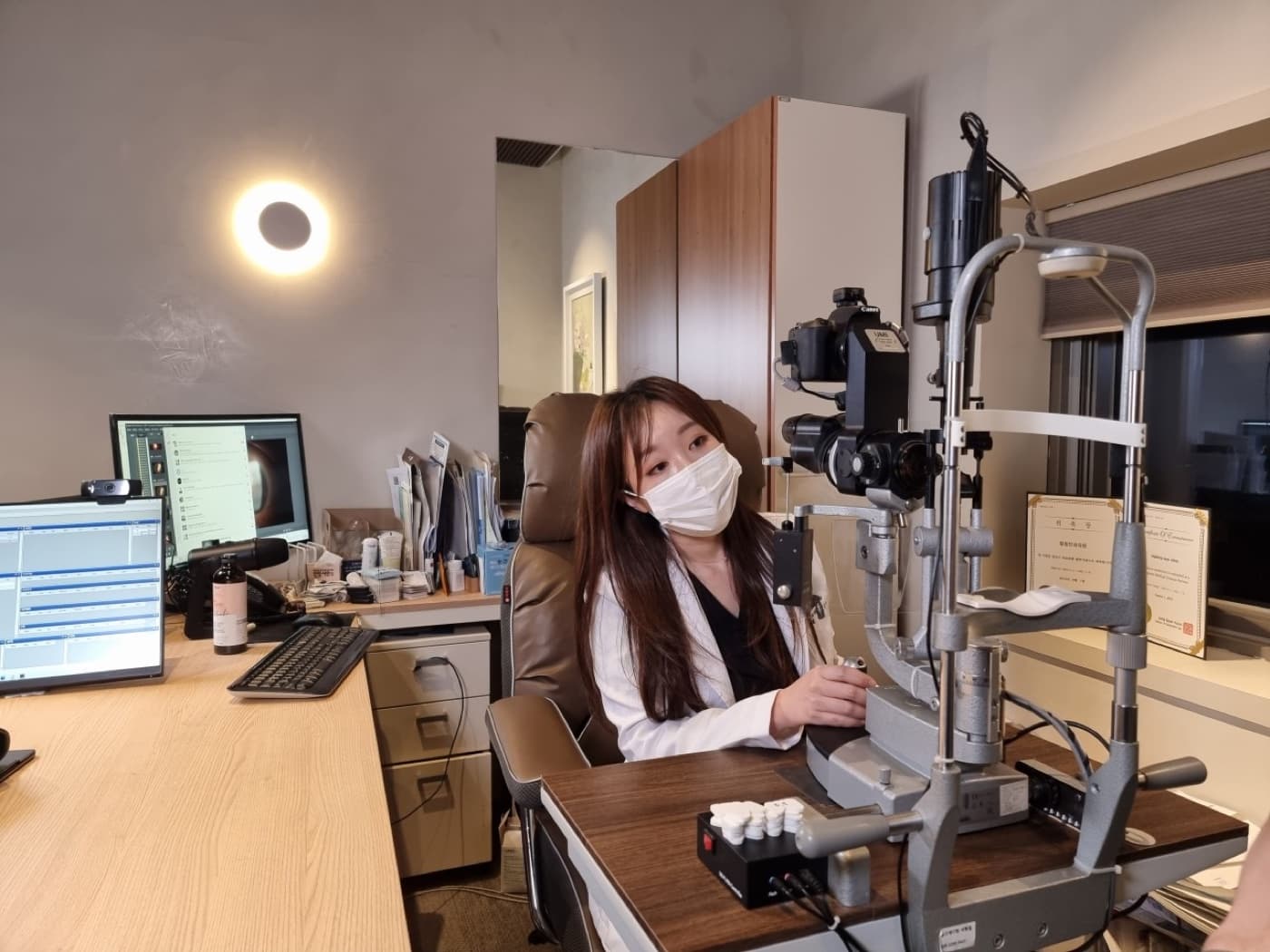
Dr. Kim Sun-young, Director
Cornea · Glaucoma · Cataract
Contents
"Two clinics have already told me my corneas are too thin for laser. Is ICL just the consolation prize?" That was the first sentence out of a 33-year-old engineer from Berlin who flew in last spring with a −10.50 prescription and a folder of scans. It is a fair question, and it deserves a fair answer rather than a brochure.
ICL surgery pros and cons come down to one honest trade: you keep your cornea untouched and gain a correction range no laser can safely reach, but in exchange you accept an operation performed inside the eye and a lens that needs monitoring for as long as you have it. Everything else — night vision, recovery speed, cost, reversibility — sits underneath that single trade. Below is the whole picture as I explain it in clinic, including the parts that lose us patients.
What an ICL actually is, and what it is not
An Implantable Collamer Lens is a very thin, custom-ordered lens made from a biocompatible material called Collamer. It is folded, inserted through a small incision at the edge of the cornea, and unfolded into the space between your iris and your own natural lens. The full description of the lens, the measurements, and the sizing logic is on our ICL implantable lens treatment page, and the Korean head office publishes the same clinical detail on its 안내렌즈삽입술(ICL) 페이지.
Two things it is not. It is not cataract surgery — your natural lens stays exactly where it is; the ICL simply sits in front of it. And it is not corneal surgery — no tissue is removed, no flap is made, and the shape of your cornea is preserved. That last point is why ICL exists at all: laser procedures correct your prescription by removing corneal tissue, and at some point there is not enough tissue to remove safely.
ICL adds a lens to the eye rather than subtracting tissue from the cornea — that single structural difference explains almost every pro and con that follows.
The pros: what ICL does that a laser cannot
Range. Very high myopia — the prescriptions where laser correction would thin the cornea beyond a safe limit — is where ICL earns its place. The correction does not depend on how much cornea you can spare.
Corneal preservation. Because the corneal nerves are largely left alone, the dry-eye burden after ICL is generally lighter than after flap-based laser surgery. For patients who already have marginal tear film, this matters more than any other single factor.
Reversibility. The lens can be removed or exchanged by a surgeon if circumstances change. That is genuine, and it is one reason I offer ICL to patients in their twenties whose lives — and eyes — have decades of change ahead. It is also the most misunderstood advantage in the whole field, which is why I wrote a separate piece on what "reversible" really means with an ICL: removal is another operation inside the eye, not an undo button.
Optical quality at high prescriptions. Correcting a −12 D eye by flattening the cornea creates a very aspheric surface. Placing the correcting power closer to the eye's natural lens plane often gives cleaner optics at those extremes.
The cons I make every patient say back to me before we book
I ask patients to repeat these in their own words. If they cannot, we have not finished the consultation.
It is intraocular surgery. Anything entering the eye carries a small but real risk of infection inside the eye (endophthalmitis), which is uncommon but serious. Sterile technique and post-op drops exist precisely because of this.
Sizing. The lens must sit at the right distance — the "vault" — from your natural lens. Too low and there is risk of contact and cataract formation over time; too high and it can crowd the iris and raise eye pressure. Sizing is calculated from anterior-chamber depth, white-to-white diameter, and pupil measurements, but biology does not always match the numbers. A minority of patients need a lens exchange.
Endothelial cells. The cornea's inner cell layer does not regenerate. We count these cells before surgery and re-count them at follow-ups, because a lens inside the eye is a lifelong neighbor to that layer.
Eye pressure. Pressure can rise in the early post-operative period, and patients with narrow drainage angles are not candidates in the first place.
Night vision. Halos and starbursts around headlights are more commonly reported after ICL than after laser correction, especially in patients with large pupils, and especially in the first months. Most report that this settles or stops bothering them; some do not. I go through the pupil-size measurements and what they predict in my honest answer on ICL, halos and night driving.
It does not stop your eyes aging. ICL corrects your current refraction. It does not prevent presbyopia in your forties, and it does not eliminate the retinal risks that come with a highly myopic eye — those eyes still need annual dilated examinations for life.
ICL versus laser correction: the comparison I draw on paper
| ICL | LASIK / SMILE | |
|---|---|---|
| Corneal tissue removed | None | Yes, proportional to prescription |
| Suits thin or irregular corneas | Often yes | Frequently no |
| Correction range | Very wide, including extreme myopia | Limited by corneal thickness |
| Dry-eye burden | Generally lighter | Higher, usually temporary |
| Location of surgery | Inside the eye | Surface of the eye |
| Reversible | Lens can be removed or exchanged | Tissue removal is not reversible |
| Typical return to daily life | 1–2 days | 1–2 days (flap) / longer for surface ablation |
| Long-term monitoring | Pressure, vault, endothelial count | Routine eye checks |
| Cost | Higher | Lower |
If your cornea is thick and your prescription moderate, the honest recommendation is usually a laser procedure — our flapless SMILE surgery page explains that route. For strong prescriptions where both are technically possible, the choice gets genuinely close, and I work through it eye by eye in ICL vs LASIK for high myopia.
Who I say yes to — and who I say no to
Yes, usually: stable prescription for at least a year, adequate anterior-chamber depth, healthy endothelial cell count for age, open drainage angles, no cataract, no active intraocular inflammation, and realistic expectations about night vision.
No, and I say it plainly: shallow anterior chambers, low endothelial counts, narrow angles or uncontrolled glaucoma, early cataract, active uveitis, unstable refraction, pregnancy or breastfeeding, and eyes with untreated retinal pathology that must be assessed by a retinal specialist before any elective surgery is discussed. Very large pupils are not an automatic no, but they change the conversation. The specific numbers I check are listed in my ICL candidacy thresholds.
Surgery day, and the days that follow
Your examination comes first and takes a few hours: topography, anterior-chamber measurements, endothelial cell count, pupil sizing, pressure, and a dilated retinal check. Soft contact lenses must be out well before this, or the readings are not trustworthy.
On the day itself, numbing drops go in, a small incision is made at the corneal edge, the folded lens is introduced and positioned, and — for toric lenses — rotated to your astigmatic axis. Both eyes usually take around fifteen minutes. Stitches are typically unnecessary. You will feel pressure and see bright, moving light rather than sharp detail.
Expect watering, grittiness and light sensitivity for several hours, and hazy vision that evening. Most patients are back to normal daily activity in one to two days, with drops continuing for weeks. No eye rubbing, no swimming, no saunas, no contact sport until I clear you — the full list is in the head office's 수술 전·후 주의사항 안내.
Cost, and the follow-up problem nobody plans for
Published ICL pricing at Healing Eye
The part patients underestimate is aftercare. You need to be in Seoul long enough for the examination, the surgery, and the early post-operative checks — pressure in particular is checked in the first day. After you fly home, you still need an eye doctor locally who will measure your pressure and endothelial cells periodically. Arrange that before you travel, not after. We keep your measurements on file and offer lifelong check-ups here, but you cannot fly to Gangnam every year, and I would rather you had someone competent nearby.
ICL is a good decision for the right eye and a poor one for the wrong eye — the examination, not the internet, is what tells you which you have.
If you take one thing from this: come with your scans and your questions, and be prepared to hear no. I would rather send you home with your glasses and an honest explanation than put a lens in an eye that was never built to hold one.
— Dr. Kim Sun-young, Medical Director, Healing Eye Clinic, Sinnonhyeon, Seoul
Frequently asked questions
What are the main pros and cons of ICL surgery in one sentence each?
The main advantage is that ICL corrects very high prescriptions without removing any corneal tissue, which keeps the cornea's structure intact and tends to place less burden on the tear film than laser surgery. The main disadvantage is that it is an intraocular procedure: a lens sits inside your eye, so sizing has to be right, and you need lifelong check-ups of eye pressure, the lens position, and your corneal endothelial cells. Halos around lights at night are also reported more often in the early months than with laser correction. Whether the trade is worth it depends entirely on your measurements, not on which procedure sounds better.
Is ICL better than LASIK or SMILE?
Neither is better in the abstract — they answer different anatomical questions. If your cornea is thick enough and your prescription is moderate, a laser procedure is usually the simpler route and I will say so. If your prescription is very high, or your cornea is thin or irregular, or you already have meaningful dry eye, ICL preserves corneal tissue and can correct a range the laser cannot safely reach. At our clinic the surgeon's fee structure gives me no financial reason to steer you either way, so the decision comes from your scans.
Can the ICL be removed later?
Yes — the lens can be explanted or exchanged by a surgeon, and that reversibility is one of the genuine strengths of the procedure. It is not, however, a casual undo button: removal is another intraocular operation with its own risks, and it is usually done for a specific reason such as incorrect vault, cataract development, or a large prescription change over decades. I explain this carefully before surgery so nobody chooses ICL purely because they think it can be undone at will. Reversible means correctable, not consequence-free.
Does ICL hurt, and how long is the recovery?
The eye is numbed with drops, and most patients describe pressure and bright light rather than pain during the roughly fifteen minutes both eyes take. Afterwards there is commonly a gritty, watery, light-sensitive phase for several hours, and vision is typically hazy that evening. Most patients are back to ordinary daily activity in one to two days, though drops continue for weeks and I ask patients to avoid swimming, saunas, eye rubbing, and heavy contact sport for longer. Some people settle faster and some slower, and neither is a sign that something went wrong.
Who should not have ICL surgery?
I decline ICL when the anterior chamber is too shallow for a lens to sit safely, when the corneal endothelial cell count is low for the patient's age, when there are narrow angles or uncontrolled glaucoma, when there is active inflammation inside the eye, or when a cataract is already forming. I also decline when the prescription has not been stable, in pregnancy or breastfeeding, and in patients who are too young for their refraction to have settled. Certain retinal conditions need to be assessed and treated by a retinal specialist before any elective surgery is considered. Saying no is part of the job, and I would rather do it before you book a flight.
How much does ICL cost in Korea, and do foreigners pay more?
Our published price for EVO ICL is ₩5,500,000 for both eyes, and EVO ICL Toric for astigmatism is ₩6,000,000 for both eyes, with Eco Lens options priced lower. The full pre-operative examination is ₩150,000. International patients pay exactly the same price as Korean patients — that is clinic policy, not a promotion. Budget separately for accommodation, and remember that the examination is the part that decides whether surgery is appropriate at all, so it is never wasted money even if the answer turns out to be no.
Message us on official LINE / WhatsApp for a special offer
Your exact candidacy and cost are confirmed in a free 1:1 consultation.