
Vision After Cataract Surgery: My Day-by-Day Recovery Brief for Patients Flying to Seoul
Vision after cataract surgery changes day by day. A Seoul surgeon's honest recovery timeline, what's normal, what needs a call, and when it's safe to fly.

Dr. Kim Sun-young, Director
Cornea · Glaucoma · Cataract
Contents
A patient from Melbourne asked me this on the morning we did her second eye: "I fly home Thursday — will my vision be finished by then?"
Vision after cataract surgery returns in stages rather than in one clean jump, and those stages are uneven enough that patients who weren't warned start worrying on day three. The clouded lens is gone the moment the operation ends, so most people do notice a brightening within a day — whites look startlingly white, colors look cooler. But the cornea is still slightly swollen, the pupil is recovering from dilating drops, and the eye is on anti-inflammatory drops it will taper off over weeks. That is why sight can look good on Monday, softer on Wednesday, then good again. What follows is the recovery brief I give every international patient: day by day, what is normal, what deserves a same-day phone call, and when I am comfortable putting someone on a plane. The operation itself is described step by step on our cataract surgery page; here I only want to talk about afterwards.
Hour 0 to 24: the day that unsettles people most
You leave wearing a clear shield. The eye was numbed with drops, so sensation returns gradually over a few hours, and with it a gritty, sandy feeling, watering, light sensitivity and a dull ache. The view is often hazy, as though through steam, and every light source throws a wide halo. All of that is expected on day 0.
Sleep with the shield taped on. The 2–3mm incision is self-sealing and needs no stitches, but it stays mechanically fragile for days, and the most common way it gets stressed is a patient rubbing the eye half-asleep. Simple painkillers such as acetaminophen are usually enough for the ache. Deep, increasing pain — the kind that builds rather than fades, sometimes with nausea — is not part of a normal first night and I want to hear about it.
The two-week timeline I hand out on paper
| When | What most patients notice | What I ask you to do |
|---|---|---|
| Day 0 (evening) | Haze, wide halos, watering, gritty ache, pupil still large | Shield on, start the drop schedule, rest |
| Day 1 (check-up) | Distinct brightening; vision often usable but soft | Come in — I check pressure, cornea and lens position |
| Days 2–3 | Fluctuation: clearer mornings, blurrier evenings; dryness | Keep drops exactly on time, artificial tears in between |
| Days 4–7 | Steadier vision, grittiness fading; a red patch may appear on the white | Second eye often scheduled here; shower with face tilted back |
| Week 2 | Most daily tasks comfortable; night glare still noticeable | Steroid taper begins; light exercise resumes |
| Weeks 3–6 | Refraction settles; halos usually soften | Glasses prescription measured now, not before |
That is a typical course, not a promise. A very dense cataract, Fuchs' corneal dystrophy, diabetic macular changes or a previous LASIK history all slow it down, and I will say so before surgery rather than after. If you want the more granular version of this same curve, it's set out in our realistic day-by-day cataract recovery timeline.
Fluctuating vision in the first two weeks is the normal healing pattern; vision that clearly worsens after having been clear is not.
Normal versus a same-day phone call
Expected, and not a reason to panic
A sandy or eyelash-in-the-eye sensation. Watering. A bright red blotch on the white of the eye — a subconjunctival hemorrhage that looks alarming and fades over one to two weeks. Halos and starbursts around headlights. Floaters that suddenly seem more obvious, simply because you can finally see them through a clear lens.
Reasons to contact us or an eye emergency service today
Vision going backwards. Pain that increases rather than settles, especially with nausea — that pattern can mean a pressure rise. Thick discharge, spreading redness and lid swelling: endophthalmitis is rare, but it is the complication where hours matter, and no surgeon anywhere can promise it will not happen. A sudden shower of new floaters, flashing lights, or a shadow or curtain across part of your field suggests a retinal problem; we do not perform retinal surgery at this clinic, so if I suspect one I arrange an urgent referral to a retina center the same day rather than observing it. I've written separately about which patients I ask not to book the flight at all in our honest account of cataract surgery risks and complications.
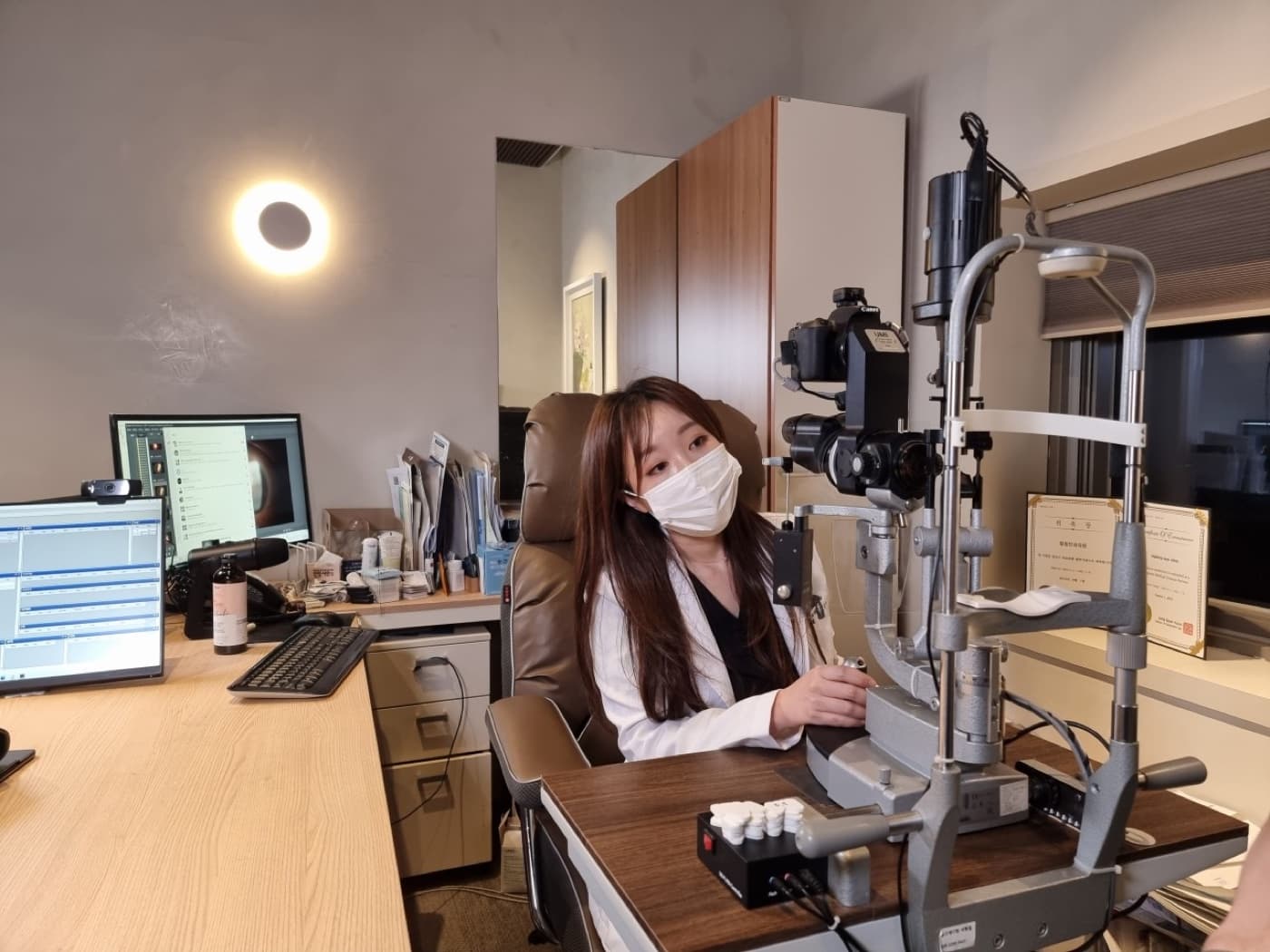
When it's safe to fly home after cataract surgery
The aircraft is rarely the problem. A self-sealing corneal incision with no gas bubble inside the eye tolerates cabin pressure; what the cabin does do is dry your tear film aggressively for ten hours. The real issue is timing: infection risk is concentrated in the first week and pressure changes in the first days, and those are the moments you do not want to be 10,000 km from the person who operated.
So my practice is simple. Stay through the day-1 examination at minimum. If both eyes are being done on one trip, I space them a few days apart and check after the second, which usually puts international patients in Seoul for around a week to ten days including the pre-op exam. I will ask you to extend if there was any difficulty with the capsule during surgery, if eye pressure hasn't settled, if the cornea is clearing slowly, or if the operated eye is your only seeing eye. Carry your drops in your hand luggage with the prescription sheet we give you, use preservative-free tears roughly every hour in the air, and keep the shield for sleeping on an overnight flight.
Drops and restrictions: the part people improvise, and shouldn't
You will go home with a short antibiotic course plus a steroid and usually an anti-inflammatory drop, tapering over several weeks. I see two opposite mistakes. Stopping the steroid early because the eye "feels fine" lets inflammation rebound and, in diabetic eyes especially, raises the risk of macular swelling. Continuing it longer than instructed can push eye pressure up in steroid responders. Neither is something you can feel, which is exactly why the schedule is written down and why follow-up measures pressure rather than asking how you are.
Practical limits for the first month: no rubbing or pressing the eye, no swimming pools, saunas or jjimjilbang, no eye makeup for about two weeks, no dusty work or gardening. Showering is fine from the day after with your face tilted back. Walking is fine immediately; heavy lifting and gym work come back gradually after the first week.
Night glare, reading glasses, and the lens you chose
How your recovery feels depends heavily on which intraocular lens is inside. With a monofocal, distance usually sharpens first and reading glasses are the expected trade-off — not a complication. With a multifocal or EDOF lens, the brain needs weeks to months of neuroadaptation, and halos or starbursts at night are common early. They usually soften; in a minority of patients they remain noticeable enough to matter, which is why I decline to put a multifocal in every eye. Large pupils, significant irregular astigmatism, macular disease or a life spent driving at night all push me toward a monofocal, and I say that at the exam. The trade-offs are laid out in my comparison of monofocal and multifocal IOLs, and if you're correcting presbyopia at the same time, see presbyopia and cataract correction in one operation.
After you land: follow-up, and the haze that can come back years later
The schedule I use is day 1, about one week, one month and three months. The first two happen here; the later two can be done by your own ophthalmologist or optometrist, and we ask for the report so I can review it and answer through our English, Japanese or Traditional Chinese interpreter support. Our lifetime check-up policy means the door stays open whenever you're back in Seoul.
One thing to know for the long term: the lens itself stays clear, but the capsule holding it can become cloudy months or years later — posterior capsule opacification. Our Korean head office explains it here: 후발성 백내장과 YAG 레이저 치료. It's treated with a YAG laser in a clinic room in minutes, without an incision.
What the aftercare side of this costs
The full list sits on our price page, and what actually moves the number — lens choice, astigmatism correction, the complexity of your eye — is broken down in cataract surgery cost in Korea.
If you're planning this trip, plan the calendar around the recovery rather than the flight price. Book the return leg loosely, tell me what your first week home looks like, and I'll tell you honestly whether the timing works — including when it doesn't.
— Dr. Kim Sun-young, Medical Director, Healing Eye Clinic, Sinnonhyeon, Seoul
Frequently asked questions
How long does vision take to stabilize after cataract surgery?
Most patients notice a clear brightening within the first day or two, but the eye keeps fluctuating for several weeks while the cornea settles and the anti-inflammatory drops are tapered. In a straightforward case, vision usually feels steady for daily tasks within one to two weeks and the measured refraction typically settles around four to six weeks. Denser cataracts, diabetes, corneal endothelial disease or previous laser vision correction can all make that curve slower. I never quote a specific acuity in advance — what I can do is tell you at your exam what your macula, optic nerve and cornea realistically allow.
Is blurry or fluctuating vision on day three normal?
Fluctuation is the normal pattern, especially in the first week: sharper in the morning, softer by evening, better one day than the next. It comes from mild corneal swelling, a changing tear film and the inflammation your drops are still controlling. What is not normal is vision that clearly gets worse and stays worse after having been clear, particularly with pain, spreading redness or discharge. That combination is a same-day call, not a wait-and-see.
When is it safe to fly home after cataract surgery?
Cabin pressure itself is not the main concern after a small-incision phacoemulsification with no gas bubble in the eye; dry cabin air and distance from your surgeon are. I ask international patients to stay at least through the day-1 check, and when both eyes are done on one trip most people are with us roughly a week to ten days. If there was an intraoperative complication, if eye pressure has not settled, or if the cornea is clearing slowly, I will ask you to delay the flight. On board, keep your drops and preservative-free tears in your carry-on and do not rub the eye.
Why can't I get new glasses right after surgery?
Your prescription is still moving while the incision seals and the inflammation settles, so a pair of glasses made in week one is usually wrong by week five. I generally measure a final prescription around four to six weeks after the second eye. If you need something to function in the meantime, inexpensive over-the-counter readers are a reasonable bridge after a monofocal lens. Needing reading glasses after a monofocal IOL is the expected outcome, not a failure of the surgery.
What follow-up do I need after I return to my own country?
The pattern I use is day 1, about one week, one month and three months. The first two happen here in Seoul; the later two can be done by your own ophthalmologist or optometrist, and we ask for the report so I can review it and reply through our Japanese, Traditional Chinese or English interpreter support. Our lifetime check-up policy means you are welcome back whenever you are in Seoul, at no extra charge for the review. If anything changes suddenly at home, you should be seen locally the same day rather than waiting for a message from us.
Can my vision become cloudy again years later?
The implanted lens itself stays clear, but in some eyes the thin capsule holding it becomes hazy months or years later — posterior capsule opacification, sometimes called an after-cataract. It can make vision look foggy or glare-prone in a way that feels like the cataract returning. It is treated with a YAG laser in a clinic room in a few minutes, without an incision, and that treatment carries its own small risks which your doctor should explain. This is a normal part of long-term follow-up, not a sign that something went wrong with your surgery.
Message us on official LINE / WhatsApp for a special offer
Your exact candidacy and cost are confirmed in a free 1:1 consultation.