
LASIK Korea Reviews: What Patients Actually Say About Their First Week
LASIK Korea reviews decoded by a Seoul eye surgeon: how to read them critically, what week one really feels like, and what a 4.8 rating can't tell you.

Dr. Kim Sun-young, Director
Cornea · Glaucoma · Cataract
Contents
"I read forty reviews last night and I'm more confused than when I started. Everyone says it went fine. Nobody says what fine actually felt like."
That was the opening line of an email from a software engineer in Toronto, sent three weeks before she flew into Incheon. It is the most honest question I receive from international patients, and it deserves a straight answer.
LASIK Korea reviews are the main research tool a foreign patient has before committing a flight, a week of leave and a few thousand dollars to a clinic they have never walked into — and they are genuinely useful, just not for the thing most people use them for. A review is a strong signal about service, communication, interpreter quality and how a clinic behaves when something goes slightly sideways. It is a weak signal about surgical judgment, because the decision that matters most — whether that patient should have had surgery at all — was made in the exam room, long before anyone opened Google Maps to leave five stars. Here is how I would read the review pages if I were the patient instead of the surgeon.
What LASIK Korea reviews can measure — and what they structurally can't
Almost every review you'll read was written between one week and two months after surgery. That window is real, but it is also the most flattering period in the entire timeline: the refractive change is dramatic, the novelty is high, and the slower parts of recovery — dryness that peaks and settles, night vision that takes months to fully mature — haven't finished playing out yet.
There is a second, quieter distortion. Reviews are written by people who had surgery. The patients I turned away — thin corneas, suspicious topography, a prescription that moved by 0.75 D in the last twelve months — almost never write anything. So the one variable that separates a careful clinic from a careless one, the willingness to say no, is invisible on the review page by design.
| What the review says | What it's genuinely evidence of | What you still have to verify yourself |
|---|---|---|
| "Whole thing took 10 minutes, so easy" | Efficient theater workflow, calm staff | Nothing about your own corneal thickness or safe residual bed |
| "English interpreter was excellent" | Real, checkable service quality | Whether the surgeon — not the coordinator — explained your data |
| "I could see the clock the next morning" | Typical early Clear LASIK experience | How your eyes behave at 6 and 12 months |
| "No pain at all" | That patient's anesthetic experience | Your own dryness and comfort trajectory |
| "Cheapest price in Gangnam" | A discount existed | What the quote included, and what it didn't |
A review shows you how a clinic treats a patient it accepted; it cannot show you how carefully that clinic decides whom to turn away.
What our 4.8 from 154 reviews does and doesn't mean
Our Google rating is 4.8 from 154 reviews. I'll tell you plainly how I read that number, because I read our competitors' numbers the same way.
The average is the least informative part. What matters is volume, recency and distribution. A 5.0 built on twenty reviews is a smaller sample than a 4.8 built on 154 — the second page has simply been exposed to more human variation. I'd also check whether the reviews are spread across years or clustered into three suspicious weeks, and I'd read the three-star entries first. Those are usually the most factual writing on the page: someone who liked the surgery but waited fifty minutes, or who felt the fee explanation could have been clearer. You can see the same mix of feedback on our own patient reviews page.
The first week, in the words my patients actually use
This is the part reviews skip. When I ask patients at their one-week check to describe the days honestly, the answers are remarkably consistent.
Day 0 — surgery day
The procedure itself runs around ten minutes for both eyes. Patients describe pressure and a sense of dimming rather than pain, since the eye is anesthetized with drops. The hours after are what people remember: three to five hours of burning, watering and light sensitivity, which is why I send everyone home to sleep rather than out to Garosu-gil for dinner. Vision that evening is typically foggy, like looking through a steamed window.
Days 1–2 — the "wow" morning, with caveats
Most people wake up able to read the clock across the room, and our record for 4th-generation Clear LASIK is a return to daily life in one to two days. What reviews rarely mention is that vision fluctuates through that day — sharp in the morning, softer by evening, sharper again after drops. That fluctuation is normal and it unsettles people who weren't warned. I walk through the whole timeline in more detail in our day-by-day LASIK recovery guide, which is worth reading before you book flights, not after.
Days 3–7 — the honest, unglamorous stretch
This is when dryness usually peaks, screen time gets tiring, and headlights sprout halos on the walk back to the hotel. Patients describe "gritty," "sandy," "my eyes get tired by 4pm." It is expected, it is managed with drops, and for most people it eases over the following weeks — but it is a real part of the experience, and no honest surgeon will tell you otherwise.
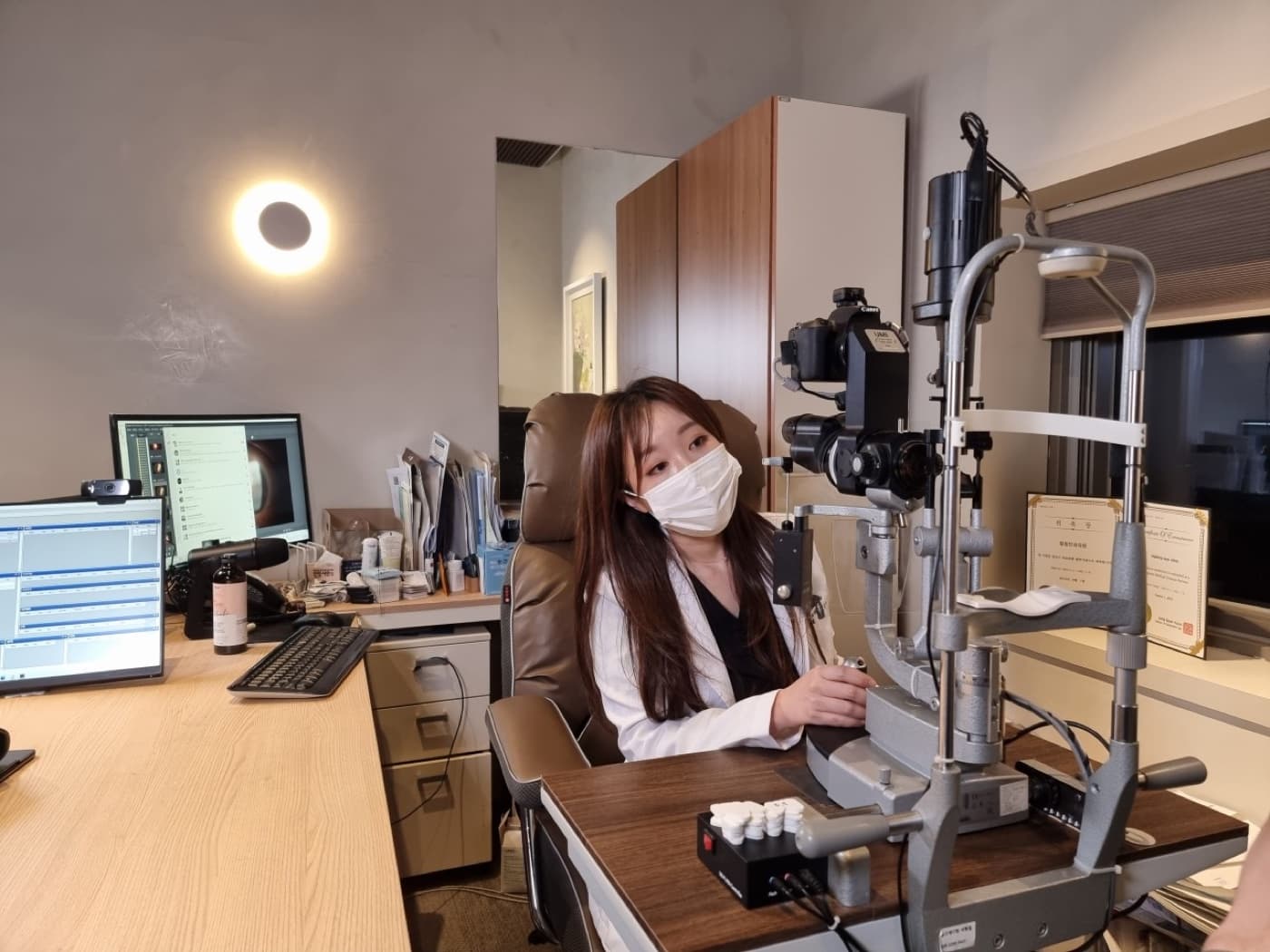
The three review topics I'd search for by name
Instead of reading reviews top to bottom, search the page for three words: glare, dry, and enhancement.
Glare tells you whether the clinic prepared patients for night vision changes. Halos and starbursts around headlights are common early on and generally settle, but pupil size and optical zone design matter, and I go through the mechanics honestly in our article on LASIK and night driving glare.
Dryness tells you whether the clinic screened tear film before surgery or discovered the problem afterward. If you already have symptoms in contact lenses, read our honest discussion of LASIK and dry eye risk before your consultation, because that assessment can change which procedure I recommend — or whether I recommend one at all.
Enhancement tells you what happens years later. Some eyes drift back, particularly higher prescriptions, and whether a re-correction is even possible depends on how much cornea was preserved the first time. That's the conversation behind our LASIK and LASEK revision page.
Review red flags I'd take seriously
- Uniform enthusiasm. No mention anywhere of dryness, fluctuation or glare means the page is filtered, not that the surgery is different there.
- Reviews that quote a guaranteed number. Any clinic promising a specific visual acuity is making a claim no surgeon can honestly make, and in Korea, cannot legally make.
- Reviews that name a salesperson, never a surgeon. If patients don't know who operated on them, ask whether one doctor owns the case from exam to aftercare. Ours is a 1:1 dedicated surgeon policy for exactly this reason.
- Price-driven praise. "Got a huge discount" tells you about a promotion, not an outcome. What actually moves a Korean quote up or down is covered in our guide to choosing a LASIK clinic in Korea.
What no review can answer: whether you're a candidate
The uncomfortable truth is that the best-reviewed clinic in Seoul is still the wrong clinic for you if your exam says corneal laser surgery isn't appropriate. I do not operate on eyes with topography suggesting keratoconus, corneas too thin to leave a safe residual bed, prescriptions that have shifted meaningfully in the past year, active uncontrolled dry eye disease, or during pregnancy and breastfeeding. Very high myopia sometimes exceeds what the cornea can safely give up, and the conversation moves to an implantable lens instead. If Clear LASIK isn't right for you, I'll say so and explain what is — including the option of not operating.
What it costs, before anyone quotes you a discount
If you'd like to see what Korean patients themselves read before booking the same procedure, our Korean head office publishes the full technical explanation on its 4세대 클리어라식 안내 페이지. Comparing that against the English page is, in my view, a better use of an evening than reading another fifty reviews.
Read the reviews — they're worth your time. Then bring the three questions they couldn't answer to your consultation, and let your own exam data settle the rest. I'd rather spend an extra thirty minutes telling you why your eyes aren't suited to a procedure than read a review from you six months later explaining that I didn't.
— Dr. Kim Sun-young, Medical Director, Healing Eye Clinic, Sinnonhyeon, Seoul
Frequently asked questions
Are LASIK Korea reviews trustworthy at all?
Most are written by real people, but they are collected in a very narrow window — usually the first few weeks after surgery, when vision is at its most impressive and dryness has not yet peaked for everyone. That makes them reliable evidence about service, communication, wait times and interpreter quality, and much weaker evidence about long-term stability. Reviews also suffer from survivor bias: a patient who was screened out and never operated on rarely writes anything at all. Read them for how a clinic behaves, not as a prediction of your own result.
Your Google rating is 4.8 from 154 reviews, not 5.0. Should that concern me?
I'd be more concerned by a perfect 5.0. Any clinic operating at real volume will have patients who waited longer than they expected, disliked a fee explanation, or had a slower recovery than the person sitting next to them in the waiting room. A 4.8 with 154 reviews carries far more information than a 5.0 with twenty, because the distribution shows you the range of experiences rather than a curated sample. What I'd actually read is the three-star reviews — they tend to be the most factual ones on the page.
Reviews say people flew home three days after LASIK. Is that realistic?
Our record for 4th-generation Clear LASIK is a return to daily life in one to two days, and many patients do fly within a few days, but I ask international patients to plan for more than the bare minimum. You need time for a full diagnostic exam before surgery, and at least one post-op check that I personally perform before you leave the country. Cabin air is dry, and a long-haul flight during the first week usually means more drops, not fewer. Book the trip around the exam schedule, not around the shortest recovery story you read online.
Why do so many reviews mention dry eyes and night halos?
Because they are the two most common and most expected experiences after laser vision correction, not because something went wrong. Corneal nerves are affected during surgery and tear production usually dips for a period afterward, which is why lubricating drops are part of the plan rather than a rescue measure. Halos and starbursts around headlights are common early on and typically become less noticeable over the following weeks and months, though a minority of patients report some degree of night-vision change that persists. If a review page contains no mention of either, I would assume it is filtered rather than assume the surgery is different there.
Who should not fly to Seoul for LASIK, whatever the reviews say?
Anyone with a cornea too thin to leave a safe residual bed, topography suggesting keratoconus or another ectatic risk, a prescription that has shifted meaningfully in the past year, or active, uncontrolled dry eye disease. Pregnancy and breastfeeding, certain autoimmune conditions, and some medications are also reasons to postpone. Very high myopia sometimes exceeds what corneal laser surgery can safely correct, in which case an implantable lens may be the more appropriate discussion. I do tell people not to have surgery, and a review page will never tell you which group you fall into — only your exam data will.
Do international patients pay more than Korean patients here?
No. Our policy is the same price for all: an international patient pays exactly what a Korean patient pays for the same procedure, and the published price list is the one we work from. Clear LASIK for both eyes is currently ₩2,700,000, and the full diagnostic exam is ₩150,000. Where costs can change is when the exam reveals something that alters the plan — a different procedure, or a preparatory treatment — and I would rather discuss that with you before you book flights than on the morning of surgery.
Message us on official LINE / WhatsApp for a special offer
Your exact candidacy and cost are confirmed in a free 1:1 consultation.