
LASIK Recovery Time, Day by Day: What I Tell Patients Before They Fly Home
LASIK recovery time day by day from a Seoul surgeon: what's normal, what needs a call, when it's safe to fly home, and the follow-up schedule after surgery.

Dr. Kim Sun-young, Director
Cornea · Glaucoma · Cataract
Contents
A patient sat down in my consultation room last month and asked the only question she actually cared about: "My flight back to Chicago leaves Thursday. Will I be able to read the departure board?" She had already read three clinic websites, all of which said "back to normal the next day," and none of which told her what the next day actually feels like.
LASIK recovery time is best understood in three separate layers: comfort, functional vision, and stability. Comfort returns fastest — usually within the first day. Functional vision, meaning you can move through an airport, read your phone, and go about ordinary life, generally follows within one to two days. Stability — the point where your prescription and your tear film have genuinely settled and I am willing to judge the result — takes weeks to months. Clinics that quote only the second layer are not lying, but they are answering a different question than the one you are asking.
Being comfortable, seeing functionally, and being stable are three different milestones after LASIK, and they arrive weeks apart.
Hours 0 to 24: the part nobody describes honestly
The surgery itself takes around ten minutes for both eyes. You will walk out of the laser room seeing shapes and light in a milky, over-bright way, as if looking through a steamed window. That is expected — the cornea holds a little fluid immediately afterward.
The anesthetic drops wear off after roughly 30 to 60 minutes, and this is the window patients are least prepared for. Expect burning, watering, and a strong gritty feeling, as though sand is in both eyes, for about three to five hours. Light will feel aggressive. The single most useful thing you can do is go back to your hotel, close your eyes, and sleep through it. I mean that literally: sleep is the treatment for hour three.
Do not rub. Not once, not gently, not through a tissue. The flap in 4th-generation Clear LASIK is held in place by the cornea's own pumping action long before it is biologically secure, and the highest-risk moment for displacing it is a half-asleep rub at 3 a.m. Wear the protective shields to bed for as many nights as I specify.
Day by day: a realistic LASIK healing timeline
| Time point | What you'll likely notice | Reasonable activity | Avoid |
|---|---|---|---|
| Day 0 (surgery day) | Burning, tearing, glare for 3–5 hrs, then easing | Sleep, drops, nothing else | Screens, rubbing, going out |
| Day 1 | Functional vision; mild grit, halos at night | Day-1 exam, short walks, light screens | Makeup, driving at night |
| Days 2–3 | Comfort largely settled; vision fluctuates through the day | Back to daily life, office work in short blocks | Sweat in the eyes, dusty places |
| Week 1 | Dryness becomes the main complaint | Light gym, walking, work | Pools, saunas, contact sports |
| Weeks 2–4 | Night halos softening; vision steadier | Most exercise, eye makeup after your check | Anything with impact risk |
| Months 1–3 | Dryness improving; refraction settling | Normal life | Judging your final result too early |
| Months 3–12 | Stability assessed at check-ups | Normal life, ongoing lubrication if needed | Skipping follow-ups |
Our clinical record for Clear LASIK is a return to daily life in one to two days, and that matches what I see. But "daily life" is not "peak visual performance." Night halos and starbursts around headlights are common in the first weeks and typically soften over one to three months — though for some patients, particularly those with large pupils or higher prescriptions, some degree persists. I go into that in detail in our article on LASIK and night driving glare, because it is the side effect patients most often wish they had understood beforehand.
Normal versus "call me now": how to tell the difference abroad
This matters more for you than for a Seoul resident, because you will be interpreting your own symptoms from another time zone.
Normal and expected
Gritty sensation and watering on day 0. Fluctuating clarity that is better in the morning and worse at night. Red patches on the white of the eye — small subconjunctival hemorrhages from the suction ring, which look alarming and resolve on their own over one to three weeks. Halos around lights. A dry, tired feeling by evening.
Contact us the same day
Pain that increases after the first 24 hours rather than fading. Vision that is getting steadily worse day over day. Redness with sticky discharge. Sudden sharp pain plus light sensitivity after any knock or rub. These can indicate infection, inflammation under the flap, or flap displacement. All are uncommon; all are treatable when addressed quickly and much less forgiving when they are not.
When it's genuinely safe to fly home
Altitude and cabin pressure do not endanger a healing cornea. Two other things do: dryness and distance from your surgeon.
Cabin air runs extremely dry, which is uncomfortable on an eye already producing less tear film than usual. Carry preservative-free artificial tears in your hand luggage, use them roughly every hour in the air, skip contact-lens-free sleep masks that press on the eye, and avoid alcohol on the flight.
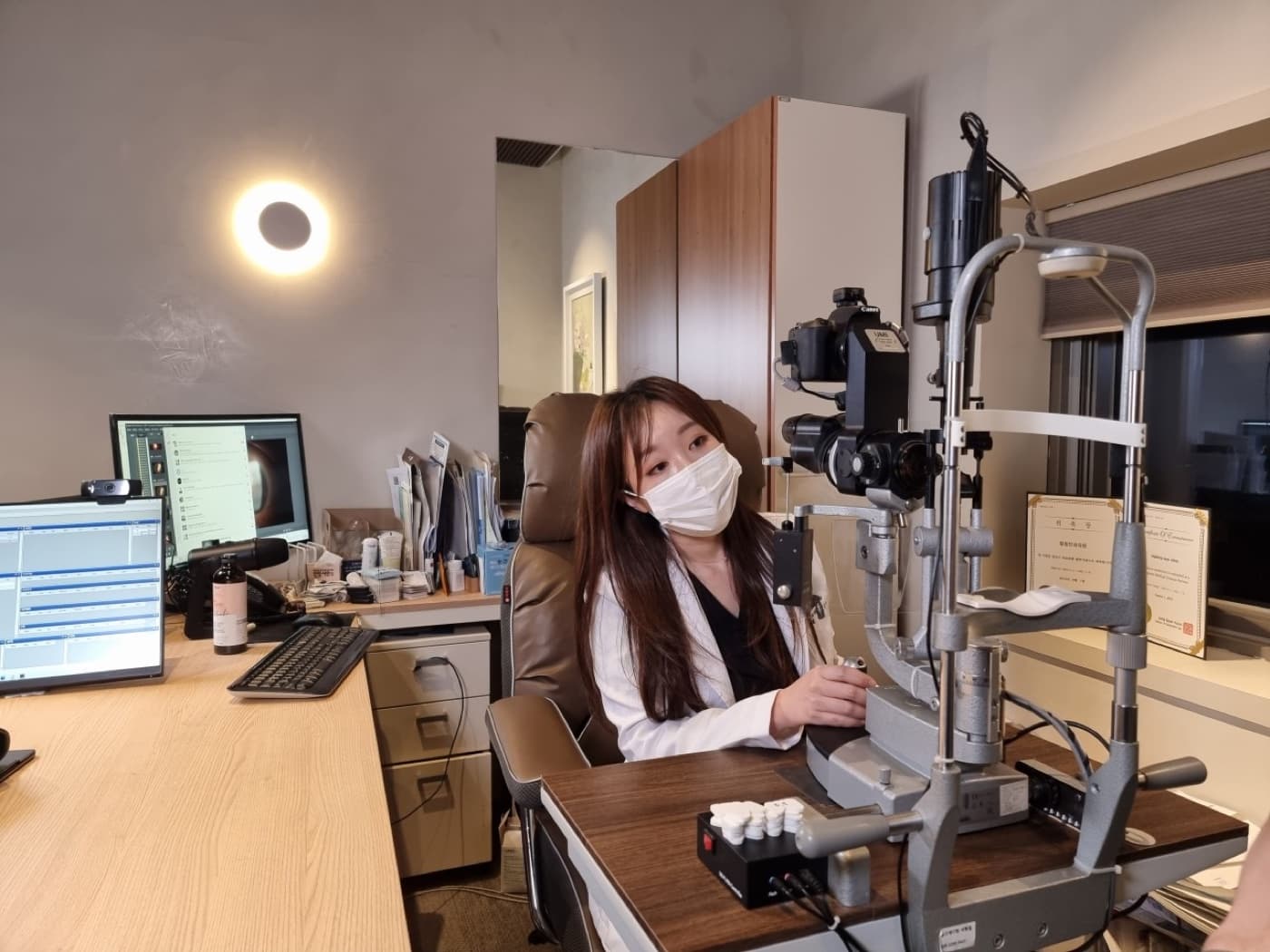
The real constraint is examination. I want to have looked at your eyes at the slit lamp at least once — day one, without exception — and preferably a second time before you leave. In practice that means planning around four to five nights in Seoul for a laser procedure. Patients who compress it into a two-night trip are asking me to sign off on a healing eye I have seen exactly once, and I will say so plainly at consultation. If your travel dates cannot flex, that is a legitimate reason to postpone surgery rather than shorten aftercare.
The limiting factor on flying home is not the flight — it is how many times I have been able to examine the eye before you board.
The follow-up schedule when you live 10,000 km away
My standard schedule is day one, week one, one month, three months, six months, and twelve months, then annually. For international patients, we split it: the first one or two visits happen here in Gangnam, and the rest are handled by video call with our Japanese, Traditional Chinese, or English interpreter, supported by a report from an ophthalmologist near you.
Before you fly home I will give you, in writing: your surgical data, your drop schedule with end dates, the exact tests I want your local eye doctor to run at one and three months, and a direct contact route for urgent questions. That documentation is what makes remote follow-up work. Our lifelong check-up and responsibility policy does not stop at the airport — but it does depend on you actually sending the results.
Dry eye and regression: the two slow stories of month one to twelve
Almost everyone has some degree of dryness after LASIK, because the procedure temporarily reduces corneal nerve sensitivity and therefore the reflex tear signal. For most patients it improves substantially over three to six months. For a minority — particularly those who already had marginal tear film, wore contacts intolerantly, or have autoimmune or hormonal contributors — it lasts longer and needs active treatment. If you already suspect your eyes are dry, read our honest discussion of LASIK and dry eye risk before you book flights, because that assessment belongs before surgery, not after.
Separately, a proportion of patients experience some regression over the years, more often with higher original prescriptions. It is not a failure of the surgery; it is corneal and lens biology. When and whether re-correction is appropriate depends on residual corneal thickness and stability, and I discuss that in our guide to LASIK enhancement and regression. No result should be described as permanent, and I do not describe mine that way.
What the recovery side of the bill looks like
Who I ask not to plan a short recovery trip
Some people should not be scheduling LASIK around a flight at all. If your cornea is too thin or your topography shows irregularity, if you have untreated significant dry eye, if your prescription has changed in the last twelve months, if you are pregnant or breastfeeding, or if you have active ocular inflammation, I will not operate — and no recovery timeline makes that acceptable. If your work or sport carries a real risk of a blow to the eye, a flap-based procedure may be the wrong architecture for you, and I would discuss flapless SMILE surgery instead. The Korean technical explanation of both procedures sits on our head office page for 4세대 클리어라식 if you want to compare what we publish domestically with what you are reading here.
Recovery is not something that happens to you after surgery — it is the second half of the surgery, and it is the half you perform. Bring the drops, keep the appointments, and tell me when something feels wrong. I would rather answer ten unnecessary messages than miss one that mattered.
— Dr. Kim Sun-young, Medical Director, Healing Eye Clinic, Sinnonhyeon, Seoul
Frequently asked questions
How long is LASIK recovery time before I can work at a computer?
Most of my patients are back to ordinary daily life, including light screen work, within one to two days. What limits you in that first week is usually dryness and fluctuating focus rather than pain. I ask patients to work in shorter blocks, use preservative-free artificial tears roughly every hour at first, and lower screen brightness in a dim room. If your job involves eight straight hours of detailed screen work, plan for a slower, less comfortable first week rather than assuming you will be at full speed.
When is it safe to fly home after LASIK?
Flying itself does not harm the cornea, and cabin altitude is not the issue people imagine. My concern is that you leave Korea only after I have examined the eye at least once at the slit lamp, and ideally twice. I ask patients to stay for the day-one check and, where possible, a check a few days later, which usually means four to five nights in Seoul. Cabin air is very dry, so bring more artificial tears than you think you need and use them on the plane.
Is blurry vision two weeks after LASIK normal?
Mild fluctuation, especially in the evening or after long screen use, is common in the first weeks while the tear film and corneal surface settle. Vision that is clear in the morning and hazier at night usually points to dryness rather than a problem with the correction. What is not routine is vision that is getting steadily worse day after day, or sudden blurring with pain, redness, or light sensitivity — that needs to be examined promptly. I judge the refractive result at the one- to three-month checks, not at two weeks.
What symptoms after LASIK mean I should contact the clinic immediately?
Sharp or increasing pain after the first 24 hours, sudden loss of vision, growing redness with discharge, or a sensation that something has physically shifted in the eye after a knock or hard rub all warrant same-day contact. Infection and flap displacement are uncommon, but they are time-sensitive, and they are treatable when caught early. If you have already flown home, message us with photos and we will arrange a video call and, if needed, direct you to a local ophthalmologist for an urgent slit-lamp exam. I would far rather review a false alarm than hear about a real problem a week late.
How long do the eye drops continue after LASIK?
Antibiotic and anti-inflammatory drops are typically used for a short, defined course in the first weeks, with the exact schedule written out for you and your interpreter before you leave. Lubricating drops usually continue for around three months, and some patients keep using them longer. Do not stop the medicated drops early because your vision feels fine, and do not extend steroid drops on your own — steroid use without pressure checks can raise intraocular pressure quietly. If you run out abroad, contact us before substituting anything from a local pharmacy.
When can I swim, wear eye makeup, or go back to the gym?
Light walking and stationary cardio are usually fine within a few days, but I ask patients to avoid sweat running into the eye for about a week. Eye makeup, swimming pools, hot springs, and saunas wait roughly two to four weeks depending on how the surface looks at your check. Contact sports and anything with a risk of a blow to the eye deserve longer caution, particularly after flap-based LASIK — for some patients I recommend a flapless option instead. Your exact dates should come from your own follow-up exam, not from a general article.
Message us on official LINE / WhatsApp for a special offer
Your exact candidacy and cost are confirmed in a free 1:1 consultation.