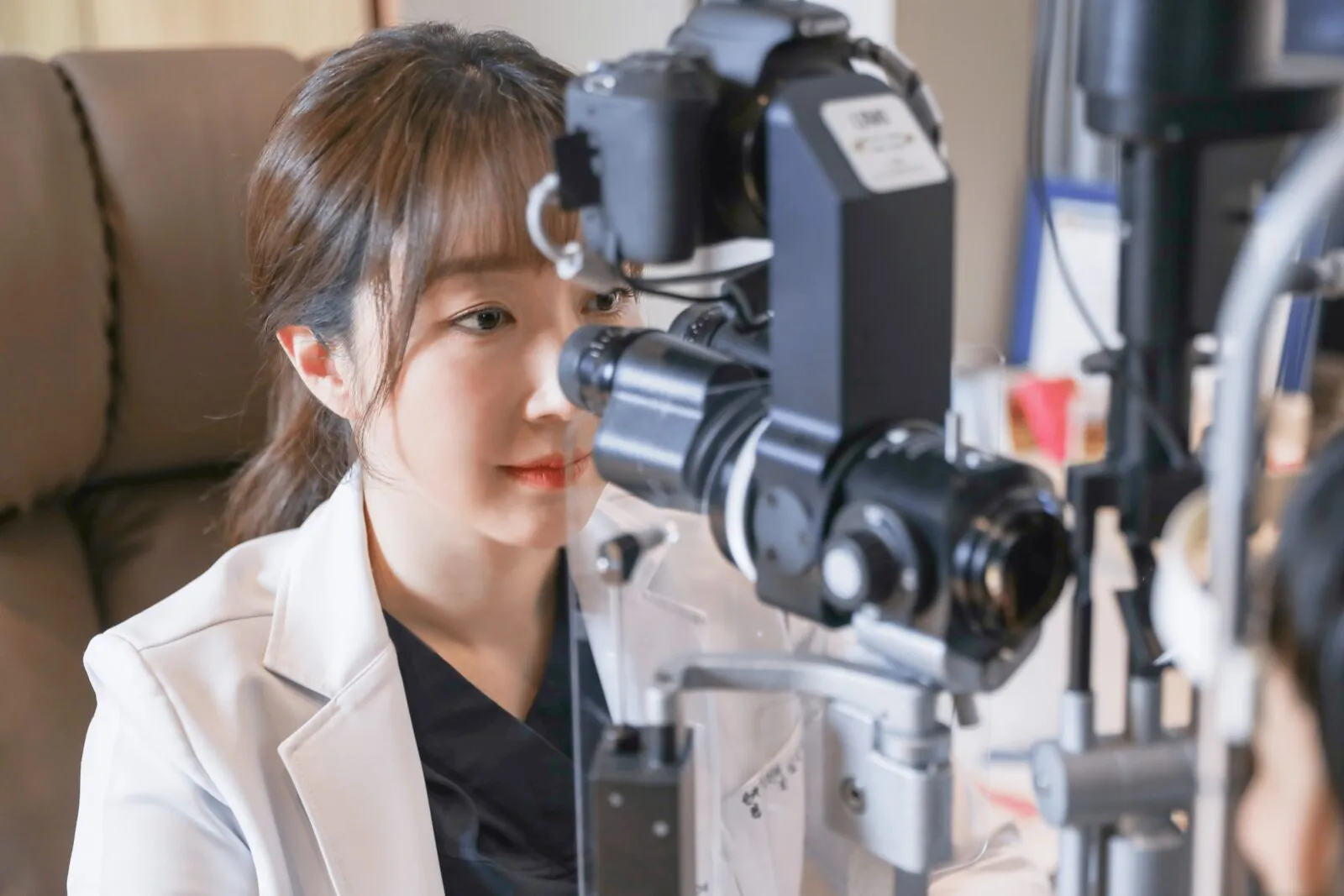
Perfect Healing LASEK Korean method: who it suits
Perfect Healing LASEK Korean surgery skips the corneal flap and comes with 3–5 days of recovery care. Who it suits, and how to time it around a break.

Dr. Kim Sun-young, Director
Cornea · Glaucoma · Cataract
Medically reviewed byDr. Kim Sun-young, Director· Medical Director
Edited by: Dr. Kim Sun-young
Contents
Perfect Healing LASEK Korean surgery, as we do it at Healing Eye Clinic in Gangnam, is a flap-free surface laser treatment: no corneal flap is cut, so more of your cornea stays uncut, and that is why it suits thinner corneas and people whose eyes take knocks. The trade-off comes in the first few days while the surface layer regrows, and Perfect Healing LASEK comes with 3–5 days of recovery care for that stretch. If you're squeezing this into one school break, those days matter more than the roughly 10-minute operation, because they're what your flight home has to fit around.
I'm Dr. Kim Sun-young, Medical Director of Healing Eye Clinic in Seoul, and "should i do my lasik in Thailand or Korea" is a question I can only half answer from my side of the map.
I'm Kim Sun-young, Medical Director at Healing Eye Clinic, and the cornea is my specialty, which is the tissue this whole decision is about.
The doctor who measures your cornea before surgery is the doctor who operates and the doctor who sees you at follow-ups. That's our 1:1 dedicated-surgeon system. With LASEK it matters, because the person who read your corneal map on exam day is the same person judging how your surface is healing a few days later.
If you're working out whether one break is enough, send two things on WhatsApp: your latest glasses or contact lens prescription, and the dates you actually have free. Add the one question that's holding you back, whether that's the flight, the discomfort or your cornea.
What is Perfect Healing LASEK, and how is it different from LASIK?
Both reshape the cornea with an excimer laser. In LASIK, a thin flap is created, the laser treats the tissue underneath, and the flap is laid back down, which is how the American Academy of Ophthalmology describes it in its patient guide. LASEK has no flap. The laser works on the surface after the epithelium, the thin outer skin of the cornea, is moved aside, and that skin grows back over the following days. If you're from the US, you may know this surface family as PRK.
The difference that matters to me is structural. A flap is generally thought to leave the cornea with a cut layer that doesn't regain all of its original strength. Without one, more of the load-bearing tissue stays intact. So surface treatment is often where I look first when a cornea is on the thin side, or when someone boxes, plays rugby or works where a blow to the eye is a real possibility.
Perfect Healing LASEK is our name for LASEK with a recovery-care program built around those first days, aimed at reducing discomfort and shortening healing time. The Perfect Healing LASEK Korean patients book here is the same procedure you would be booking from abroad. If a parent or partner reads Korean and wants to look into it with you, send them our main clinic's Korean-language LASIK page.
Why the first few days are slower
The laser takes about 10 minutes for both eyes. What sets the pace afterwards is the epithelium. Until it has closed over the treated area the surface is open, and surgeons usually place a bandage contact lens to protect it while it heals.
For many people the first two or three days bring light sensitivity, watering and a gritty, sore feeling. Your vision is usable but soft. Once the surface closes, comfort usually improves quickly, but sharpness keeps settling for weeks and can drift between morning and evening. People often don't expect this part: you can feel fine and still not see as crisply as you will a month later.
Our 3–5 days of recovery care cover this stretch. Plan those days to be quiet: sunglasses on, short screen sessions, no driving, and nothing on the calendar you'd hate to cancel.
When should I book it around a school break?
Earlier in the break than you'd guess. If the exam and surgery come near the start, the slow days fall while you're still close to the clinic, and the end of your break is for you rather than for healing.
The season matters too, because surface-treated eyes react to their surroundings in the first weeks. Many surgeons ask LASEK patients to be strict about UV protection for the first months, since sun exposure is thought to add to the risk of corneal haze.
| Your break | What works in your favor | What to plan for |
|---|---|---|
| Summer | Long daylight for an easy last week | Strong UV, pools and the sea; sunglasses and keeping water out of your eyes for as long as advised |
| Winter | Lower UV | Dry, heated indoor air, which can make healing eyes feel scratchy |
| Seollal or Chuseok | Several days off in a row | We're closed on public holidays, so exams and checks have to fall on the days either side |
Our hours shape the plan as well. We're open Monday to Thursday 10:00–18:30, until 21:00 on Fridays, and 10:00–14:00 on Saturdays, with lunch from 13:00 to 14:00 and no clinic on Sundays or public holidays. Land on a Saturday afternoon and nothing can start until Monday.
The clinic is at 470 Gangnam-daero, one minute's walk from Sinnonhyeon Station and about 70 minutes from Incheon Airport. Our partner hotel is the O'Cloud Hotel in Seocho-gu, if you'd rather not hunt for a room. If you're puzzled by how many eye clinics share this one street, I've written about why so many eye clinics are concentrated in Gangnam.
How many nights you need in Seoul, and how long to leave out your contact lenses before the exam, are both confirmed at consultation. Don't lock in a non-refundable return flight before then. The other treatments we offer, from Clear LASIK to cataract surgery, are listed on the Healing Eye Clinic English homepage.
Who does it suit, and who should choose something else?
In short, it suits a stable prescription where the cornea is thinner than I'd like for a flap, and people whose sport or job puts their eyes at risk of impact. It suits people less well when they need to be back at a screen or behind the wheel within a day or two.
When a new chart lands on my desk, the first thing I look at isn't the prescription. It's the thickness map next to it. A -5.00 D eye with a thin cornea needs a different conversation from the same number on a thick one. I don't recommend a particular surgery for its own sake; I choose, with you, the method that fits your eyes and your life, based on your exam data. If LASEK isn't right for you, I'll say so clearly and explain the alternatives.
Those alternatives are usually one of two. If your cornea is thick enough and its topography is even, Clear LASIK recovers faster and fits a short break more easily. If your myopia is very high, or your cornea is too thin for any laser, an implantable lens (ICL) corrects vision without reshaping the cornea and can be removed if needed.
Because ICL is surgery inside the eye, it carries its own risks, such as raised eye pressure, and it needs enough space in the front of the eye and a healthy cell count on the inner corneal surface, which are measured first. If you want to see the measurements behind these choices, I've written about the four numbers I check first on a safety question.
Risks and side effects to know
The common effects are temporary: soreness and light sensitivity in the first days, watering, and vision that fluctuates for several weeks. Dry eye is common for weeks to months, and some people notice glare or halos around lights at night early on. Less often, the cornea develops a faint haze as it heals, the correction ends up slightly under or over target and needs a later touch-up, or an infection takes hold while the surface is still open.
Healing speed varies from person to person, so treat these timelines as typical rather than fixed.
Some people should wait or choose something else. The U.S. Food and Drug Administration's LASIK patient guidance lists a prescription that has changed within the past year, pregnancy or breastfeeding, and regular contact sports among the reasons laser surgery may not be right for you yet. Contact sports are mainly a flap concern, which is one reason LASEK comes up for athletes. Beyond that list, significant dry eye, a corneal map that suggests keratoconus, or an active eye infection or inflammation are all reasons to stop and look harder.
Whether surgery suits you at all is decided in the exam room, after the detailed tests.
If something feels wrong after you've flown home, act on it that day. Pain that gets worse instead of better after the first days, a sudden drop in vision, or a red eye with discharge needs a local ophthalmologist the same day, not a wait-and-see approach. Keep a photo of your surgery details and drop schedule on your phone so the doctor at home can see what was done. For the ordinary weeks after you're back, I've covered what laser eye surgery aftercare looks like at home.
Who looks after my eyes once I'm home?
One limit is worth saying plainly: I can't examine your eyes from another country. Once you're home, the day-to-day checks belong to an eye doctor near you, which is why the risk section above ends with a local appointment.
What I can offer is continuity while you're here. The same surgeon handles your exam, surgery and follow-ups in Seoul. We have English interpreters on site, and we review your results together in your own language before you decide anything. We're registered with Korea's Ministry of Health and Welfare as an institution for international patients. We also run a dedicated LASIK/LASEK revision center for people whose vision declined or became uncomfortable after surgery elsewhere.
If you're weighing up clinics, these are the kinds of things you can actually verify about a LASIK clinic in Korea before you book.
If an eye exam at home has already given you a corneal thickness number, send a photo of that printout on WhatsApp with your break dates, and ask the one thing you'd want settled before you book a flight.
Frequently asked questions
Is Perfect Healing LASEK the same as PRK?
They belong to the same surface-treatment family: there's no flap, the laser works on the corneal surface, and the epithelium grows back afterwards. They differ mainly in how that outer layer is handled before the laser. Perfect Healing LASEK adds our recovery-care program for the first days. If you've been offered PRK at home, the same questions about corneal thickness and healing time apply here.
How long does the operation itself take?
About 10 minutes for both eyes. Your day at the clinic will run longer than the laser itself, so keep the rest of that day free and plan to rest afterwards.
Can I fly home a few days after LASEK?
How many nights to plan in Seoul is confirmed at consultation.
I had LASIK or LASEK elsewhere and my vision has drifted. Is another treatment possible?
Sometimes. We run a dedicated LASIK/LASEK revision center for people whose vision declined or became uncomfortable after surgery at another clinic. Whether a second treatment is possible depends on how much cornea is left and why your vision changed, and the plan is decided after a detailed exam.
Do I have to stop wearing contact lenses before the exam?
Usually, yes. The U.S. FDA's LASIK patient guidance explains that contact lenses change the shape of the cornea, so they're left out for a while before the measurements are taken. The number of days for your lens type is confirmed at consultation.
Will someone explain my results in English?
Yes. We have English interpreters on site, and we go through your exam results together in your language before you decide anything.
Message us on official LINE / WhatsApp for a special offer
Your exact candidacy and cost are confirmed in a free 1:1 consultation.