
Presbyopia Correction Surgery Options: The First-Time Guide I Give Patients Flying Into Seoul
Presbyopia correction surgery options explained by a Seoul surgeon: how each works, who it suits, what the day looks like, and who should not have it.

Dr. Kim Sun-young, Director
Cornea · Glaucoma · Cataract
Contents
"I can see the road signs perfectly. It's the menu I can't read — and I'm tired of holding my phone at arm's length." That was a 54-year-old from Melbourne, sitting in my consult room on a Tuesday morning with three pairs of readers in her handbag and a flight home on Sunday.
Presbyopia correction surgery options divide into two genuinely different families — reshaping the optics in front of your natural lens with a laser, or replacing that natural lens with a premium implant — and which family you belong to is decided mostly by the state of your own lens, not by preference. Patients arrive having read about "multifocal surgery" as if it were one thing. It isn't. Below is the same explanation I give across the desk, including the parts that don't flatter the procedure.
Presbyopia isn't your glasses getting weaker — it's your lens losing its flex
Inside your eye, behind the iris, sits a clear lens roughly the size of an aspirin. A ring of muscle changes its shape so you can shift focus from a road sign to a phone screen. From the late thirties that lens slowly stiffens, and by the mid-forties it can no longer flex enough for close work. That is presbyopia. Nothing you did caused it, reading glasses don't accelerate it, and no exercise reverses it.
This single fact explains the whole surgical menu. If your natural lens is still clear, a laser can only re-engineer the cornea in front of it to buy you usable near vision. If the lens is already clouding — the beginning of a cataract — then removing it and choosing a lens that carries more than one focus is the more logical move. Our Korean head office has a plain-language explainer on what presbyopic cataract actually is if you want the mechanism in more detail.
Presbyopia is a stiffening of your eye's own lens, so surgery either redesigns the optics in front of that lens or replaces it — there is no third mechanism.
The presbyopia correction surgery options that actually exist for a 45-to-60-year-old eye
Presbyopia-correcting laser (presbyopic LASIK, LASEK, or Clear LASIK)
Here I use the laser to build a deliberate imbalance: the dominant eye is set for distance, the non-dominant eye is given a slight near bias, and the brain blends the two. Done well, it works for a person in their late forties whose natural lens is still clear and who mainly wants to stop hunting for readers at lunch. Our head office page on presbyopia LASIK and LASEK for patients in their 40s and 50s covers the Korean-language version of this discussion. The honest limitation: the laser does not stop your natural lens from stiffening further, so near comfort can drift over the years, and if a cataract develops later you may still end up having lens surgery. I say that out loud before anyone books.
Lens replacement with a multifocal or EDOF implant
If your natural lens is already losing clarity, we're no longer choosing whether to have lens surgery — only which lens goes in. That is the whole logic of simultaneous presbyopia and cataract correction: the clouded lens comes out either way, so the decision is whether the implant carries one focus or several. It takes roughly 15–20 minutes per eye, and recovery is typically within days.
A monofocal lens plus reading glasses
This is a legitimate choice, not a consolation prize. One crisp focal distance, less night-time glare, the lowest cost — and readers for close work. For a patient who drives at night for a living, it is often the option I recommend.
| Option | Best suited to | Main trade-off |
|---|---|---|
| Presbyopic LASIK / LASEK | Mid-40s to mid-50s, clear natural lens, moderate prescription | Near comfort can drift as the lens keeps stiffening; blended vision needs adaptation |
| Presbyopic Clear LASIK | Same group, wanting a flap-based 4th-gen laser platform | Same drift issue; corneal thickness must allow it |
| Multifocal / EDOF implant | 45+, lens already clouding, wants near and far handled in one operation | Night halos, some contrast loss, weeks-to-months of neuroadaptation |
| Monofocal implant | Cataract present, heavy night driving, glare-sensitive | Readers still needed for close work |
How multifocal and EDOF lenses split light — and the trade-off I raise before anyone books
A multifocal IOL creates several focal zones within the lens and divides incoming light between far and near. An EDOF lens instead stretches focus into one elongated zone, which tends to give smoother intermediate and distance vision with less glare. Neither is superior in the abstract; the right answer moves with your pupil size, corneal astigmatism, the distances your life actually uses, and how much you do after dark. You can see the premium lens families we work with on the head office page comparing premium intraocular lenses.
The cost of splitting light is that some light goes where you aren't looking. That shows up as rings or starbursts around headlights, and as a subtle loss of contrast in dim rooms. Most patients adapt over weeks to a few months as the brain learns to ignore the out-of-focus image; a minority stay aware of it. I lay both columns out side by side — the version of that table I draw by hand is written up in my monofocal versus multifocal IOL comparison.
The patients I tell not to book the flight
Not everyone is a candidate, and pretending otherwise is how patients end up unhappy. I decline or defer multifocal correction for eyes with significant macular disease, advanced glaucoma with field loss, amblyopia, keratoconus or a markedly irregular cornea, and for uncontrolled dry eye — because an unstable tear film makes the measurements themselves wobble, which leads to lens power error. I am also cautious with patients whose stated goal is perfection rather than improvement.
Timing matters too. If your natural lens is still genuinely clear and your only complaint is reading distance, I am conservative about removing a healthy lens for convenience; there is a laser route, or simply waiting. How I actually weigh that timing is in my piece on when to have cataract surgery. And if the exam uncovers a retinal or glaucoma problem, we do not perform those surgeries here — I will tell you directly and point you to the right specialist.
The exam decides most of the result
Satisfaction with a premium lens is settled before the operating room. Biometry measures axial length and corneal curvature to calculate lens power. Topography maps astigmatism and surface irregularity. We assess the tear film, pupil size in dim light, and the health of the macula and optic nerve. If any of that is unreliable, I fix it or postpone rather than guess. Stop soft contact lenses for about a week and rigid lenses longer before the exam, or the cornea will lie to us.
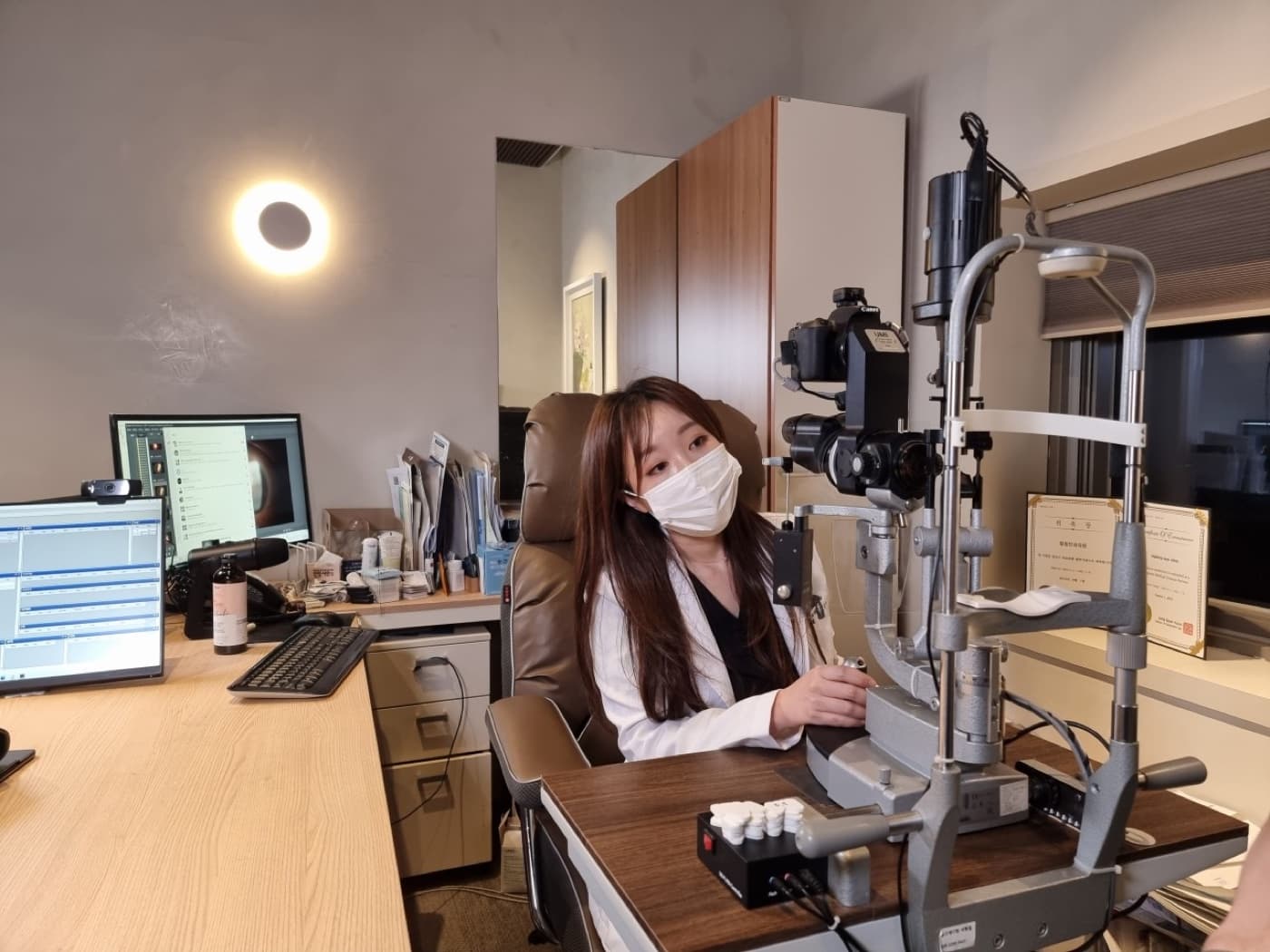
If your tear film or cornea is unstable, the numbers we base your lens choice on are unstable too — which is why I never rush this stage.
What the trip to Seoul actually looks like
We are 10–11F at 470 Gangnam-daero, one minute from Sinnonhyeon Station and about 70 minutes from Incheon Airport. A typical plan: a two-to-three-hour precision exam and consultation on day one, surgery on a subsequent day, a check the following morning. Sometimes I prefer to space the two eyes a few days apart so I can see how the first eye behaves. Interpreters in English, Japanese and Traditional Chinese sit in on the consultation, one surgeon owns your case from exam through aftercare, and follow-up continues by LINE or WhatsApp once you're home, with lifelong check-ups available if you return.
Vision in the first days is usually functional but not settled — fluctuating, slightly hazy, sometimes glary. My day-by-day account of that phase is in what vision after cataract surgery really looks like.
What the numbers look like
What drives the gap between those lens prices is a fair question, and I break it down in what you're actually paying for in presbyopia lens surgery.
If you take one thing from this guide: the goal is not glasses-free perfection, it is choosing the trade-off you can live with for the next twenty years. Bring me your real week — the night drives, the spreadsheets, the sewing, the golf — and I will tell you which option fits it, or that none of them does yet.
— Dr. Kim Sun-young, Medical Director, Healing Eye Clinic, Gangnam
Frequently asked questions
At what age do presbyopia correction surgery options start to make sense?
Most of the patients I operate on for presbyopia are between 45 and 65. Before 45, the natural lens usually still has some flexibility left and the picture is still changing, so I would rather measure you again in a year or two than lock in an optical design that your eye will outgrow. From the mid-40s, laser-based presbyopia correction becomes a reasonable conversation if the natural lens is still clear. Once the lens itself is clouding, lens replacement becomes the more logical route because that surgery is coming eventually anyway.
Will I be able to throw away my reading glasses completely?
I can't promise that, and I won't. What premium multifocal and EDOF lenses aim for is a large reduction in how often you reach for readers — many patients manage most daily tasks without them, while still preferring glasses for very small print, dim restaurant menus, or long hours of fine work. Some patients keep a weak pair of readers in a drawer permanently and are perfectly happy. If your requirement is absolute independence from glasses in every lighting condition, I would tell you honestly that no lens or laser available today can guarantee that.
How long do I need to stay in Korea for presbyopia surgery?
For lens-based presbyopia correction I usually plan the precision exam and consultation on one day, surgery on a following day, and a check the day after surgery. If we decide to space the two eyes a few days apart — which I sometimes prefer so I can see how the first eye behaves before finalizing the second — the stay gets longer. Laser-based presbyopia correction generally needs a shorter stay but still requires a next-day check. I give each patient a day count only after the exam, because the exam is what decides the plan.
What are the honest downsides of a multifocal or EDOF lens?
The main ones are night-time halos or starbursts around headlights and streetlights, a subtle drop in contrast in dim conditions, and an adaptation period that can run from a few weeks to several months while the brain learns to prioritize the focal zone it needs. A small number of patients never fully settle with the optics and remain aware of the rings at night. There is also the ordinary surgical risk set of any intraocular lens procedure — inflammation, elevated pressure, swelling at the back of the eye, infection (rare but serious), and the possibility that the lens power lands slightly off target and needs a laser touch-up or, very occasionally, an exchange. These are uncommon, but they are real, and they are why I screen carefully rather than sell enthusiastically.
Who should not have presbyopia correction surgery?
I turn down patients with significant macular disease, advanced glaucoma with field loss, amblyopia (a 'lazy eye' that never developed full vision), keratoconus or a markedly irregular cornea, and uncontrolled dry eye that makes the measurements unreliable until it is treated. I am also cautious with patients whose work depends on hours of night driving, and with anyone whose expectation is perfection rather than improvement. If your exam turns up a retinal or glaucoma problem, we do not treat those conditions here — I will tell you plainly and refer you to the right specialist rather than operate around it.
Do international patients pay more at Healing Eye Clinic?
No. Our policy is the same price for all: international patients pay exactly what Korean patients pay, from the exam through to surgery. The published per-eye lens prices and the both-eyes laser prices are on our price list, and the premium lens you choose is the single biggest variable in the total. Interpretation in English, Japanese and Traditional Chinese is part of the service rather than a paid extra, and follow-up after you fly home can continue by LINE or WhatsApp.
Message us on official LINE / WhatsApp for a special offer
Your exact candidacy and cost are confirmed in a free 1:1 consultation.