Which Vision Correction Surgery Is Right for Me? A Seoul Surgeon's First-Time Guide
Which vision correction surgery is right for me? A Seoul surgeon's guide to LASIK, LASEK, ICL and lens surgery — who each suits, and who should not.

Dr. Kim Sun-young, Director
Cornea · Glaucoma · Cataract
Contents
"I've worn contacts for eighteen years, my eyes burn by 4 p.m., and my optometrist in Melbourne said I 'might not be a LASIK candidate.' Does that mean ICL? Or does it mean nothing at all?"
That message landed in our inbox at 2 a.m. Seoul time, and some version of it arrives most weeks. It is a fair question asked in the wrong order.
Which vision correction surgery is right for me is a question that cannot honestly be answered from a prescription number alone — it is answered by four measurements taken in an exam room: how thick and how regular your cornea is, how strong your prescription is, how much space sits inside the front of your eye, and how well your tear film holds up. I am Dr. Kim Sun-young, medical director at Healing Eye Clinic in Gangnam, and this guide is the conversation I have with first-time patients before anyone books a flight. It includes the part most articles leave out: who I send home without surgery.
What "vision correction surgery" actually covers
There are only two families of procedure, and understanding the split makes everything else simpler.
Laser corneal surgery reshapes the front window of your eye. A laser removes a precisely calculated amount of corneal tissue so light focuses on the retina instead of in front of it. Fourth-generation Clear LASIK creates a thin, uniform flap, lifts it, reshapes underneath and lays it back. LASEK skips the flap and works on the surface instead. Wavefront-customized LASIK maps the individual irregularities of your cornea into the treatment profile, which matters more when astigmatism is significant.
Intraocular lens surgery leaves the cornea alone and changes the optics inside the eye. An implantable collamer lens (ICL) adds a thin lens in front of your own natural lens without removing anything. Cataract surgery removes a clouded natural lens and replaces it with a clear artificial one — a different procedure for a different problem, though it is sometimes the right answer for a patient in their sixties who arrived asking about LASIK.
Laser surgery changes the cornea; lens surgery changes the optics inside the eye — your anatomy, not your preference, decides which family you belong to.
The four measurements that actually decide it
Corneal thickness and shape
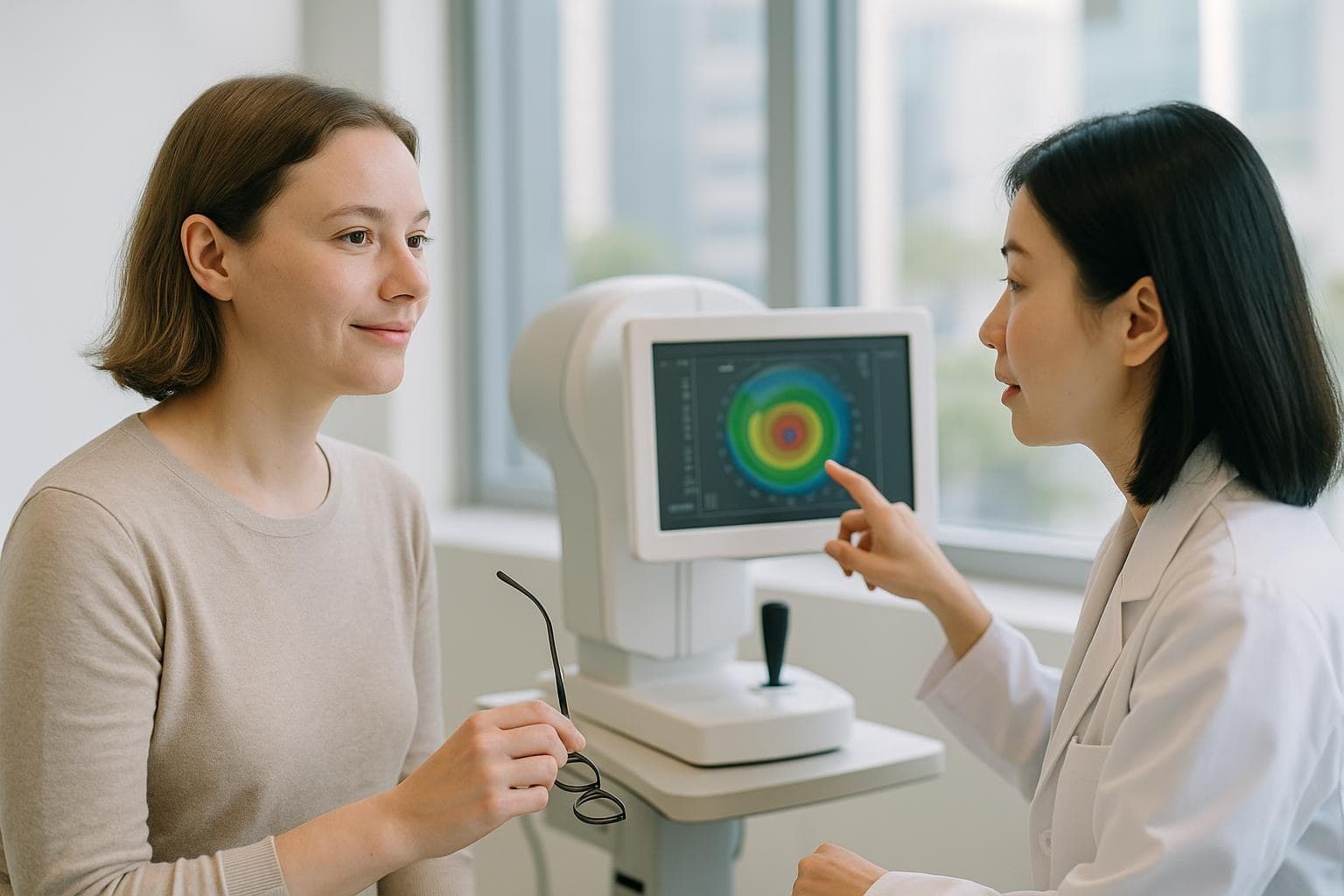
After correction, a safe amount of corneal tissue has to remain underneath. A high prescription in a thin cornea uses up that margin fast. Shape matters as much as thickness: topography sometimes shows subtle irregularity or early signs of keratoconus in an eye that feels completely normal. That single scan has changed more of my recommendations than any other test.
The strength of your prescription
Moderate myopia with adequate cornea is comfortably laser territory. Very high myopia is where the arithmetic stops working, and where a lens implant preserves corneal tissue instead of spending it.
Anterior chamber depth
For ICL, I measure the depth of the space the lens will occupy, the white-to-white diameter and the corneal endothelial cell count. A shallow anterior chamber or a low endothelial count means I do not implant a lens, however much a patient wants one.
Tear film
If your eyes are already inflamed and dry from years of contact lens wear, laser surgery will not improve that in the short term. Often we treat the surface first and re-measure. Speaking of contacts — soft and rigid lenses distort the cornea for days to weeks, so please read when to stop wearing contacts before your exam before you book anything. Patients who skip this get measured wrong, and being measured wrong is how people end up with the wrong surgery.
LASIK vs LASEK vs ICL: an honest comparison
| Clear LASIK | LASEK (surface) | ICL (implantable lens) | |
|---|---|---|---|
| What it does | Thin flap, laser reshaping underneath | No flap; laser on the corneal surface | Lens placed inside the eye, cornea untouched |
| Usually suits | Adequate corneal thickness, low-to-moderate myopia and astigmatism, wants fast return to work | Thinner corneas, contact sports, jobs with impact risk | Very high myopia, thin corneas, significant dry eye |
| Return to daily life | 1–2 days | Slower than LASIK; vision settles gradually over weeks | 1–2 days |
| Reversibility | Tissue removed is not replaced | Tissue removed is not replaced | Lens can be removed if needed |
| Main trade-offs | Flap-related risk, dry eye, night glare | Longer, more uncomfortable early recovery | Intraocular procedure: infection, pressure change, possible repositioning; night glare |
| Both eyes, procedure time | ~10 min | Comparable | ~15 min |
Numbers in a table are a starting point, not a verdict. Two patients with identical prescriptions routinely leave my consultation room with different plans because one has a 520-micron cornea and drives at night, and the other has 460 microns and plays rugby. If neither of the laser options fits, that is not a failure — it is the exam doing its job. You can see the full range of what we do on our treatments overview.
Who I tell not to have surgery
This is the section that matters most, and it is short by design.
I do not operate on eyes with a prescription that is still changing — if your glasses have shifted meaningfully in the past twelve months, wait. I do not operate when topography suggests keratoconus or unstable corneal shape. I decline when residual corneal thickness after correction would be too thin, when severe dry eye or ocular surface disease is uncontrolled, when there is active inflammation or infection, and during pregnancy or breastfeeding, when refraction is unreliable. Poorly controlled diabetes or an uncontrolled autoimmune condition affects healing and changes the conversation. For ICL, a shallow anterior chamber or a low endothelial cell count is a stop sign.
And I decline when expectations do not match the biology — for example, a patient of fifty-five who expects distance and reading vision from one laser treatment and does not want to hear about the trade-offs.
What the days in Seoul actually look like
The detailed exam takes roughly two hours and includes topography, corneal thickness, pupil measurement, tear film assessment, intraocular pressure, endothelial cell count and dilated fundus examination. We review the numbers together with an interpreter — Japanese, Traditional Chinese and English are available on site — and only then choose a procedure. You can see the diagnostic equipment line-up on our Korean head office site.
Surgery itself is short: about ten minutes for both eyes with Clear LASIK, about fifteen for ICL, under drop anesthesia, awake, no hospital stay. You go back to your hotel with shields and a drop schedule. The next-day check is not optional — it is the appointment where I find the things you cannot feel.
Build in buffer. I've written a realistic version of the itinerary in our guide on how many days to plan in Korea for eye surgery, and if your flight home is looming, read when it is actually safe to fly after LASIK before you rebook anything.
Afterwards: what settles, and what takes longer
Expect fluctuating vision, light sensitivity and dryness in the early phase — that is the ordinary course, not a complication. Drops matter more than most patients expect, and the full pre- and post-operative precautions are published on our Korean aftercare page. Dry eye and night glare typically ease over weeks to months; occasionally they linger, and a small number of patients need an enhancement procedure later. We provide lifelong check-ups after surgery, and if you are back in Seoul, the door is open.
What it costs at our published rates
If a quote you receive elsewhere looks unusually low, ask what is inside it. I break that down in what a Seoul eye surgery price actually includes.
The exam fee is the only money you should spend before you know which procedure — and whether — you should have.
Come with your old prescriptions, your contact lens history and your honest daily life — night driving, screen hours, sports. I will give you the measurements, the option I would choose for your eyes, and the reason. If that reason is "not yet," or "not at all," you will hear that too.
— Dr. Kim Sun-young, Medical Director, Healing Eye Clinic, Sinnonhyeon, Seoul
Frequently asked questions
Can you tell me which surgery I need before I fly to Seoul?
I can tell you what is likely, not what is right. From your prescription, your age and a photo of your old optometry report I can usually say which two options are realistic and which one is probably off the table. But corneal thickness, topography shape, anterior chamber depth and tear film quality decide the final answer, and none of those can be read from an email. That is why I ask every international patient to treat the first day in Seoul as a decision day, not a surgery day.
I was told my corneas are too thin for LASIK. Is that the end of it?
Not necessarily, but it does narrow the field. A thin cornea usually rules out flap-based LASIK because too little tissue would remain underneath after correction. Surface treatment such as LASEK may still be possible for a moderate prescription, and an implantable lens leaves the cornea untouched entirely, which is often the more sensible path for a thin cornea with high myopia. What matters is the actual measurement in millimetres alongside your prescription, not the label 'thin'.
How many days do I need in Korea to do this properly?
For laser correction, I ask patients to plan on a detailed exam day, a surgery day, and a check the following day at minimum, with a few extra days of buffer. For an implantable lens I prefer a little more room, because lens sizing depends on measurements I want to review carefully before ordering. Both eyes are usually treated in one session. If your trip is genuinely rigid — a wedding, a conference — tell me at the consultation, because I would rather move the surgery than compress the safety margin.
Will I still need reading glasses after vision correction surgery?
If you are over about forty-two, very possibly yes, and I would rather say that clearly than let you discover it later. Distance correction does not stop the natural age-related loss of near focus. Some patients choose a deliberately blended correction, and some choose to keep reading glasses for close work, which is a perfectly reasonable trade. We discuss this at the exam, because expectations are the part of the outcome I can actually shape in advance.
How risky is this, honestly?
No eye surgery is free of risk, and anyone who tells you otherwise is selling something. The common issues are dry eye and night glare, which usually ease over weeks to months but occasionally persist. Rarer problems include undercorrection or overcorrection needing a second procedure, flap-related complications with LASIK, inflammation, and — for intraocular lens surgery — infection, pressure rise or the need to reposition or exchange the lens. Careful measurement and honest candidacy screening reduce these risks; they do not abolish them.
Do international patients pay more at Healing Eye Clinic?
No. International patients pay exactly the same published price as Korean patients, and our price list is public. What varies is the procedure and, for lens surgery, the specific lens chosen for your eye. The full pre-operative exam is charged separately from surgery, and I would rather you paid for a thorough exam and then declined surgery than the other way round.
Message us on official LINE / WhatsApp for a special offer
Your exact candidacy and cost are confirmed in a free 1:1 consultation.