Seoul Eye Surgery Price: What the Number Actually Includes, and What Moves It
Seoul eye surgery price, explained by a Gangnam surgeon: what a quote includes, what changes the number, and how to compare clinic estimates honestly.

Dr. Kim Sun-young, Director
Cornea · Glaucoma · Cataract
Contents
A patient in Vancouver wrote to me last spring with one line: "Just tell me the number so I can stop guessing." She had four quotes from four Seoul clinics that varied by nearly three million won for what looked, on the surface, like the same operation. Not one of them said what was inside the number.
Seoul eye surgery price is one of the very few things in medicine you can research honestly before you board a plane — but only if you are comparing the same contents. A quote is not a price; it is a package of decisions about which exam you get, which laser or lens is used, who operates, and what happens to you six months later when you are back home and something feels off. Below is how I structure that number at my own clinic in Sinnonhyeon, what genuinely moves it, and the questions that make two quotes comparable.
A number without a list of contents is not a price — it is a marketing figure.
What a Seoul eye surgery price actually covers, line by line
Here is our published list, exactly as our Korean patients see it. Note carefully which items are quoted for both eyes and which are per eye — this single detail causes more quote confusion than anything else.
| Item | Published price | Billed as | Usually considered for |
|---|---|---|---|
| Full pre-operative exam | ₩150,000 (was ₩400,000) | one time | everyone, before any surgical quote exists |
| Premium LASIK & LASEK | ₩1,990,000 | both eyes | moderate myopia/astigmatism, adequate corneal thickness |
| Clear LASIK (4th gen) | ₩2,700,000 | both eyes | those wanting the shortest return to daily life |
| Presbyopic Clear LASIK | ₩3,000,000 | both eyes | over-40s also managing near vision |
| EVO ICL | ₩5,500,000 | both eyes | high myopia, thin corneas, significant dry eye |
| EVO ICL Toric | ₩6,000,000 | both eyes | the same, plus astigmatism correction |
| Cataract — monofocal IOL | ₩1,250,000 | per eye | clean night vision, single focal distance |
| Cataract — FineVision trifocal | ₩4,000,000 | per eye | reduced dependence on reading glasses |
| Cataract — Synergy | ₩7,000,000 | per eye | broadest range of focus, premium optics |
The exam sits on its own line on purpose. It is a genuine diagnostic workup — corneal thickness and topography, pupil size in the dark, tear film, intraocular pressure, endothelial cell count, and for lens procedures the anterior chamber depth and white-to-white diameter — and a meaningful number of people who pay for it are told by me that surgery is not appropriate for them. If I buried that cost inside the surgical fee, the patients who proceed would be subsidising the ones who don't, and I would have a quiet financial reason to find everyone operable. I walk through what that appointment actually feels like in our guide to the free consultation and exam process.
Both eyes vs per eye
What genuinely moves the number — and what shouldn't
Three things legitimately change your price: the procedure your anatomy allows, whether astigmatism has to be corrected, and which lens you choose if a lens is involved.
Your cornea decides more than your budget does
If your corneal thickness and topography leave enough safe residual tissue after a flap, 4th-generation Clear LASIK is on the table and you are choosing within the ₩1,990,000–₩2,700,000 band. If your cornea is thin, your prescription is extreme, or topography shows subtle irregularity or signs of keratoconus, laser correction comes off the table entirely and an implantable collamer lens becomes the appropriate route at ₩5,500,000 for both eyes. That is not an upsell; it is a different operation for a different eye. The reason I refuse to quote a firm figure over email is that I would be guessing at the one variable that decides everything.
Astigmatism and lens choice
A toric design — whether EVO ICL Toric at ₩6,000,000 or a toric IOL in cataract surgery — costs more because the lens is manufactured to your astigmatic axis. In cataract surgery the lens choice is the single biggest cost lever: ₩1,250,000 per eye for a monofocal versus ₩7,000,000 per eye for Synergy. More expensive does not mean better for you. Monofocals give clean contrast and suit heavy night drivers; multifocals reduce reliance on reading glasses but a minority of patients notice halos and glare at night. If your pupil size, corneal astigmatism or macular findings don't favour a multifocal, I will say so and recommend the monofocal — which happens to be the cheaper lens.
Why our international price is the same as our Korean price
Some clinics maintain a separate rate for overseas patients, sometimes bundled as a "package" with airport pickup and a hotel. Our policy is one list for everyone: a visitor from Melbourne pays what a Gangnam office worker pays for the identical procedure with the identical surgeon. Interpreter support in English, Japanese and Traditional Chinese is how the clinic operates, not a billable extra, and the full price list is the same document in both languages.
There is a practical reason beyond fairness. The moment a clinic has a foreigner rate, the incentive shifts toward volume and speed for travelling patients, and the exam gets shorter. My structure is the opposite: one dedicated surgeon owns your case from the exam through surgery to aftercare, which only works if there is no financial reason to rush you.
The equipment question people never think to ask about cost
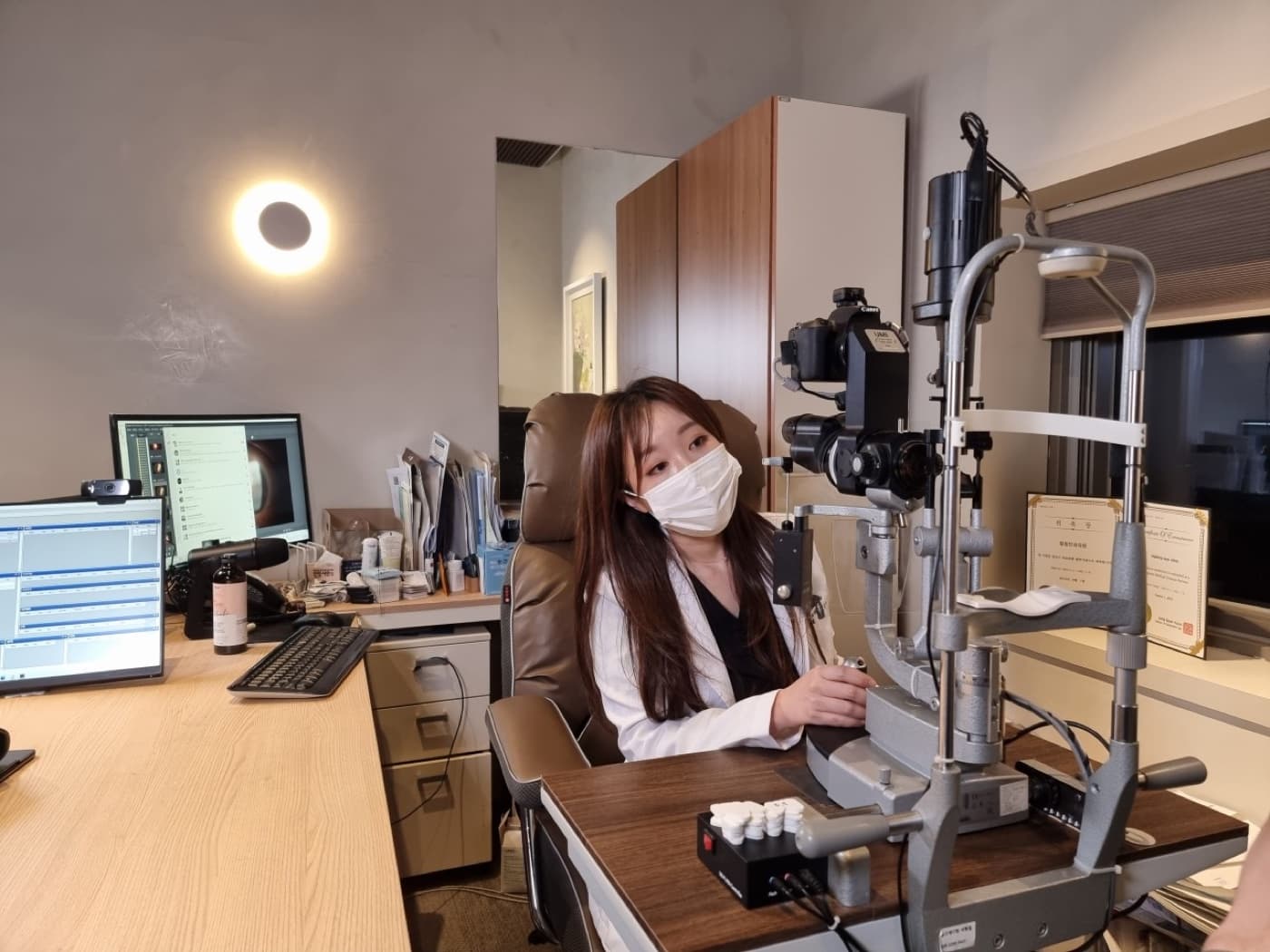
When a quote is unusually low, the difference is often in diagnostics rather than the surgery itself. Measuring accurately is what makes an ICL sit at the correct distance from the natural lens and the iris, and what determines the biometry behind an IOL power calculation. Those devices are expensive, they require calibration, and the time to use them properly is staff time. You can see the diagnostic and laser line-up we work with on our Korean head office equipment page. If a clinic quotes you a surgical price before it has measured any of this, you are not being given a price — you are being given a hook.
Comparing two quotes without fooling yourself
Ask each clinic the same five questions, in writing:
- Is this figure for both eyes or per eye, and is the exam included or separate?
- Which surgeon performs the operation, and is that the same person who examined me?
- What is the follow-up schedule, and what does it cost after I leave Korea?
- Under what circumstances would you tell me not to have this surgery?
- If an additional corrective procedure were needed later, what would determine whether it is even possible?
Question four is the one that separates clinics. Any surgeon who cannot immediately name the disqualifiers — unstable prescription, insufficient residual cornea, keratoconus suspicion, active uncontrolled dry eye, shallow anterior chamber for ICL, retinal or macular disease affecting the visual potential — is not examining people carefully enough to have found them. I've written more on how to read the answers in our guide to choosing an eye clinic in Korea.
The cheapest quote and the most expensive quote are both suspicious until you know which procedure your cornea actually permits.
The costs that never appear on a clinic invoice
Flights, accommodation and time away from work often add more than the price difference you were shopping for. Clear LASIK patients are typically back to daily life in one to two days, but I still want an exam day, the surgery, and a post-operative check before anyone flies home; cataract vision settles gradually over days rather than hours. Budget your trip against a realistic itinerary — a practical day-by-day schedule for eye surgery in Korea will do more for your total spend than haggling over a few hundred thousand won.
And budget honestly for outcome risk, because it is a cost too. Dry eye can worsen for a period after laser correction. Night glare, halos and starbursts are real and more likely in large-pupil eyes — I discuss that trade-off frankly in our article on LASIK and night driving glare. Under- and over-correction happen. Infection is uncommon but never zero, and after cataract surgery, posterior capsule clouding can occur later. No price buys those risks away; a thorough exam and a surgeon who stays responsible for you afterward simply lowers them.
If you take one thing from this: get the exam first, then talk about money. A price attached to the wrong procedure is not a bargain, and I would rather send you home with an honest "not you" than a discount.
— Dr. Kim Sun-young, Medical Director, Healing Eye Clinic, Sinnonhyeon, Seoul
Frequently asked questions
Why is the pre-operative exam charged separately from the surgery?
Because the exam is a real diagnostic procedure, not a sales appointment, and some people who take it are told not to have surgery at all. Our full exam is ₩150,000 (reduced from ₩400,000) and covers corneal thickness and topography, pupil size, tear film, intraocular pressure, endothelial cell count and, for lens procedures, anterior chamber depth and white-to-white measurement. If I folded that cost into the surgery fee, I would be quietly charging the people who proceed for the people who don't. Keeping it separate also means you can pay for an honest opinion and walk away with it.
Do international patients pay more than Korean patients at Healing Eye?
No. Our policy is one price list for everyone, so a visitor from Sydney or Singapore pays the same figure a Seoul office worker pays for the same procedure with the same surgeon. Interpreter support in English, Japanese and Traditional Chinese is part of how the clinic runs, not a billable extra. You can see the same list our Korean patients see on our price page. If another clinic quotes you a 'foreigner package,' ask them plainly what the domestic price is for the identical procedure.
Why are cataract prices quoted per eye when LASIK is quoted for both?
Because cataract surgery is genuinely done one eye at a time, and the intraocular lens is a separate physical device implanted in each eye. A monofocal IOL is ₩1,250,000 per eye and a trifocal such as Synergy is ₩7,000,000 per eye, so the two-eye total is roughly double the number you see. Laser vision correction, by contrast, is priced as a both-eyes procedure — ₩2,700,000 for Clear LASIK, for example. When you compare two quotes, always confirm which basis each clinic is using before you conclude one is cheaper.
Is the least expensive option ever the right one?
Sometimes, yes — and I say so when it is. Plenty of patients with a moderate prescription and a healthy, adequately thick cornea do well with Premium LASIK or LASEK at ₩1,990,000, and pushing them toward a more expensive procedure would be dishonest. But if your cornea is thin, your prescription is very high, or topography shows irregularity, the cheaper laser option is not an option at all, and an implantable lens becomes the safer path even though it costs more. Price should follow the anatomy, never the other way around.
If my vision changes later, will I have to pay for more surgery?
Our policy is lifelong check-ups and a responsibility guarantee after surgery, so follow-up care with your surgeon is part of the relationship rather than a new invoice each time. Whether an additional corrective procedure is even possible, however, depends on physical facts — how much residual corneal tissue you have, how stable your prescription is, and the health of your tear film. Some eyes have room for an enhancement and some do not, and I will not promise one in advance. Ask about this before surgery, not after, and get the answer in writing.
How many days in Seoul should I budget, and does that affect the total cost?
It affects your total spend far more than most people expect, because accommodation and time off work are real money. For laser vision correction I want a detailed exam day, the surgery, and at least the next-day check before you fly, and Clear LASIK patients are typically back to daily life in one to two days. Cataract surgery takes about 15 to 20 minutes per eye and settles gradually over days, so a second-eye schedule needs planning. Build your travel budget around a realistic itinerary rather than the shortest one someone promises you.
Message us on official LINE / WhatsApp for a special offer
Your exact candidacy and cost are confirmed in a free 1:1 consultation.