
Affordable Quality Eye Surgery in Korea: How I'd Judge a Seoul Clinic Before Booking the Flight
Affordable quality eye surgery Korea: a Seoul surgeon on how to judge a clinic, interpreter support, same-price policy and follow-up after flying home.

Dr. Kim Sun-young, Director
Cornea · Glaucoma · Cataract
Contents
"Once I add flights and a hotel, Seoul isn't that much cheaper than Sydney. So what am I actually buying?"
That was the opening line of an email I received last month from a 33-year-old software engineer in Melbourne. It was a better question than most, because she wasn't asking me to sell her anything. She was asking me for a way to judge.
Affordable quality eye surgery in Korea is real — but the word affordable is doing an enormous amount of work in that phrase, and it is the word most likely to mislead you. A number on a website tells you what a clinic charges. It tells you nothing about who will hold the laser, how long someone spent measuring your cornea before deciding you were a candidate, or who reads your message at 11pm Seoul time when you are back home with a red eye and no idea whether it matters. So this is not an overview of procedures. It is the set of checks I would run on another surgeon's clinic before I let anyone near my own eyes from eight thousand kilometers away.
Price is the easiest thing for a clinic to publish and the least informative thing to compare — judge the exam, the named surgeon and the follow-up first, then look at the number.
Start with the surgeon, not the procedure menu
Ask one question in your first email: which physician will examine me, and will that same physician operate? Get the name in writing.
In a high-volume refractive clinic it is entirely possible to be counseled by a non-physician coordinator, scanned by a technician, and to meet the operating surgeon for the first time three minutes before surgery. That model is not automatically bad — but it means nobody carries the whole picture of your eyes in their head. Our policy here is a 1:1 dedicated surgeon: the doctor who reads your topography is the doctor who operates and the doctor who sees you at your post-op checks. My own background is cornea, glaucoma and cataract — you can read the full credentials of our surgeons on the Korean head office's medical team page, and I would encourage you to look up any surgeon you're considering the same way.
What "same price for all" actually means on your invoice
A fair test of a clinic's pricing is whether the number it gives a foreigner is the same number it gives the Korean office worker sitting in the next chair. Ours is: our price list is published, and international patients are charged from that same list, with no interpreter fee, no foreigner package and no agency commission folded in.
Published prices (both eyes, unless noted)
What legitimately moves your quote is clinical, not national: astigmatism may require a toric lens, a thin cornea may push you from laser correction toward an implantable collamer lens (ICL), and lens choice in cataract surgery changes the figure substantially. What should never move it is your passport. If you want the line-by-line version of what a Seoul quote does and doesn't cover — drops, the next-day check, the enhancement policy — I break that down in our guide to what a Seoul eye surgery price includes.
The ₩150,000 exam is the part you're really buying
If you only audit one thing, audit the examination. For a laser procedure I want corneal topography and tomography, pachymetry, pupil diameter in the dark, tear film assessment, intraocular pressure, a dilated retinal check and endothelial cell count. For an implantable lens I additionally need anterior chamber depth and white-to-white diameter, because those numbers determine lens sizing and how far the lens sits from your natural lens and iris. That workup takes roughly two hours. A twenty-minute screening followed by a surgery date is not a workup; it is a sales funnel.
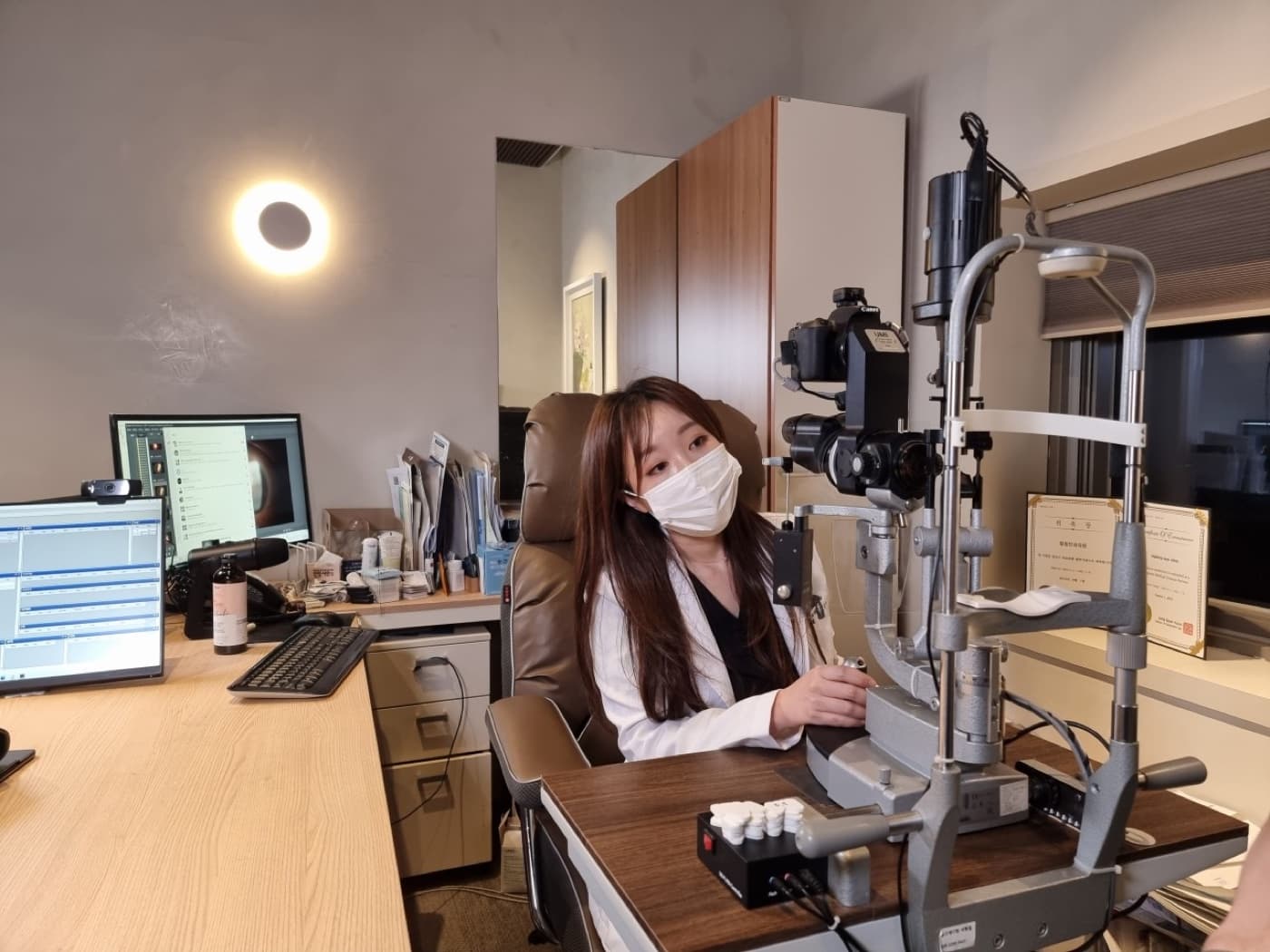
Ask which devices the clinic uses and whether scans are repeated on a second day if a reading looks borderline. Our equipment line-up is documented on the Korean site's diagnostic equipment page. And before you board: contact lenses must be out long enough for the cornea to return to its own shape, or the whole exam is unreliable. Soft lenses need days, rigid and ortho-k lenses far longer — the timelines are in our article on stopping contacts before an eye exam, and getting this wrong is the most common way an overseas trip loses a day.
Interpreter support is a safety system, not a courtesy
Informed consent in your second language is not informed consent. Neither is a drop schedule you half-understood on the day you were discharged.
We have Japanese, Traditional Chinese and English interpreters on site, and they are in the room for the results discussion, the consent conversation and the post-op instructions — not just at reception. What that changes clinically is specific: you can describe halo versus starburst versus glare accurately, you can tell me whether the ache is pressure or grittiness, and you can repeat your drop regimen back to me before you leave. Ask any clinic whether the interpreter is a staff member present during the consultation or a phone line called when there's a problem; the difference matters more than the brochure suggests. I've written about how to test this before you book in our piece on having eye surgery in Korea with an interpreter.
Aftercare once you've flown home
This is where medical tourism is genuinely weaker than treatment at home, and any clinic that pretends otherwise is not being straight with you.
Here is how I structure it. You are seen the morning after surgery in Seoul, non-negotiable. You leave with a written operative summary in English — pre-op measurements, what was done, implant or laser parameters, drop schedule, and a short list of symptoms that mean be examined today: worsening pain, a drop in vision, increasing redness, or new floaters and flashes. We continue follow-up by email or messenger in your language, and our post-surgery policy includes lifelong check-ups if you return to Seoul. General pre- and post-operative precautions are documented on the Korean site's precautions page.
What I insist on is that you identify a local eye doctor before surgery, not after. I cannot examine a cornea over video. Build your trip so the next-day check isn't a scramble — the realistic day counts are in our schedule guide for how many days to stay in Korea. Clear LASIK patients are generally back to daily life in one to two days, but that is not the same as being safe to fly the same evening, and I'd rather you booked a flexible ticket.
Who I tell not to fly
No procedure here suits everyone, and saying so is not modesty — it is the actual clinical picture.
I decline laser correction when corneal thickness leaves too little residual tissue, when topography suggests keratoconus, when the prescription has shifted in the past year, or when dry eye is uncontrolled — laser correction can worsen dryness before it settles. I decline an implantable lens when the anterior chamber is too shallow or endothelial cell count is low. Pregnancy and breastfeeding, active autoimmune disease and certain retinal conditions push surgery back. And I would ask anyone who cannot commit to the drop schedule and the follow-up checks to reconsider entirely.
Even for good candidates, honest risks exist: night glare and halos (more likely with large pupils), dry eye for weeks to months, under- or over-correction that may need an enhancement, and — rarely — infection or inflammation. Reading prescriptions still change with age; nothing done here stops that. You can read unfiltered patient accounts on our reviews page — our Google rating is 4.8 from 154 reviews, and I'd read the mid-range ones first.
The questions that separate a good clinic from a good website
| Ask this | Answer that reassures me | Answer that worries me |
|---|---|---|
| Who examines me, and who operates? | A named physician, same person for both | "Our surgical team" / name given on the day |
| How long is the pre-op exam? | About two hours, repeated if borderline | 20–30 minutes, surgery booked same hour |
| Do foreigners pay the published price? | Yes, same list, no package markup | A separate "international" quote |
| Is the interpreter in the consultation room? | Yes, staff interpreter, present throughout | Phone line on request |
| What if I'm not a candidate? | The exam finding is explained, alternatives offered | Everyone seems to qualify |
| What happens after I fly home? | Written op report, contactable surgeon, local doctor arranged | "Just see someone at home" |
If you want to compare the procedures themselves rather than the clinic, our 4th-generation Clear LASIK page sets out candidacy and recovery in detail, and the ICL page covers high myopia and thin corneas.
Send me your most recent prescription, your contact lens type and any scans your home clinic will release. I'd rather tell you by email that your cornea looks too thin for laser correction than tell you in person after you've crossed an ocean. That, more than any price, is what I think you should be buying.
— Dr. Kim Sun-young, Medical Director, Healing Eye Clinic, Sinnonhyeon, Seoul
Frequently asked questions
Is eye surgery in Korea genuinely cheaper, or is something being cut?
For many patients from the US, Australia and Western Europe, the Seoul price for laser vision correction or an implantable lens is meaningfully lower than at home, and the reason is structural rather than clinical: lower facility overhead, a dense concentration of refractive clinics in one district, and national price transparency that keeps quotes visible side by side. What is not lower is the diagnostic workload — my exam protocol takes about two hours because the decision to operate rests on it. The honest risk is not that Korean surgery is cheap, it is that a very low advertised number can mean a shorter exam, a shared consultation with a non-physician counselor, or an older laser platform. Ask what the number includes and who performs each step, then compare.
Do international patients pay more than Korean patients here?
No. Our policy is one published price list for everyone, and you can read it on our prices page before you write to us. There is no interpreter surcharge, no foreigner package markup and no commission added for an agency. What can legitimately change your quote is the clinical choice itself — a toric lens for astigmatism costs more than a non-toric one, and a premium intraocular lens in cataract surgery costs more than a monofocal — so I explain which of those applies to your eyes and why before you commit.
What happens if I have a problem after I fly home?
You leave Seoul with a written operative summary in English: your pre-op measurements, what was done to each eye, the implant or laser parameters, your drop schedule and the symptoms that mean you should be examined the same day. We continue follow-up by email or messenger in your language, and if your local optometrist or ophthalmologist sends me their slit-lamp findings, I can advise on the basis of real data. What I cannot do is examine you across a screen, so I ask every overseas patient to identify a local eye doctor before surgery, not after. If you return to Seoul, check-ups with us continue for life under our post-surgery responsibility policy.
How many days should I plan to stay in Seoul?
Plan for the exam, the surgery and at least the next-day check as separate days, and build in slack. With Clear LASIK, patients are generally back to daily life in one to two days, but I still want to see the eye the morning after surgery before you go anywhere. For an implantable lens I want a slightly longer window because pressure and lens position are checked in the first days. I also tell patients not to book a non-refundable flight for the day after surgery — if your eye needs another look, the schedule should bend, not your recovery.
Do I really have to stop wearing contact lenses before flying in?
Yes, and this is the single most common reason an overseas trip gets derailed. Contact lenses reshape the corneal surface, and topography taken on a distorted cornea can make a normal eye look irregular or hide a real irregularity. Soft lenses generally need to be out for days and rigid or ortho-k lenses for considerably longer, so I confirm your exact lens type by email before you book anything. If you arrive having worn lenses that morning, we may only be able to give you a provisional reading and repeat the scans later in your stay.
What if the exam shows I shouldn't have surgery at all?
Then I tell you that, and I explain what the scan showed rather than simply declining. Thin corneas, topography suggestive of keratoconus, an unstable prescription, a shallow anterior chamber or a low endothelial cell count are all reasons I decline laser correction, an implantable lens, or both. Sometimes the answer is a different procedure; sometimes it is treating dry eye first and re-measuring; sometimes it is glasses and a review in a year. It is a difficult conversation to have with someone who has flown fifteen hours, which is why I would rather flag a concern from your home-country records before you buy the ticket.
Message us on official LINE / WhatsApp for a special offer
Your exact candidacy and cost are confirmed in a free 1:1 consultation.