ICL Korea Patient Experience: A First-Timer's Guide From My Chair in Gangnam
ICL Korea patient experience: what the exam, surgery day and recovery really involve — from a Seoul surgeon who also says who shouldn't have it.

Dr. Kim Sun-young, Director
Cornea · Glaucoma · Cataract
Contents
A patient wrote to me last month: "I'm about -11.00 in both eyes, two clinics at home told me my corneas are too thin for laser, and I'll be in Korea for ten days. Is ICL something I can realistically do while I'm there — and what actually happens to me on each of those days?"
The ICL Korea patient experience, for most international patients, comes down to a tightly scheduled four to seven days built around one long examination, a roughly fifteen-minute surgery, and several short follow-up checks — and the part that decides the whole outcome happens before you ever lie down on the bed. I'm Dr. Kim Sun-young, medical director at Healing Eye Clinic in Sinnonhyeon, Gangnam. Below is the honest version of that week, including the measurements I take, the people I turn away, and the things that can go wrong.
What ICL actually is — and why your cornea stays untouched
LASIK, LASEK and SMILE all correct your prescription by reshaping the cornea with a laser. ICL does something structurally different: a thin, custom lens made of Collamer, a biocompatible material, is placed inside the eye, in the space between the iris and your own natural lens. Your cornea is not reshaped, and unlike cataract surgery, your natural lens is not removed — the implant simply sits in front of it.
Three consequences follow from that, and they're the reason I reach for ICL at all. Because no corneal tissue is removed, there's no ceiling on how strong a prescription can be corrected. Because fewer corneal nerves are disturbed, the dry eye burden tends to be lighter. And because the implant is an added component rather than a subtraction, it can be removed or exchanged if circumstances ever require it. The technical details of lens design and toric options are laid out on our ICL implantable lens treatment page, and the Korean head office page on 안내렌즈삽입술(ICL) covers the same indications for our domestic patients.
ICL adds a removable lens inside the eye rather than subtracting corneal tissue — which is why it remains an option when lasers have run out of room.
The numbers I check before I say yes
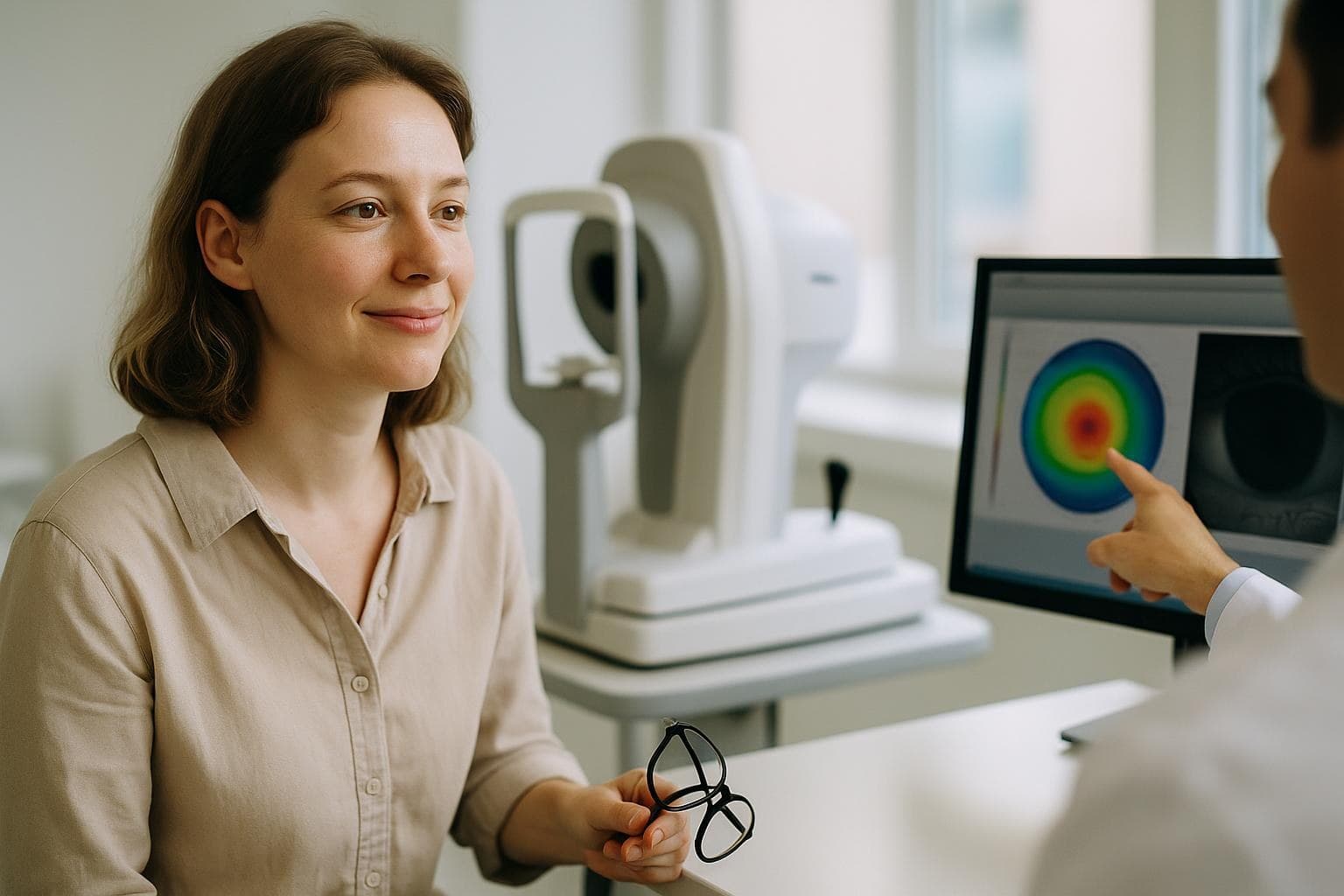
Placing a lens inside an eye means the space it occupies has to be measured, not estimated. At your examination I record anterior chamber depth — the depth of the room the lens enters — along with white-to-white corneal diameter, corneal endothelial cell count, pupil size under dim light, intraocular pressure, and a full refraction after your contacts have been out long enough for your corneas to return to their natural shape.
Those figures determine two things: which lens size, and which power. Get the size wrong and the lens sits too close to your natural lens or presses toward the iris. That's the mechanism behind most of the problems people read about online, and it's avoidable by measurement rather than by luck. I walk through the specific thresholds I use in my guide to ICL candidacy requirements, and I'd genuinely rather you read it before booking a flight.
Who I tell not to have ICL
- Anyone whose prescription has changed meaningfully in the past 12 months.
- Shallow anterior chambers — the room is simply too small for the lens to sit safely.
- A low corneal endothelial cell count, which I won't put under additional lifetime stress.
- Active uveitis or other uncontrolled inflammation inside the eye.
- Pregnancy or breastfeeding, where refraction is unstable.
- Anyone whose lifestyle makes a two-week eye drop schedule and lifelong annual checks unrealistic.
ICL, LASIK or SMILE: how the choice is actually made
I don't decide on a method in advance and then find reasons for it. Your cornea, your prescription and your work decide, and because the fee doesn't change my recommendation, I can afford to be blunt.
| ICL | Corneal laser (LASIK / SMILE / LASEK) | |
|---|---|---|
| Corneal tissue | Preserved — nothing removed | Reshaped; thickness is the limiting factor |
| Very high myopia | Correctable across a wide range | Limited by how much cornea can be removed |
| Thin corneas | Often still an option | Frequently ruled out |
| Dry eye tendency | Generally gentler on corneal nerves | More corneal nerve disturbance early on |
| Reversibility | Lens can be removed or exchanged | Tissue removal is not undoable |
| Inside-the-eye risk | Yes — intraocular procedure | No — surface/stromal procedure |
| Return to daily life | 1–2 days | Varies by method |
The honest trade is in the last two rows. ICL buys you reversibility and corneal preservation, and pays for it by being an operation inside the eye, with the risk profile that implies. If your cornea is thick and your prescription moderate, laser is often the simpler, more sensible route — I compare the two in detail in ICL vs LASIK for high myopia.
What your days in Seoul actually look like
Before you fly. Stop soft contact lenses at least a week before your exam, longer for toric or rigid lenses — I'll give you an exact figure by email. Send me any recent topography or prescription records you have.
Day 1 — examination. Two to three hours. Dilating drops will blur your near vision for several hours afterward, so don't plan anything visually demanding. We go through every number together with an interpreter present, in Japanese, Traditional Chinese or English, and I tell you plainly whether ICL, laser, or neither is the right answer. The full workup is ₩150,000.
Day 2 or 3 — surgery day. Numbing drops, a very small incision at the corneal edge, the folded lens inserted and positioned between the iris and your natural lens. No stitches are usually needed. Both eyes are typically done in about fifteen minutes, and you rest at the clinic afterward while I check your eye pressure. A step-by-step account of what you'll see and feel is in my walkthrough of the ICL procedure from the surgeon's chair.
Next morning — first check. Pressure, lens position, vault measurement.
Day 4 or 5 — second check before you travel. I decide flight clearance individually; I won't sign off on a long-haul flight I'm not comfortable with just because a ticket is already booked.
Recovery, described honestly
Most patients are back to ordinary daily life within one to two days. That's the clinic's authoritative figure and I won't shorten it for you. What that sentence doesn't capture is the texture of the first week: mild grittiness, light sensitivity, fluctuating focus through the day, and a strict drop schedule you must actually keep — antibiotic and anti-inflammatory drops, several times daily, on time.
Nighttime glare and halos around headlights or streetlights are common early on and usually settle as the eye quiets down and the pupil behavior stabilizes, though a minority of patients remain aware of them, particularly those with large pupils. I set that expectation before surgery rather than after, and I've written the full explanation in my honest answer on ICL halos and night vision. No swimming, no eye rubbing, no makeup near the eyes, and no saunas or jjimjilbangs in the early period — the Korean head office keeps the complete list of 수술 전·후 주의사항, which is the same protocol I give my international patients.
What it costs, and what happens afterward
ICL at Healing Eye Clinic
After you fly home, you'll need local follow-up. I ask patients to arrange an eye check at one month and then annually, and to send me the report. Our lifetime check-up and responsibility policy applies to you as much as to a patient living in Gangnam — distance doesn't end my responsibility for the lens I implanted.
Before you book the flight
Ask any clinic three things: which measurements they take before sizing the lens, who performs your surgery and whether that same surgeon sees you at follow-up, and what happens if the vault is wrong. Our policy is one dedicated surgeon from exam through aftercare — I explain what else I'd verify in how to judge an ICL surgeon in Korea. If the answers are vague, you have your answer.
Send me your records before you send me your flight dates. If your eyes have room for a lens, I'll tell you — and if they don't, I'll tell you that too, which is the more useful sentence of the two.
— Dr. Kim Sun-young, Medical Director, Healing Eye Clinic, Sinnonhyeon, Seoul
Frequently asked questions
How many days should I stay in Seoul for ICL?
I ask international patients to plan for a minimum of four to five days, and I'm more comfortable when they allow a week. You need a full examination day, a separate surgery day, a check the next morning, and at least one further check before you fly. Daily life generally resumes in one to two days, but that is not the same as being cleared for a long-haul flight, which I decide per patient at the post-op check. If your schedule is rigid to the hour, tell me before you book — I would rather move your surgery date than rush a check.
Does ICL hurt during the surgery?
The eye is numbed with drops, so what most patients report is pressure and bright light rather than sharp pain. I will not describe any surgery as painless, because sensation varies between people and some patients feel a brief stinging as the drops go in or a dull ache in the first hours afterwards. Both eyes are usually completed in about fifteen minutes, and an interpreter stays with you so you always know what is happening next. If you feel anything uncomfortable during the procedure, you tell me and we stop and address it.
What are the real risks of ICL I should weigh up?
The ones I discuss in every consultation are elevated eye pressure in the early period, a lens vault that sits too high or too low and may require a lens exchange, gradual corneal endothelial cell loss, glare or halos around lights at night, and — rarely but seriously — intraocular infection. There is also a long-term possibility of cataract formation, which is one reason I measure the space between the implant and your natural lens so carefully. None of these are common, but none are zero, and a clinic that tells you otherwise is selling rather than consenting. Because the lens can be removed or exchanged, several of these situations are manageable, which is part of why I favor ICL in the right eye.
Can I have ICL if I have astigmatism?
Often yes, using a toric ICL, which corrects the astigmatic axis as well as the myopia. The lens must be rotated to a specific axis during surgery and it needs to stay there, so sizing and pre-operative axis marking matter a great deal. I check the regularity of your astigmatism on corneal topography first — irregular astigmatism from a corneal condition is a different problem and may make you unsuitable. At our clinic the toric version is priced above the standard EVO ICL, and the difference is listed openly on our price page.
Do international patients pay more than Korean patients at your clinic?
No. Our policy is the same price for everyone, so the figure you see on the Korean price list is the figure you pay. Our published EVO ICL fee covers both eyes, and the full pre-operative examination is charged separately. What is not included is your flight, accommodation, or any additional treatment you might need, such as dry eye management before surgery. I would rather you know the total before you arrive than discover extras on the day.
What if ICL turns out to be the wrong choice for my eyes?
Then I say so, and I tell you why, using your own measurements. If your anterior chamber is too shallow, your endothelial cell count is low, your prescription has shifted in the past year, or you have uncontrolled inflammation inside the eye, I will not implant a lens. Sometimes the honest recommendation is laser correction instead, sometimes it is glasses and a review in a year, and sometimes it is treating dry eye first and deciding later. Being told not to have surgery after flying here is frustrating, which is why I review your recent records by email before you commit to dates.
Message us on official LINE / WhatsApp for a special offer
Your exact candidacy and cost are confirmed in a free 1:1 consultation.