Vision Correction Surgery Korea Package Price: What My Quote Actually Covers, and What Moves It
Vision correction surgery Korea package price, itemized by a Seoul surgeon: what's included, what changes the total, and how to compare quotes honestly.

Dr. Kim Sun-young, Director
Cornea · Glaucoma · Cataract
Contents
A nurse in Manchester emailed me in the spring with the fairest question I was asked all year: "I have three Seoul quotes for 'all-inclusive LASIK,' from ₩1.5 million to ₩4 million. Are the cheap ones leaving something out, or are the expensive ones charging me extra for being foreign?"
The vision correction surgery Korea package price you are quoted is almost never wrong — it is usually just describing a different set of things than the quote sitting next to it. One number includes the pre-operative exam and a year of follow-up; another is the laser fee alone and everything else appears later. My job in this article is not to sell you a figure. It is to show you exactly which line items exist, which of them legitimately move the total, and what questions expose a quote that will grow after you land.
A package price is only comparable once you know four things: what the exam costs, which technology the fee buys, how many follow-ups are included, and what happens if an enhancement is needed later.
What the word "package" is actually doing in your quote
When a Seoul clinic writes "package," it is usually bundling some combination of five items: the pre-operative examination, the surgery itself (including the specific laser or intraocular lens), post-operative eye drops, a defined number of follow-up visits, and some form of after-care commitment if the result needs adjusting. The gap between a ₩1.5 million quote and a ₩2.7 million quote is rarely a gap in surgical skill. More often it is a gap in which generation of laser platform is used, how deep the exam is, and how many of those five items are inside the number.
The exam is the part I refuse to compress
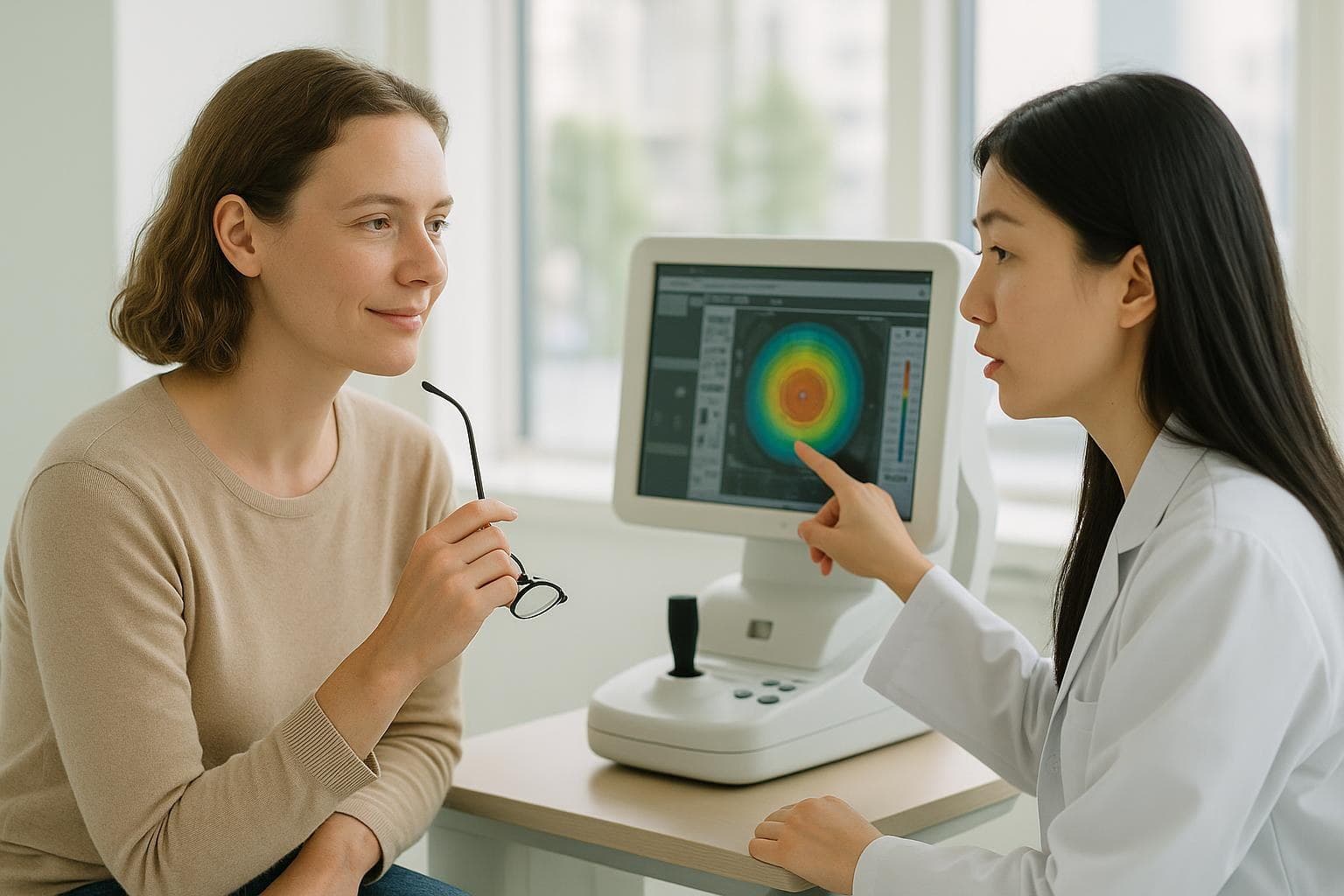
At Healing Eye the full pre-operative exam is published separately at ₩150,000 (reduced from ₩400,000), and it is not a formality before a decision that has already been made. I measure corneal thickness and topography, pupil size in the dark, tear film quality, intraocular pressure and corneal endothelial cell count, and I look specifically for the subtle topographic irregularity that suggests early keratoconus. That last check is the one that keeps people out of trouble years later. A quote that includes a fifteen-minute screening and a quote that includes ninety minutes of diagnostics are not the same product, and you can see the diagnostic platforms we run on our Korean head office's equipment page.
The published Seoul numbers, procedure by procedure
Here are our actual listed prices. I publish them because a fixed public number is the simplest defense against being sold something you don't need — the full list lives on our transparent price page.
| Procedure | Published price | Typically appropriate when |
|---|---|---|
| Full pre-operative exam | ₩150,000 (was ₩400,000) | Everyone, before any decision |
| Premium LASIK & LASEK (both eyes) | ₩1,990,000 (was ₩2,190,000) | Moderate myopia/astigmatism, adequate corneal thickness |
| Clear LASIK, 4th generation (both eyes) | ₩2,700,000 (was ₩2,900,000) | Thin, uniform flap design; fastest return to daily life |
| Presbyopic LASIK & LASEK (both eyes) | ₩2,290,000 (was ₩2,490,000) | Reading-distance correction added |
| Presbyopic Clear LASIK (both eyes) | ₩3,000,000 (was ₩3,200,000) | As above, 4th-generation platform |
| EVO ICL (both eyes) | ₩5,500,000 (was ₩6,000,000) | High myopia, or cornea too thin for laser |
| EVO ICL Toric (both eyes) | ₩6,000,000 (was ₩6,500,000) | The above, with significant astigmatism |
| Eco Lens, India (both eyes) | ₩4,500,000 (was ₩5,000,000) | Alternative implantable lens option |
| Cataract, monofocal IOL (per eye) | ₩1,250,000 | Single focal distance, clean night contrast |
| Cataract, LISA tri trifocal (per eye) | ₩3,000,000 | Distance, intermediate and near in one lens |
Notice that cataract prices are per eye and laser prices are for both eyes. That single difference is responsible for more confused email threads than any other line in ophthalmology. If you are weighing lens options for a clouded natural lens, the mechanics and trade-offs are laid out on our cataract surgery page.
Why ICL costs roughly double a laser procedure
Five things that legitimately move your number
- Your prescription and corneal thickness. These decide whether a laser procedure is even on the table. A −10.00 D eye with a 480-micron cornea is an ICL conversation, and that shifts the budget by millions of won before anyone discusses preference.
- Astigmatism. A toric ICL costs ₩500,000 more than the non-toric version because it corrects the astigmatic axis as well.
- Presbyopia. If you are in your forties and want reading distance addressed, the design changes and so does the fee.
- Add-ons your exam calls for. Corneal cross-linking is ₩500,000 for both eyes, autologous serum drops ₩200,000, SCOUT ₩200,000. These are not upsells sprinkled on every case; they are prescribed when the measurements ask for them.
- Which procedure genuinely fits your eye. This is the biggest variable and the least negotiable one. If you are still deciding between platforms, start with our guide to which vision correction surgery fits you rather than with a price list.
Same price for Koreans and internationals — and why that protects your budget
International patients at Healing Eye pay exactly what Korean patients pay. There is no foreigner rate, no interpreter surcharge, no "international coordination" line. I hold to this for a reason that is more clinical than commercial: the moment a foreign patient is worth more revenue than a local one, a quiet pressure enters the consultation room to recommend the costlier procedure. With a fixed public price, the recommendation can only be based on your topography and your life.
The practical consequence for you is that a quote given by email should match the invoice at reception. If it doesn't, ask why before you consent to anything. I go through the full anatomy of a Seoul quote — line by line — in our breakdown of what a Seoul eye surgery price includes.
The costs that never appear on the invoice
Surgery is one line. The trip is the rest of the budget.
- Days in Seoul. Clear LASIK takes about 10 minutes for both eyes and most people are back to daily life in 1–2 days, but you still need the detailed exam, the surgery, and the post-operative check. ICL takes about 15 minutes for both eyes with a similar 1–2 day return to daily life. Plan the calendar with our realistic schedule for how many days to stay in Korea.
- A buffer day. If your exam shows borderline dryness or an irregular tear film, I may want to treat that first and move your surgery date. An itinerary with no slack turns a sensible medical decision into a travel crisis.
- Contact lens washout. Soft lens wearers must be out of lenses before the exam, or the measurements are simply wrong. That is unpaid time before you even board.
- A possible return flight. A minority of eyes need an enhancement. Budget mentally for it.
We are one minute from Sinnonhyeon Station and about 70 minutes from Incheon Airport, with Japanese, Traditional Chinese and English interpreters on site — which keeps the logistics cost of the trip low, but does not make it zero.
How to compare two quotes honestly
Ask both clinics the same six questions and write the answers side by side:
- Which laser or lens, by name, does this fee cover?
- Is the pre-operative exam included, and what happens to that fee if I am not a candidate?
- How many post-operative visits are inside the price?
- Will the surgeon who examines me be the surgeon who operates? (At Healing Eye, one dedicated surgeon owns your case from exam through aftercare.)
- What exactly does your after-care commitment cover, in writing?
- If my exam rules out the procedure I asked for, what is your alternative and what does it cost?
A clinic that answers all six without hesitation is telling you a great deal about how it operates. Our guide to choosing an eye clinic in Korea has the follow-up questions I would ask if I were the patient.
Who I tell not to book the flight
No price is a good price for the wrong eye. I decline surgery, or postpone it, for patients with signs of keratoconus or unstable corneal topography; for prescriptions that have shifted meaningfully in the past year; for insufficient residual corneal thickness after a planned flap; for uncontrolled dry eye or active ocular surface disease until it is treated; during pregnancy or breastfeeding; and for certain autoimmune or uncontrolled systemic conditions. Some patients simply have expectations that the measurements do not support, and I would rather say that in the consultation room than after surgery.
And the honest downsides apply to everyone who does proceed: dry eye that can persist for months, glare and halos at night — particularly with larger pupils or multifocal lenses — the possibility of under- or over-correction, and, for ICL, uncommon but real risks including raised intraocular pressure, cataract formation, or a lens needing repositioning or exchange. Those are the things I discuss before money is ever mentioned. If your prescription is high or your corneas are thin, our implantable lens page explains what we measure before we would consider it; if your cornea is healthy and thick enough, our 4th-generation Clear LASIK page sets out the recovery timeline.
Compare the depth of the exam and the ownership of your aftercare, not the headline figure — those are what the fee is really buying.
Send me your most recent prescription and, if you have one, a corneal topography scan from home. I will tell you what is realistically on the table for your eyes and what the total would be — including the answer some patients don't want but deserve, which is that you should keep your glasses.
— Dr. Kim Sun-young, Medical Director, Healing Eye Clinic, Sinnonhyeon, Seoul
Frequently asked questions
Does the vision correction surgery Korea package price include the pre-operative exam?
At our clinic the full pre-operative exam is listed separately at ₩150,000, discounted from ₩400,000, and the surgical fee is published on its own line. I prefer it that way because the exam is the part that decides whether you should have surgery at all, and it has value even if the answer is no. Some clinics bundle the exam into the surgical fee, which is fine as long as you know what happens to that money if you turn out not to be a candidate. Ask that question before you fly, in writing.
Why do international patients pay the same as Korean patients here?
Because the surgery is the same surgery, the lens is the same lens, and the surgeon's time is the same time. Same Price for All is a clinic policy at Healing Eye, not a seasonal promotion, so the figure you see on our published price list is the figure you pay whether you live in Gangnam or in Toronto. It also removes an awkward incentive: if foreign patients were charged more, there would be a quiet pressure to recommend the more expensive procedure. When the price is fixed and public, the recommendation can be purely clinical.
Is LASIK in Korea cheaper than in the US or Australia, and does that mean lower quality?
Korean prices for laser vision correction are generally lower than US or Australian prices, and the main reasons are structural rather than clinical: national fee competition, high procedure volume in Seoul, lower facility overhead, and no insurance-billing layer. That is not the same as being cheap, and it does not mean every Korean clinic is equivalent. What separates clinics here is exam depth, which laser and diagnostic platforms they run, and whether one named surgeon carries your case from exam through aftercare. Compare those things, not just the number.
What happens if I need an enhancement after I've flown home?
A small proportion of eyes under-correct or regress, most often in higher prescriptions, and an enhancement may be discussed once the refraction has been stable for several months. Our clinic policy includes lifelong check-ups and a responsibility guarantee after surgery, and I ask every international patient to have that policy explained in detail, in their own language, before surgery day. What I cannot control is your airfare back to Seoul, so build a possible return trip into your mental budget rather than assuming one visit is always the end of the story. If you can have follow-up locally, tell me at the consultation and I will write your records so your home ophthalmologist can act on them.
How much should I budget beyond the surgical fee?
Add flights, five to seven nights of accommodation in Seoul, local transport, meals, and one buffer day in case your exam pushes the surgery date. Prescription drops after surgery are inexpensive in Korea compared with many countries, but they are still an item. I also tell patients to budget for the possibility that the exam says no: you would have paid for the trip and the exam and received an honest answer, which is a real outcome, not a wasted one. Realistically, the non-medical costs of the trip land somewhere in the range of a mid-priced procedure upgrade, so plan the whole number, not just the surgery line.
Is ICL worth roughly double the price of LASIK?
It is not an upgrade, it is a different solution for a different eye. EVO ICL is priced higher largely because the lens itself is a manufactured, custom-ordered medical device sized to your anterior chamber, and that cost sits inside the fee. If your cornea is thick enough and your prescription is moderate, spending more on ICL buys you no extra safety and I will say so. If your prescription is very high or your cornea is thin, ICL may be the appropriate option and LASIK the wrong one at any price.
Message us on official LINE / WhatsApp for a special offer
Your exact candidacy and cost are confirmed in a free 1:1 consultation.