How to Choose a Cataract Surgeon in Korea: 3 Things I'd Check First
How to choose a cataract surgeon in Korea: a Seoul cataract surgeon on consultation time, who measures your eye, and whether the clinic can redo surgery.

Dr. Kim Sun-young, Director
Based on Dr. Kim's video
Korean audio · plays muted — tap the speaker for sound, CC for subtitles
The short answer
- Cataract surgery happens once in a lifetime, so the lens consultation should take at least 10–15 minutes — sometimes much longer.
- The doctor who explains your lens should be the doctor who operates; a lens chosen by a counselor to fit a budget is a warning sign.
- The pre-op measurements decide as much of the result as the surgeon's hands — ask who takes them and how experienced they are.
- Before you book, confirm the clinic can take responsibility for revision surgery if your vision changes later.
Key moments
Tap a moment to jump the video there
I'm Dr. Kim Sun-young, medical director of Healing Eye Clinic in Gangnam, Seoul. I trained in ophthalmology at the Catholic Medical Center and served as a clinical professor of cornea and cataract at Uijeongbu St. Mary's Hospital; I'm a member of KOS and ESCRS, and I've operated on my own family. Patients considering cataract surgery in Seoul often ask me how they're supposed to judge a surgeon from overseas, when every clinic website says the same things.
I can't tell you who to choose. But I can tell you the three rules I run my own clinic by, because they're also the three things I would check anywhere. A good cataract result depends on the consultation, the measurements and the clinic's willingness to stand behind you afterwards — not only on the surgeon's hands.
Rule 1: an unhurried lens consultation, with the doctor who operates
Cataract surgery happens once in a lifetime, and the lens stays for good. Today there are many lens types — monofocal, enhanced monofocal, refractive and diffractive multifocal, toric versions of each. Explaining them properly takes time. I believe at least 10 minutes is the minimum, and 15 minutes or more is normal. Sometimes my consultations run 30 minutes, occasionally an hour. That does mean other patients sometimes wait, and I apologize for that, but I think it's the most important step before surgery.
In some large clinics, the doctor who consults and the doctor who operates are different people. That can work for LASIK. For cataract surgery, where the lens choice is so personal, I don't think it's right.
When patients who are unhappy after surgery elsewhere come to me, I ask how their lens was chosen. The answers are often: "A counselor picked it." "We chose based on the budget." "The consultation took a few minutes." Those are the warning signs.
In my consultation I go through your life — job, hobbies, the distances you need, what you expect — and your eye's condition, then recommend lenses as a first, second and third choice. We keep talking until you have no questions left.
I also don't hire many doctors. I'd rather see patients slowly and in detail than quickly and in numbers, and work only with experienced doctors.
Ask Dr. Kim's team about your eyes
Interpreters on site · same price as Korean patients
Rule 2: who measures your eye
Most people have never heard of an optometrist's role in cataract surgery. Before surgery, an optometrist measures your exact nearsightedness, farsightedness and astigmatism — not just "0.5" or "1.0" on a chart. Those numbers decide the lens power.
I honestly think the measurements decide about half of the outcome, as much as surgical skill. If any nearsightedness, farsightedness or astigmatism is left after surgery, the operation may have gone flawlessly in the technical sense, yet the result has failed for you.
At Healing Eye, the lens-power measurements that matter most are done only by our most senior optometrists, whose accuracy has been proven over years. Other clinics try to recruit them; I work hard to keep them. A clinic is only as good as its weakest measurement.
So ask: Who will measure my eye? How experienced are they? Will the doctor review the numbers personally? More on what to ask, in order, is in Seoul cataract surgeons: the questions to ask.
Rule 3: can the clinic redo your surgery?
Even when surgery goes well, a small difference can matter: slight over- or under-correction, or astigmatism that appears years later, perhaps from rubbing the eyes. Then revision surgery may be needed.
If the clinic that operated can't do the revision, the patient is left to find another hospital — and the second doctor, who didn't do the first operation, finds it hard to take full responsibility. Revision is also much more demanding than a first operation: the eye is more delicate, a new lens may be needed, and it may take more than one procedure. Many clinics avoid revision for those reasons.
That's why Healing Eye has a dedicated revision center and a lifetime surgery responsibility program. You don't have to choose us — but wherever you go, ask whether the clinic can handle a revision itself.
Credentials to look at, and what they mean
Titles help, but read them for what they say:
- Cornea and cataract specialty training — cataract surgery is about precise optics, and the cornea is half of the eye's focusing power.
- Membership of societies such as ESCRS or KOS — a sign the surgeon keeps up with new lenses and methods.
- Who does your follow-up — you want the surgeon, not a stranger, at your one-month check. See who does cataract surgery follow-up.
Cataract surgery at Healing Eye (per eye)
Monofocal IOL ₩1,250,000 · Eyhance ₩2,500,000 · multifocal lenses from ₩3,000,000 (LISA tri) to ₩7,000,000 (Synergy) · full exam ₩150,000. Foreign patients pay the same price as Korean patients.
What to do next
Choosing a cataract surgeon is really choosing a system: a doctor who takes time, measurements you can trust, and a clinic that stays responsible after the operation. If those three are in place, the lens decision becomes much easier — I explain how multifocal lenses are chosen in multifocal lens cataract surgery and what the weeks afterwards look like in life after cataract surgery.
At Healing Eye, the same doctor does your exam, your surgery and your check-ups, interpreters are on site, and foreign patients pay the same price as Korean patients. If you have questions, send them — I'm happy to answer before you decide anything. The cataract surgery page has stay and lens details.
Procedures in this video

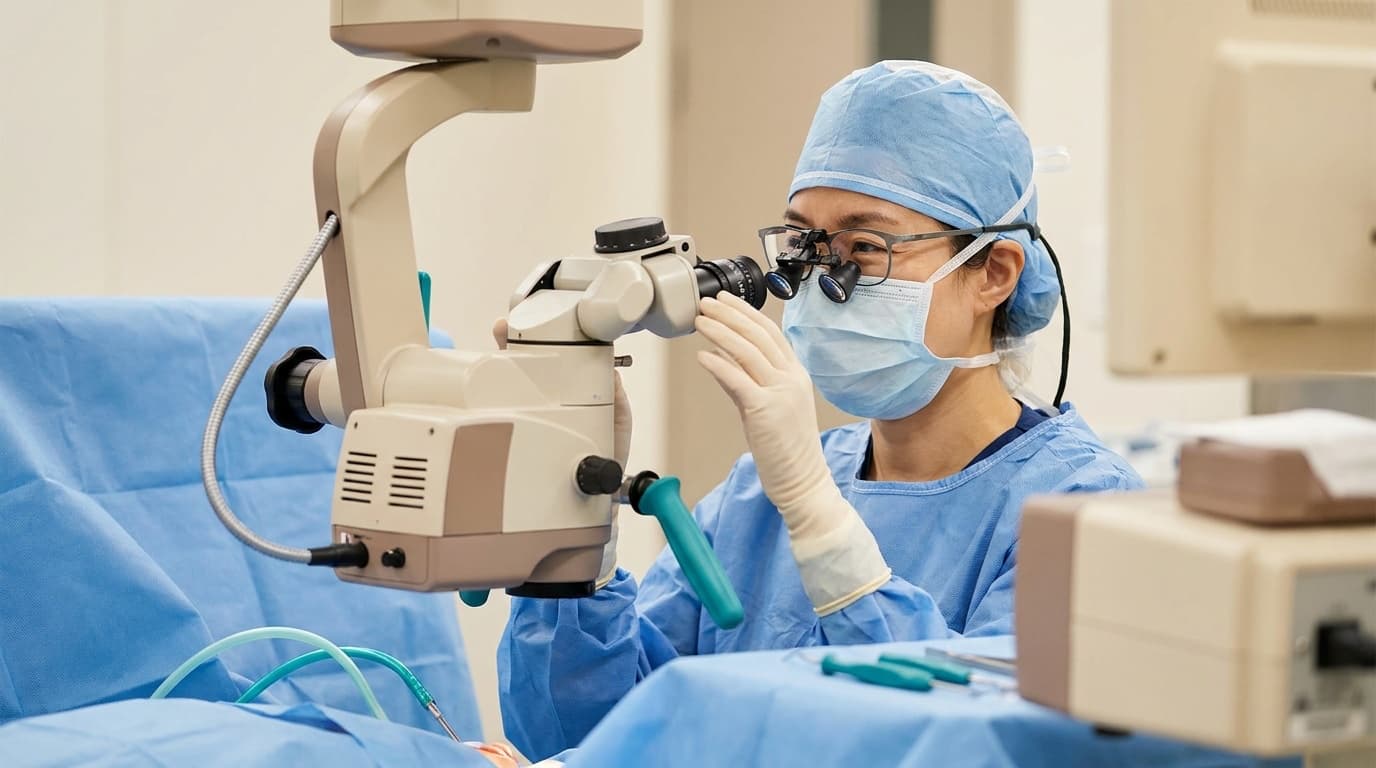
Questions patients ask
How long should a cataract consultation take?
For choosing a lens, I think at least 10 minutes is the minimum and 15 minutes or more is normal. When a patient has many questions or a complex eye, my consultations sometimes run 30 minutes to an hour. A decision made in a few minutes, or by a counselor based only on budget, is not enough.
Does it matter who does the measurements before cataract surgery?
Very much. If any nearsightedness, farsightedness or astigmatism is left after surgery, the result disappoints even when the operation itself went well. For toric lenses, a 10-degree axis error can cost about a third of the astigmatism correction. At Healing Eye, lens-power measurements are done by our most experienced optometrists.
What happens if I need a second operation after cataract surgery?
Over- or under-correction, or later changes like astigmatism, can mean a revision is needed. Before booking any clinic, ask whether it can do that revision itself. At Healing Eye I take responsibility for my patients' results, and the clinic runs a lifetime surgery responsibility program and a dedicated revision center.
Will the same doctor see me before and after surgery?
Yes. At Healing Eye each patient has one doctor — the same doctor does the exam, the surgery and the follow-up visits, with interpreters on site.
About the doctor

Dr. Kim Sun-young, Director
Cornea · Glaucoma · Cataract
- MS, Catholic Univ. College of Medicine · Ophthalmology specialist, Catholic Medical Center
- Clinical Professor (Cornea & Cataract), Uijeongbu St. Mary's Hospital
- Best Resident Award, Seoul St. Mary's (2009) · Minister of Health & Welfare Award (2008)
- 108th Korean Ophthalmological Society Research Award · KDCA epidemiology citation
- Member — Korean Ophthalmological Society (KOS), KEEDS, KCLSS & ESCRS
What patients say on Google
4.8
217 reviews
Dr. Kim's articles on this topic



Patients who came from abroad
More videos from Dr. Kim
Videos are in Korean; many have English subtitles.
More from Dr. Kim TV
 19:03Watch
Choosing a Cataract Lens in Korea: Why the Priciest IOL Isn't Always Right
 11:26Watch
Dry Eye Treatment: 4 Everyday Habits That Keep Your Eyes Dry
 9:18Watch
Hyperopia Surgery in Korea: Yes, Farsighted Eyes Can Have LASIK or LASEK
 11:50Watch
Life After Cataract Surgery: The Changes Nobody Warns You About
Not sure which one fits your eyes?
Send your prescription or questions — Dr. Kim's team replies in English.