Choosing a Cataract Lens in Korea: Why the Priciest IOL Isn't Always Right
Which cataract lens in Korea suits you? A Seoul cataract surgeon compares enhanced monofocal, refractive and diffractive multifocal IOLs and prices.

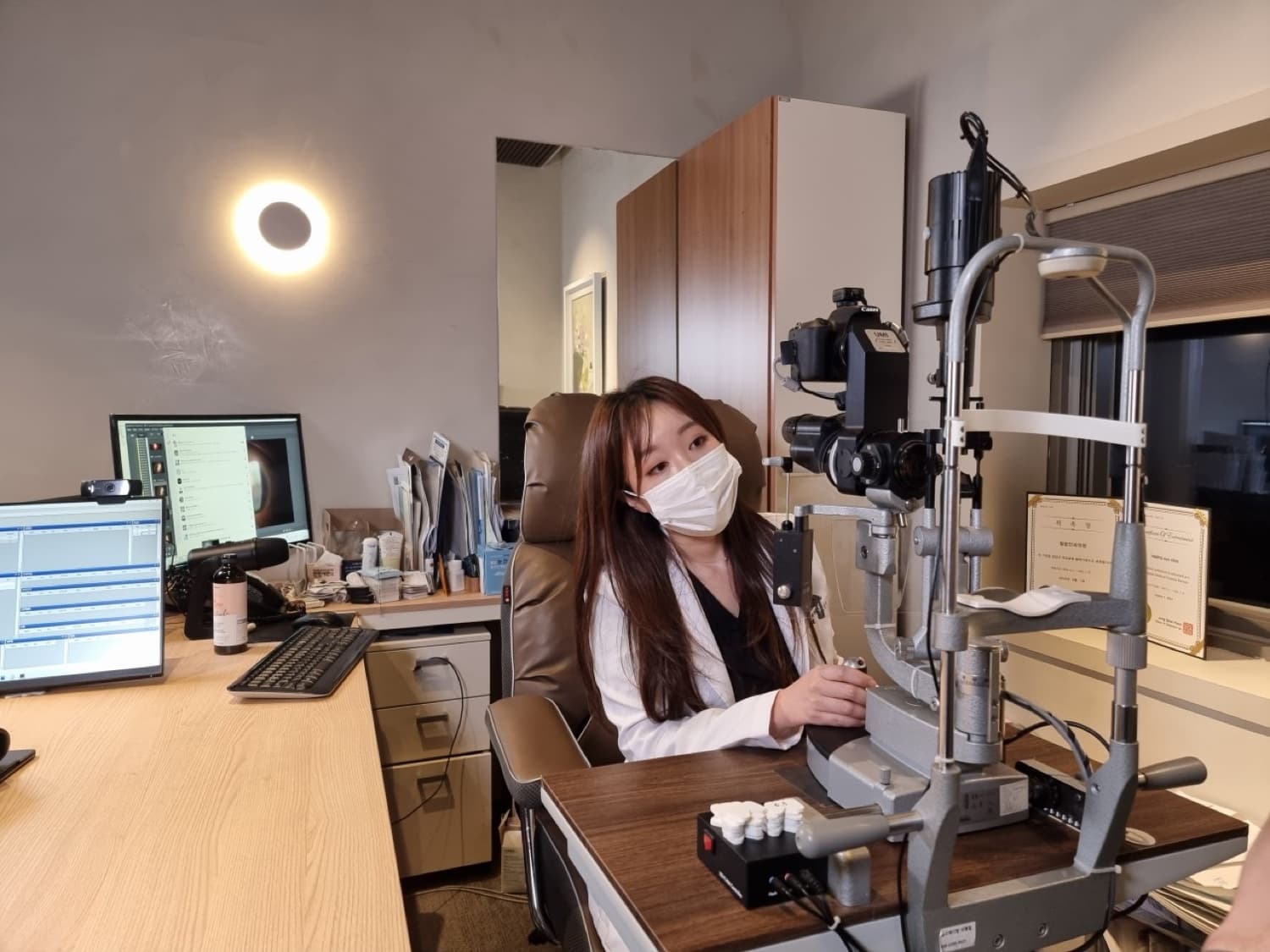
Dr. Kim Sun-young, Director
Based on Dr. Kim's video
Korean audio · plays muted — tap the speaker for sound, CC for subtitles
The short answer
- Price is not the answer: some expensive lenses don't earn their cost, and some modest ones perform very well.
- An enhanced monofocal gives clearer intermediate vision than a standard monofocal with the same safety — but not phone-text reading, unless one eye is set slightly near.
- A refractive multifocal loses little light, so it suits sensitive eyes, irregular corneas and patients unhappy with a diffractive lens.
- Newer diffractive multifocals have smoothed optics with less glare; designs differ in whether they favor distance or intermediate.
- The right lens depends on your cornea, retina, astigmatism and the distances your daily life needs.
Key moments
Tap a moment to jump the video there
I'm Dr. Kim Sun-young, medical director of Healing Eye Clinic in Gangnam, Seoul, and a former clinical professor of cornea and cataract at Uijeongbu St. Mary's Hospital. I'm also a full member of the European Society of Cataract & Refractive Surgeons (ESCRS). One request I hear in almost every cataract consultation is: "Just give me the most expensive lens — that one must be the right one."
I understand the instinct. But after years of putting many different lenses into many different eyes, my answer is: the price of a lens tells you very little about whether it suits your eyes. Some costly lenses don't earn their price, and some modest ones are excellent. Here are the three lens families I reach for most, and how I decide between them.
Type 1: the enhanced monofocal lens
A standard monofocal lens gives one sharp focus, usually for distance. Within about a metre, things blur: the computer, a phone, sheet music. Patients see clearly and brightly after surgery but need reading glasses again.
Good monofocal lenses are aspheric. Light passing through the edge of the cornea focuses slightly in front of light passing through the center (positive spherical aberration). Your natural lens used to compensate; once it's removed, an aspheric lens with negative spherical aberration brings those rays back to one point, which keeps night vision crisp.
Push that negative spherical aberration a little further and something useful happens: intermediate vision improves. Things at arm's length — food on the table, objects on a desk, a computer screen a little farther away — become clearer than with a standard monofocal. In real patients I'd say about 70–80 cm becomes reasonably clear. These enhanced monofocal lenses keep the safety of a monofocal: no added glare or halos.
An enhanced monofocal is not a replacement for a multifocal — small phone text still won't be sharp. But if I set one eye slightly near (monovision), the difference between the eyes can stay small and many patients can still read messages with that eye.
This lens family suits people who can't have a multifocal — for example with moderate macular degeneration, diabetes likely to affect the retina, a hazy cornea, or very irregular astigmatism after off-center laser surgery. If you have regular astigmatism, a toric version is needed to get the same effect.
Type 2: the refractive multifocal lens
Most multifocal lenses heavily advertised today are diffractive: they split light between distance, intermediate and near. A different family, refractive multifocals, is developed mainly by European optics companies. LENTIS is one example. Because they bend light through zones rather than splitting it, they lose very little light.
That matters for three groups:
- Sensitive eyes that I suspect won't adapt to a diffractive lens.
- Eyes with an imperfect cornea or retina. Splitting light works well only when the cornea and retina are very healthy. If the cornea is irregular — for instance after LASIK or LASEK that was slightly off-center — or the retina can't make full use of the light it receives, a split image looks faint and dim. A refractive design keeps it clearer.
- People unhappy with a diffractive multifocal. When a patient comes to me saying distance looks hazy, as if something is in the way, I often exchange the lens for a refractive multifocal rather than going back to a monofocal. Distance becomes clear, and they keep useful near vision instead of returning to reading glasses.
A refractive multifocal is the type I chose for my own mother. Some refractive designs can cause a mild doubled or overlapping image at first; it usually improves with time.
Ask Dr. Kim's team about your eyes
Interpreters on site · same price as Korean patients
Type 3: newer diffractive multifocal lenses
Diffractive lenses have a fine step pattern on the surface. Older designs had sharp step edges; newer ones round those edges off — each company has its own name for the method, but the principle is the same. Lenses such as LISA tri and Intensity are examples of this smoothing approach. The result: less light scatter, more light reaching the retina, and brighter, clearer vision in dim light.
Synergy is known for strong near and intermediate vision, with distance a little softer than some patients want. Successor designs from different companies have gone in opposite directions — one moving some intermediate power into distance, another strengthening intermediate. That gives a clear choice:
- If you have always seen well far away and only presbyopia bothers you, a design that protects distance suits you.
- If near and intermediate matter more and you can accept slightly softer distance, choose a design that favors intermediate.
For more on how the families compare, see my monofocal vs multifocal comparison and the sibling video on multifocal lens cataract surgery.
Cataract lenses at Healing Eye (per eye)
Monofocal IOL ₩1,250,000 · Eyhance / Eyhance Toric ₩2,500,000 · LISA tri / LISA tri Toric ₩3,000,000 (high-power ₩6,000,000) · FineVision ₩4,000,000 · FineVision Toric ₩4,500,000 · Intensity ₩4,000,000 · LENTIS ₩6,000,000 · Synergy ₩7,000,000 · full exam ₩150,000. Foreign patients pay the same price as Korean patients.
How I match a lens to a patient
I don't start with the lens catalogue. I start with you:
- Eye health — corneal regularity, astigmatism, retina and macula. A diffractive lens needs a healthy cornea and retina; otherwise I lean toward refractive or enhanced monofocal.
- Your distances — driving, computer, phone, reading, hobbies. A musician, a designer and a golfer may need different lenses.
- Your personality — some people tolerate a little glare for spectacle freedom; others notice every halo.
- Astigmatism — if present, a toric version is needed, which narrows the options.
Then I give a first, second and third choice and explain each. Prices at Healing Eye are per eye and listed openly; see cataract surgery cost in Korea and the presbyopia & cataract and cataract surgery pages for what's included.
What to do next
Cataract surgery is done once, and the lens stays for life. The right choice comes from a careful exam and an unhurried conversation. At Healing Eye, the same doctor does your exam, surgery and check-ups, interpreters are on site, and foreign patients pay the same price as Korean patients. Send me your situation, and I'll tell you which lens families are realistic for your eyes before you book a flight.
Procedures in this video

Questions patients ask
Which cataract lens is the top choice?
There isn't one lens that is right for everyone. A lens that is excellent for a driver who reads little can disappoint a musician or an office worker. I recommend lenses in a first, second and third order for each patient after looking at the eye's health and how they live.
Can I read my phone with an enhanced monofocal lens?
Usually not with both eyes set for distance — it improves intermediate vision, roughly to arm's length. If one eye is set slightly near (monovision), many patients can read messages with that eye without needing a large difference between the eyes.
I had LASIK or LASEK years ago. Can I still have a multifocal lens?
Often yes, but it depends on how regular your cornea is. If it is irregular or was treated off-center, a refractive multifocal is usually a better match than a diffractive one, because it doesn't split light into several foci.
How much do cataract lenses cost at Healing Eye?
Per eye: monofocal ₩1,250,000, Eyhance ₩2,500,000, LISA tri ₩3,000,000, FineVision and Intensity ₩4,000,000, FineVision Toric ₩4,500,000, LENTIS ₩6,000,000 and Synergy ₩7,000,000. Foreign patients pay the same price as Korean patients.
About the doctor

Dr. Kim Sun-young, Director
Cornea · Glaucoma · Cataract
- MS, Catholic Univ. College of Medicine · Ophthalmology specialist, Catholic Medical Center
- Clinical Professor (Cornea & Cataract), Uijeongbu St. Mary's Hospital
- Best Resident Award, Seoul St. Mary's (2009) · Minister of Health & Welfare Award (2008)
- 108th Korean Ophthalmological Society Research Award · KDCA epidemiology citation
- Member — Korean Ophthalmological Society (KOS), KEEDS, KCLSS & ESCRS
What patients say on Google
4.8
217 reviews
Dr. Kim's articles on this topic




Patients who came from abroad
More videos from Dr. Kim
Videos are in Korean; many have English subtitles.
More from Dr. Kim TV
 9:16Watch
How to Choose a Cataract Surgeon in Korea: 3 Things I'd Check First
 11:26Watch
Dry Eye Treatment: 4 Everyday Habits That Keep Your Eyes Dry
 9:18Watch
Hyperopia Surgery in Korea: Yes, Farsighted Eyes Can Have LASIK or LASEK
 11:50Watch
Life After Cataract Surgery: The Changes Nobody Warns You About
Not sure which one fits your eyes?
Send your prescription or questions — Dr. Kim's team replies in English.